This article was researched and reviewed by Leo, our indoor plant specialist.
The Big Box Reality Check: Why Your $20 Find is a Biohazard
I walked into a Lowe’s last Tuesday—mostly to hide from the biting Portland wind that’s currently trying to turn my loft into a walk-in freezer—and there they were. A sea of Thai Constellations, sitting right next to some sad, overwatered succulents and a rack of dying Poinsettias. It’s a miracle of tissue culture, really, but it’s also a ticking time bomb. If you just scored one of these for $20 or $60, congratulations, you’ve just brought a potential biological hazard into your home.
Guide Overview
- The Big Box Reality Check: Why Your $20 Find is a Biohazard
- The Strict 30-Day Quarantine Protocol
- Ditching the ‘Death Soil’: The Chunky Aroid Mix Blueprint
- The Anatomy of the Ultimate Aroid Mix
- The Chlorophyll Deficit: Why Your Thai Needs 2x More Light
- Measuring Light: Don’t Guess
- Stable Variegation vs. Albo: The Lab-Grown Advantage
- The Science of Tissue Culture (TC)
- Vertical Ambition: Training Your Hemiepiphyte for Giant Leaves
- Why a Moss Pole is Superior to a Plank
- The Art of the Deal: How to Negotiate Big Box Plant Prices
- Specimen Selection Strategy
When these plants are mass-produced and shipped in cramped trailers, they become magnets for what I call a ‘Mass Casualty Incident’ (MCI). In the big-box environment, pest management is basically non-existent. You aren’t just buying a variegated monstera; you’re likely buying a starter colony of thrips or spider mites. This is why my current 14-day ‘blue trap’ monitoring period is non-negotiable. While everyone reaches for the yellow sticky traps, I’ve moved exclusively to blue. Why? Because thrips, the bane of any serious collector’s existence, are disproportionately attracted to the blue spectrum. If I see even one tiny, elongated speck on that blue adhesive during the first two weeks of quarantine, the plant stays in the ‘dead zone’—my bathroom—until it’s been nuked with a systemic insecticide.
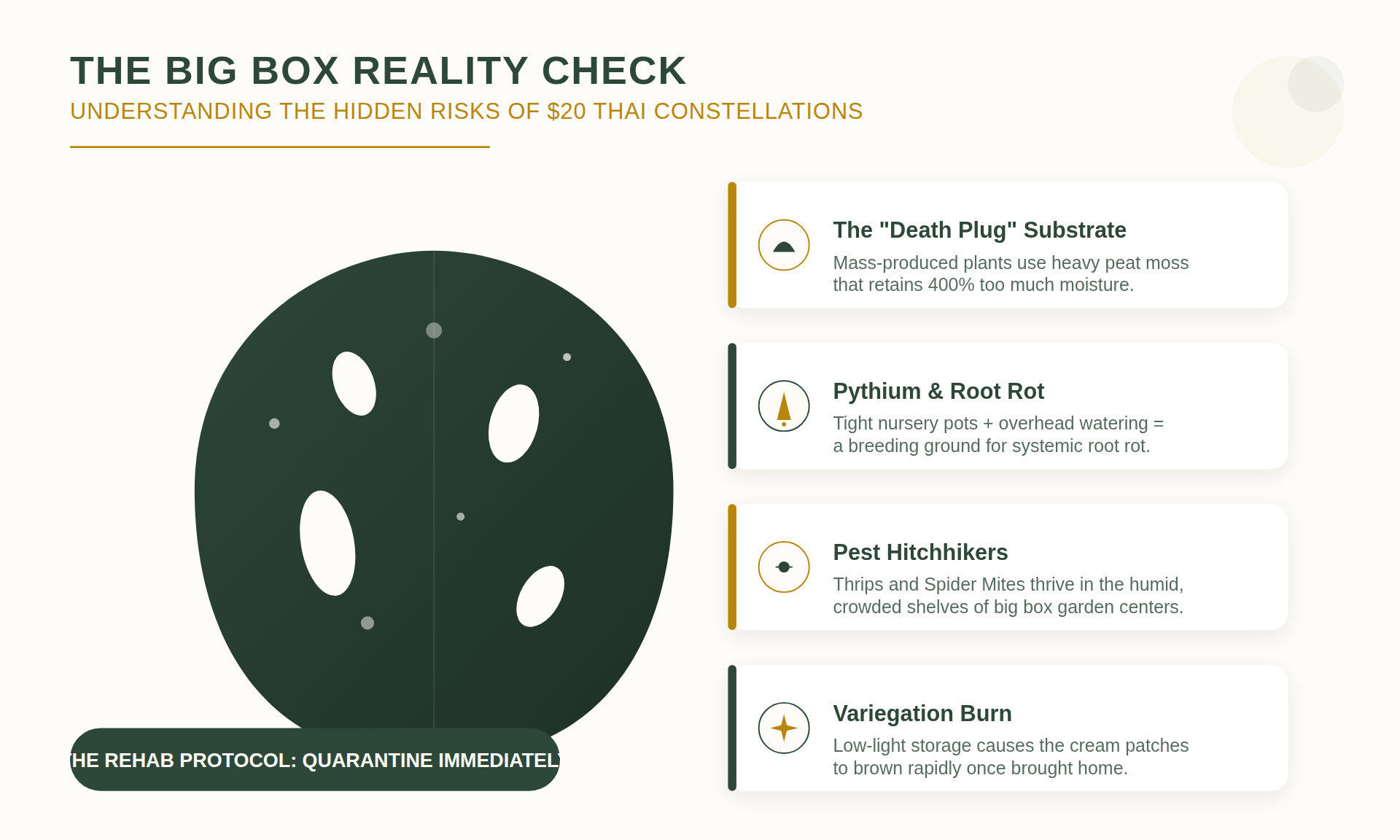
Don’t trust a visual inspection at the store. These pests are experts at hiding in the tight crevices of the petioles or the underside of the emerging leaves. During these dry Portland winters, when my indoor humidity is struggling to stay at 25%, spider mites thrive. They love the stagnant, dry air produced by my baseboard heaters. I always perform the ‘Smear Test’ on any new acquisition: take a white paper towel, dampen it with a bit of water or isopropyl alcohol, and wipe the underside of the leaves. If you see reddish-brown streaks, that isn’t dust. That’s the crushed bodies of spider mites. It’s visceral, it’s gross, and it’s the only way to be sure before you introduce a new specimen to your ‘personal jungle.’
The Strict 30-Day Quarantine Protocol
Never, under any circumstances, place a big-box Thai Constellation near your prized collection immediately. I don’t care how ‘clean’ it looks. I keep mine in a separate room for a full month. During this time, I treat the foliage with a mixture of castile soap and neem oil as a preventative, and I’ve recently started using systemic granules in the soil. Given that I lost my first major deliciosa in 2018 to a soil-borne nightmare, I don’t take risks anymore. Your home is a closed ecosystem; one infested $20 plant can cost you thousands in rare aroids if you’re careless.
Ditching the ‘Death Soil’: The Chunky Aroid Mix Blueprint
If you look at the soil your Thai Constellation came in, you’ll notice it’s likely a heavy, black, peat-based sludge. In the industry, we call this ‘nursery mix,’ and in a greenhouse with professional-grade airflow and high heat, it works. In a Portland loft in February? It’s a death sentence. That peat holds onto water like a sponge, creating anaerobic conditions—environments devoid of oxygen where pathogens like Pythium and Phytophthora (the horsemen of root rot) thrive.
My 2018 heartbreak taught me that Thai Constellations are significantly more prone to root rot than their solid green counterparts. This is likely due to the metabolic stress of maintaining variegation. When roots sit in soggy, compacted peat, the lack of substrate porosity prevents gas exchange. The roots literally suffocate. To save your plant, you need to perform an immediate ‘soil ectomy.’ Strip that peat away—carefully, I use a chopstick to tease it out of the root ball—and move it into a chunky aroid mix.
The Anatomy of the Ultimate Aroid Mix
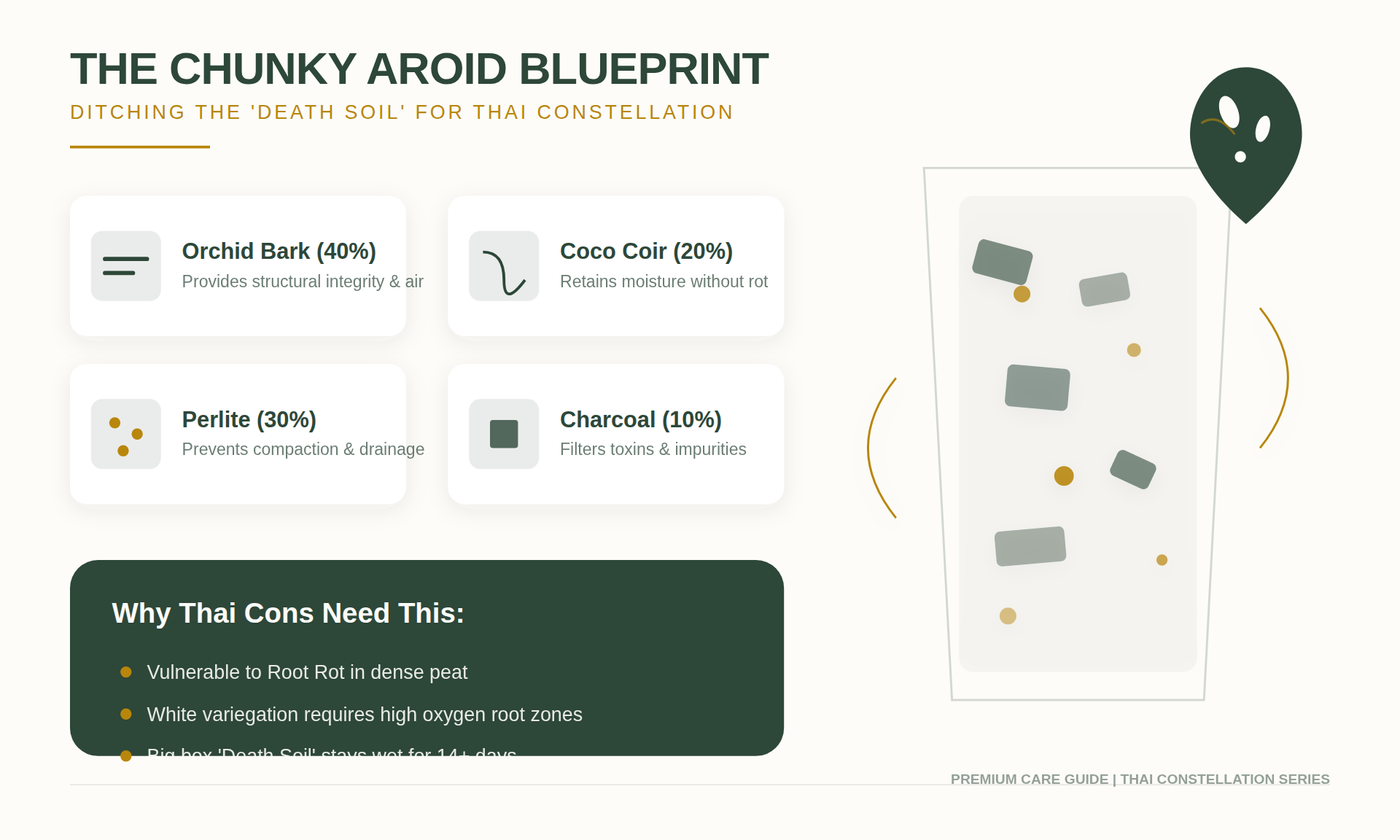
My ‘Gold Standard’ mix for the Thai Constellation is designed for maximum root aeration. I use a ratio that looks something like this: – 40% Orchid Bark (Large grade for structure) – 30% Perlite or Pumice (For drainage and aeration) – 20% Coco Coir or Husk (For minimal moisture retention) – 10% Horticultural Charcoal (To help filter impurities and prevent ‘sour’ soil)
When you pot a Thai in this, you can pour water through the top and see it run out the bottom almost instantly. That’s what you want. It forces you to water more frequently, which might sound like a chore, but it ensures that the roots are constantly being exposed to fresh oxygen. Barnaby usually watches me do this from the kitchen counter, tail twitching in judgment as I spill bark everywhere, but he knows the drill. If the soil doesn’t ‘crunch’ when you squeeze it, it’s too dense.
The Chlorophyll Deficit: Why Your Thai Needs 2x More Light
There is a biological tax on beauty. Those creamy-yellow splashes and starry speckles that make the Thai Constellation so desirable are actually areas of ‘cellular bankruptcy.’ Because those white and cream patches lack chlorophyll, they cannot perform photosynthesis. This means the green parts of the leaf have to work twice as hard to support the entire organism. If you treat a Thai Constellation like a standard Monstera deliciosa and stick it in a ‘low light’ corner, it will slowly starve to death, beginning with the browning of the variegated sections.
In the winter, this problem is amplified. Here in Portland, the sun currently feels like a myth told by our ancestors. The light coming through my north-facing windows is practically non-existent in terms of PAR (Photosynthetically Active Radiation). To compensate, I use adjustable grow light bars. You want to aim for at least 800 to 1,000 foot-candles of light for 12 hours a day. Without this intensity, the plant will start to ‘eat’ its own variegation to survive, leading to those ugly brown crispy edges that no amount of misting can fix.
Measuring Light: Don’t Guess
I’m a firm believer in using a light meter. Most people overestimate how much light their plants are getting. ‘Indirect bright light’ is a vague term that has killed more plants than overwatering ever did. If you don’t have a light meter, there are apps for your phone that are surprisingly accurate. During these short winter days, I position my grow lights about 12-18 inches above the foliage. Be careful, though—if the light is too close, the lack of protective chlorophyll in the cream sections makes them susceptible to ‘bleaching’ or light burn. It’s a delicate balance between providing enough energy for growth and not frying the delicate tissue.
Stable Variegation vs. Albo: The Lab-Grown Advantage
One of the biggest points of confusion for new collectors is the difference between a Thai Constellation and a Monstera Albo. The Albo is a genetic chimera; its variegation is unstable. It’s a random mutation that can disappear at any moment, leaving you with a plain green plant (reversion) or a completely white plant that can’t feed itself (ghosting). This is why Albos require constant pruning and strategic ‘node-watching.’
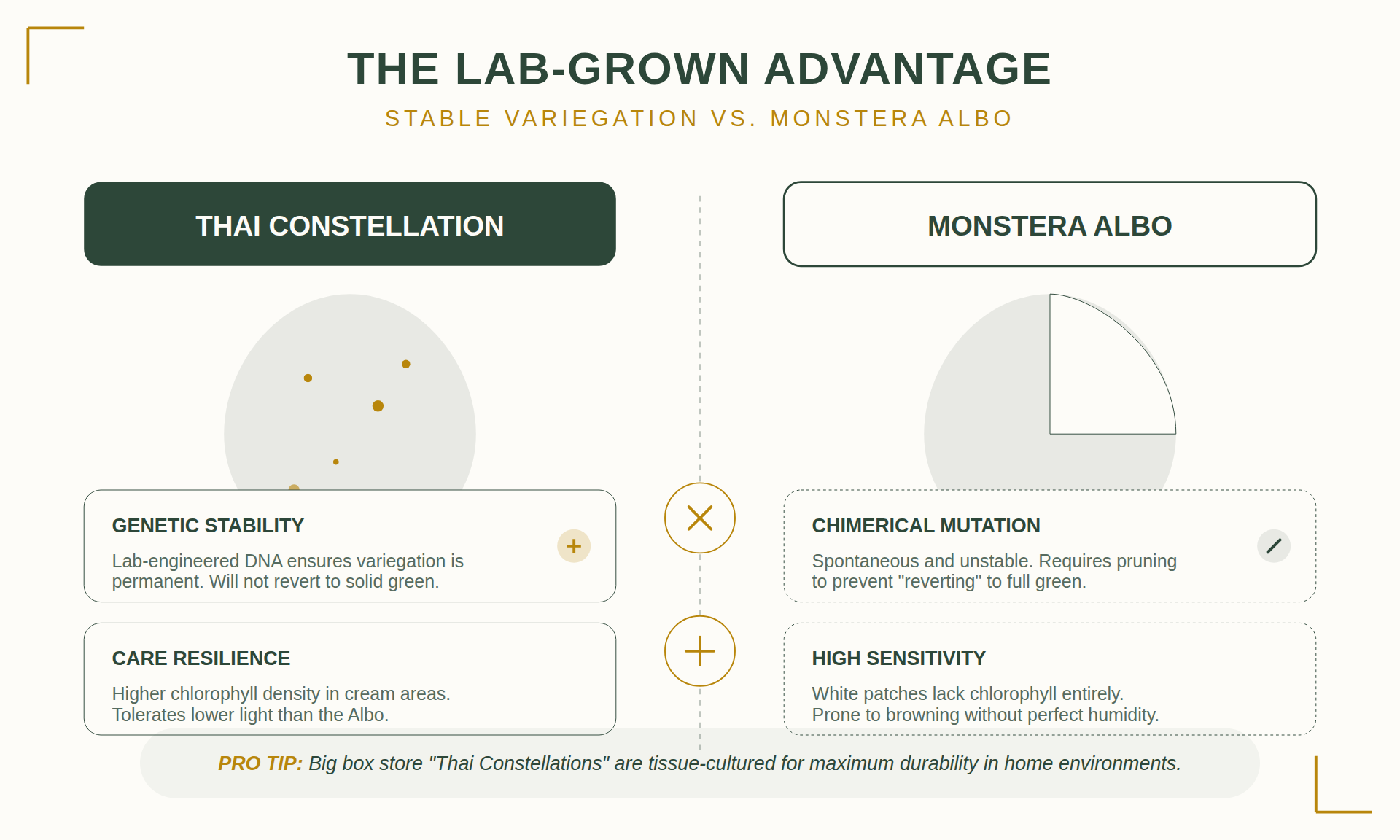
The Thai Constellation is different. It was born in a lab in Thailand through tissue culture (TC). Its variegation is part of its DNA. It is stable. You can chop a Thai Constellation into ten pieces, and every single one of those pieces will grow back with that signature starry splash. This genetic stability is why the Thai is actually a much better long-term investment for a serious collector. You aren’t fighting the plant’s genetics; you’re just providing the environment it needs to express them.
The Science of Tissue Culture (TC)
In tissue culture, scientists take a small cluster of cells from a ‘mother’ plant and grow them in a sterile, nutrient-rich agar. Because the Thai Constellation’s variegation is integrated at a cellular level, it persists through this cloning process. This is why we’re seeing them at big-box stores now. Lab production has scaled to the point where they can churn out thousands of these ‘designer’ plants. However, keep in mind that ‘TC’ plants can sometimes be a bit more sensitive when they are young. They’ve spent their early lives in a perfectly controlled lab, so the transition to your 25% humidity living room is a massive shock. This is why I emphasize the chunky soil and light—they need every advantage to acclimate to ‘real world’ conditions.
Vertical Ambition: Training Your Hemiepiphyte for Giant Leaves
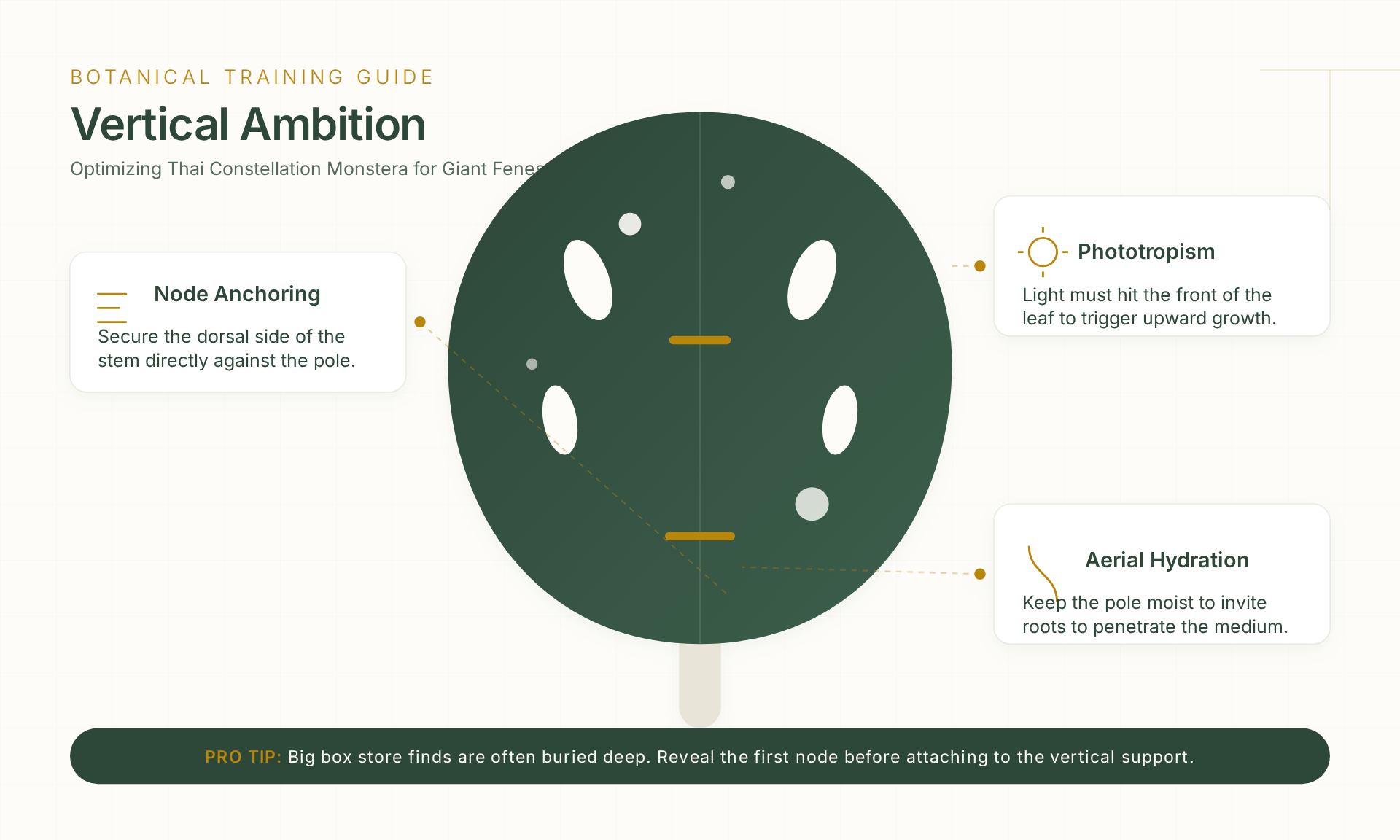
In their natural habitat in the rainforests of Central America, Monstera deliciosa are hemiepiphytes. They start their lives on the forest floor and then use their aerial roots to climb up massive trees toward the canopy. When they are climbing, they feel ‘secure.’ This security triggers a hormonal shift in the plant that leads to larger leaves and more complex fenestrations (those beautiful holes and slits).
If you let your Thai Constellation crawl across the floor or hang over the side of a pot, it will stay in its juvenile form. The leaves will remain relatively small, and the node spacing (the distance between leaves) will stretch out as the plant ‘searches’ for something to climb. To get those massive, dinner-plate-sized leaves you see on Instagram, you must provide a vertical support, ideally a moss pole.
Why a Moss Pole is Superior to a Plank
While a cedar plank or a bamboo stake provides physical support, a high-quality moss pole provides a secondary root zone. If you keep the moss pole damp, the aerial roots will grow into the moss, absorbing moisture and nutrients directly. This mimics the damp bark of a rainforest tree. In my dry loft, keeping a moss pole wet is a struggle. I’ve started using a plastic-backed pole that holds moisture longer, preventing the aerial roots from drying out and dying before they can anchor. Once those roots lock in, you’ll see the leaf size double within a few months. Just make sure the pole is sturdy; a mature Thai Constellation is heavy, and you don’t want it toppling over and crushing your cat (sorry, Barnaby).
The Art of the Deal: How to Negotiate Big Box Plant Prices
Finally, let’s talk about the ‘retail hustle.’ Big-box stores like Lowe’s or Home Depot often have inconsistent pricing. I’ve seen Thai Constellations marked at $60 in one aisle and $25 on a clearance rack because a single leaf had a brown spot. Because these stores move such high volumes, the staff often aren’t experts. They see a ‘damaged’ plant; you see a specimen that just needs a repot and a grow light.
If you find a Thai Constellation with a ripped leaf or some minor cosmetic damage, don’t be afraid to ask for a discount. I’ve successfully negotiated 50% off by pointing out signs of ‘stress’ or by showing the manager that the display signage is confusing. Look for plants that have been sitting in the back of the shelf; they might have some yellowing lower leaves. This is usually just a nitrogen deficiency or a lack of light, both of which are easily fixed once you get the plant home and into your own custom mix.
Specimen Selection Strategy
When you’re picking out your Thai from a big-box lineup, don’t just look at the biggest leaves. Look at the stem. You want thick, sturdy internodes and a healthy root system. If you see roots peeking out the bottom of the nursery pot that are white and firm, that’s a winner. If they are brown and mushy, move on. Also, look for ‘high-contrast’ variegation. Since the variegation is stable, what you see is generally what you’ll get. Find one with large ‘sectors’ of cream if you want a showstopper, but remember my warning: more cream equals more light required. Choose the plant that fits your ability to provide the intensity it needs to thrive through the winter.
I’m sitting here in my Portland loft, looking at the grey, drizzly February sky, and the radiator is currently hissing like a disgruntled cobra. It’s February 22, 2026, and the indoor humidity has plummeted to a bone-dry 22%. Barnaby, my 14-year-old rescue cat, is currently curled into a tight ball on my lap, likely trying to steal my body heat because the draft coming off the floor-to-ceiling windows is severe.
Guide Overview
- The Genetic Edge: Why Your Thai Constellation Won’t Revert
- The Science of Stable Variegation
- Chimeric Variegation vs. Genetic Stability
- The Light Paradox: Feeding a Plant That Can’t Eat
- Measuring Photons, Not Feelings
- The “Melting” Phenomenon
- The ‘Anti-Rot’ Substrate: Engineering the Perfect Aroid Mix
- The Epiphytic Reality
- Leo’s “Never Again” Aroid Recipe
- Pest Warfare: Eradicating Thrips and spider mites
- The Thrips Mass Casualty Incident
- The Pro-Level Treatment Plan
- Replicating the Thai Climate: Humidity and Temperature Benchmarks
- The Humidity Myth vs. Reality
- Managing Evapotranspiration
- The Condo Problem: Managing Massive Growth and Support
- The Necessity of the Moss Pole
- Node Spacing and Pruning
- Big Box Rescue: Acclimation and Recovery
- The First 14 Days
Directly to my left is my largest Thai Constellation. It’s a beast—nearly four feet across—and right now, it’s a living testament to why everything you’ve been told about “easy care” for these plants is a half-truth at best. If you’ve just picked up one of those $20-60 tissue culture plantlets from a big-box retailer, or if you’ve dropped a few hundred on a mature specimen, listen closely. I lost my most prized monstera Deliciosa to root rot back in 2018 because I trusted a “premium” bag of big-box soil. I’m still bitter about it. I don’t want you to feel that specific kind of heartbreak when your variegated gem turns into a mushy, brown tragedy.
The Genetic Edge: Why Your Thai Constellation Won’t Revert
One of the most frequent questions I get during my time as a curator—and even now, through the blog—is the fear of reversion. People see the white splashes and cream constellations and panic that their plant will suddenly decide to go back to its boring, all-green roots. Here is the biological reality: the Thai Constellation is not like the Monstera Albo Borsigiana.
The Albo is a result of a random, unstable chimeric mutation. It’s a genetic lottery. If the meristem (the growth point) loses those white cells, the plant reverts to green, and you’re left with an overpriced basic Monstera. The Thai Constellation, however, is a product of a Thailand laboratory where the mutation was stabilized through tissue culture. This isn’t just a “spot” of variegation; it’s hardwired into the plant’s DNA.
The Science of Stable Variegation
In a Thai Constellation, the variegation is what we call “stable.” This means every single cell in that plant carries the genetic blueprint for that creamy-yellow splashing. You can chop it, prop it, or neglect it (please don’t), and the new growth will still emerge with those celestial patterns. The white sectors lack chlorophyll—the pigment responsible for photosynthesis—which means the plant is essentially carrying “dead weight.” The green sectors have to work double-time to feed the white parts. In the wild, this would be a death sentence, but in our living rooms, it’s high art.
Chimeric Variegation vs. Genetic Stability
Understanding the difference between the Albo’s sectoral chimera and the Thai’s stable mutation is vital for your peace of mind. While an Albo requires strategic pruning to “encourage” variegation, the Thai just needs you to stay out of its way. It will never go back to being a standard green Monstera deliciosa. However, that stability comes with a trade-off: because it was birthed in a lab via tissue culture, these plants often arrive with weaker immune systems and a higher sensitivity to fungal pathogens than their wild-type cousins.
The Light Paradox: Feeding a Plant That Can’t Eat
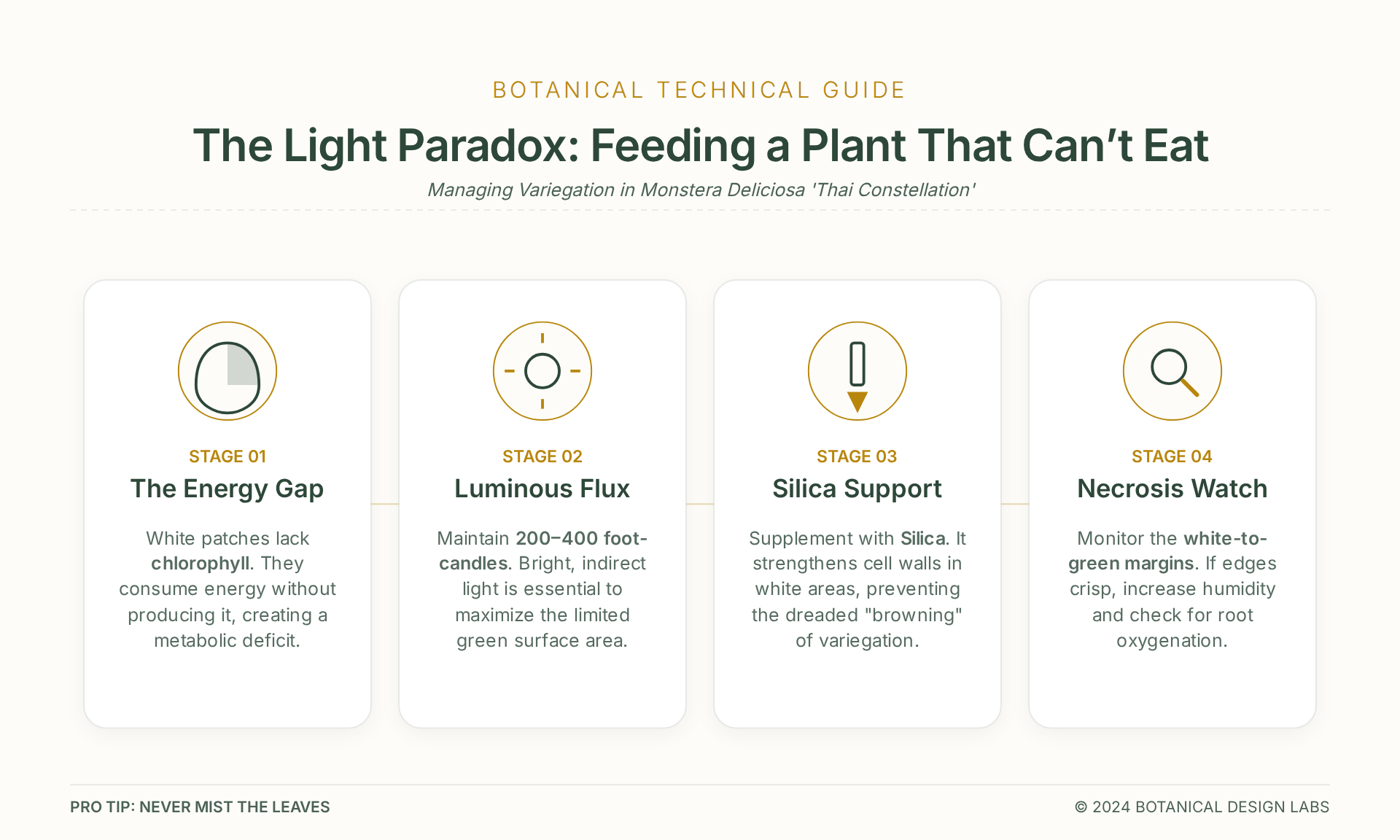
Here in Portland, the winter sun is a myth. It’s 2:00 PM and I’ve already got my Barrina grow lights cranked to 100%. If you treat a Thai Constellation like a standard green Monstera, you are effectively starving it. Remember: those beautiful cream patches are biological parasites. They consume energy but produce none.
Measuring Photons, Not Feelings
Stop guessing if your light is “bright indirect.” Use a light meter or a phone app to measure foot-candles. For a Thai Constellation to actually grow—not just survive—it needs between 400 and 800 foot-candles for at least 12 hours a day. During this Portland winter, my windows are providing maybe 50 foot-candles on a good day. Without supplemental grow lights, the plant will begin to “melt.”
The “Melting” Phenomenon
When the plant doesn’t get enough light, it enters a survival mode. It realizes it can’t support the non-productive white sectors. The result? The white patches turn brown and crispy, often looking like they’ve been burned. Ironically, this usually happens because of too little light, not too much. The plant is literally digesting its own variegated sectors to reclaim nutrients for the green, productive parts. If you see your cream patches browning while the green remains healthy, move it closer to the light or buy a high-quality LED grow light immediately.
The ‘Anti-Rot’ Substrate: Engineering the Perfect Aroid Mix
If you take nothing else away from my rambling, take this: the soil your plant came in from the store is likely a death trap. Most big-box retailers use a heavy, peat-based mix designed to retain moisture during shipping. In a home environment—especially a dry, heated home in February—that soil stays wet in the center while the top looks dry, leading to the 2018 massacre I still have nightmares about.
The Epiphytic Reality
In Southeast Asia, Monstera deliciosa are epiphytes. They climb trees; their roots are exposed to the air, getting drenched by rain and then drying out rapidly. They don’t live in heavy mud. Your substrate needs to mimic this. You want a mix that is so chunky it looks like you could almost eat it (don’t).
Leo’s “Never Again” Aroid Recipe
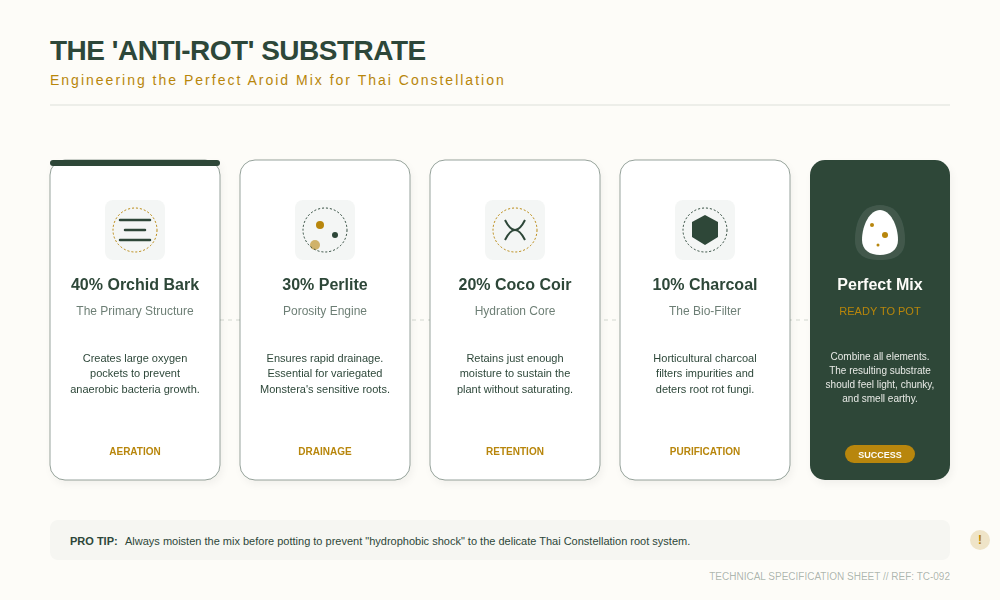
This is the mix I use for all my high-value aroids, and it has saved me from further heartbreak: – 40% Orchid Bark (Large grade): This provides the structural integrity and air pockets. – 25% Perlite or Pumice: For drainage. I prefer pumice because it doesn’t float to the top over time. – 20% Coco Coir or Tree Fern Fiber: For just enough moisture retention to keep the roots from desiccating. – 10% Horticultural Charcoal: This acts as a filter and helps prevent the buildup of harmful bacteria. – 5% Worm Castings: For a gentle, organic nutrient boost.
This mix allows for maximum root aeration. When you water, the liquid should pour straight through the bottom of the pot within seconds. If the water sits on top for more than three seconds, your mix is too dense.
Pest Warfare: Eradicating Thrips and Spider Mites
Winter is the season of the Spider Mite. The dry air from our heaters is like a luxury spa for these pests. Just last week, I was doing my routine check and found a suspicious dusty look on the underside of a new leaf. I grabbed a white paper towel and did the ‘Smear Test’—wiping the leaf firmly. Sure enough, streaks of reddish-brown. Spider mites.
The Thrips Mass Casualty Incident
Thrips are the true villains of the variegated Monstera world. Because Thai Constellations have those thick, succulent leaves, thrips love to lay eggs inside the leaf tissue. Generic advice like “spray with neem oil” is useless here. Neem oil is a cosmetic fix for a systemic problem. If you see silver, etched scarring or tiny black specks (thrip poop), you need to go aggressive.
The Pro-Level Treatment Plan
- Systemic Granules: Use a systemic insecticide containing Imidacloprid. You sprinkle it on the soil, water it in, and the plant absorbs it. When a thrip bites the leaf, it dies. This is the only way to break the larvae cycle hidden inside the tissue.
- Spinosad Spray: For active infestations, use a Spinosad-based spray (like Captain Jack’s Dead Bug Brew). It’s a natural bacteria that paralyzes the pests but is relatively safe for humans and cats like Barnaby.
- Isopropyl Alcohol: For spider mites, a 70% isopropyl alcohol wipe-down removes the webbing and kills the adults on contact.
Replicating the Thai Climate: Humidity and Temperature Benchmarks
We often forget that “Thai” isn’t just a name; it’s a geographical origin. Thailand is humid. It’s sticky. It’s tropical. Meanwhile, I’m sitting in Portland where the air is so dry I’m getting static shocks from my own keyboard.
The Humidity Myth vs. Reality
You’ll hear people say these plants need 80% humidity. While they love that, it’s not practical in a house unless you want mold growing on your drywall. The sweet spot for a Thai Constellation is 50-60%. Below 40%, you’ll start to see the tips of the leaves browning and the new leaves struggling to unfurl from the sheath (stuck leaves are a classic low-humidity symptom).
Managing Evapotranspiration
In the winter, the radiator heat accelerates evapotranspiration—the process where the plant loses water through its stomata (pores). To counter this, I don’t mist. Misting is a waste of time and a recipe for leaf spot disease. Instead, I use a large ultrasonic humidifier positioned about three feet away from the plant. I also keep a hygrometer right next to the pot to track the specific microclimate. If the temperature drops below 60°F (15°C) at night, the plant’s metabolism slows to a crawl, making it even more susceptible to root rot because it isn’t drinking the water in the soil.
The Condo Problem: Managing Massive Growth and Support
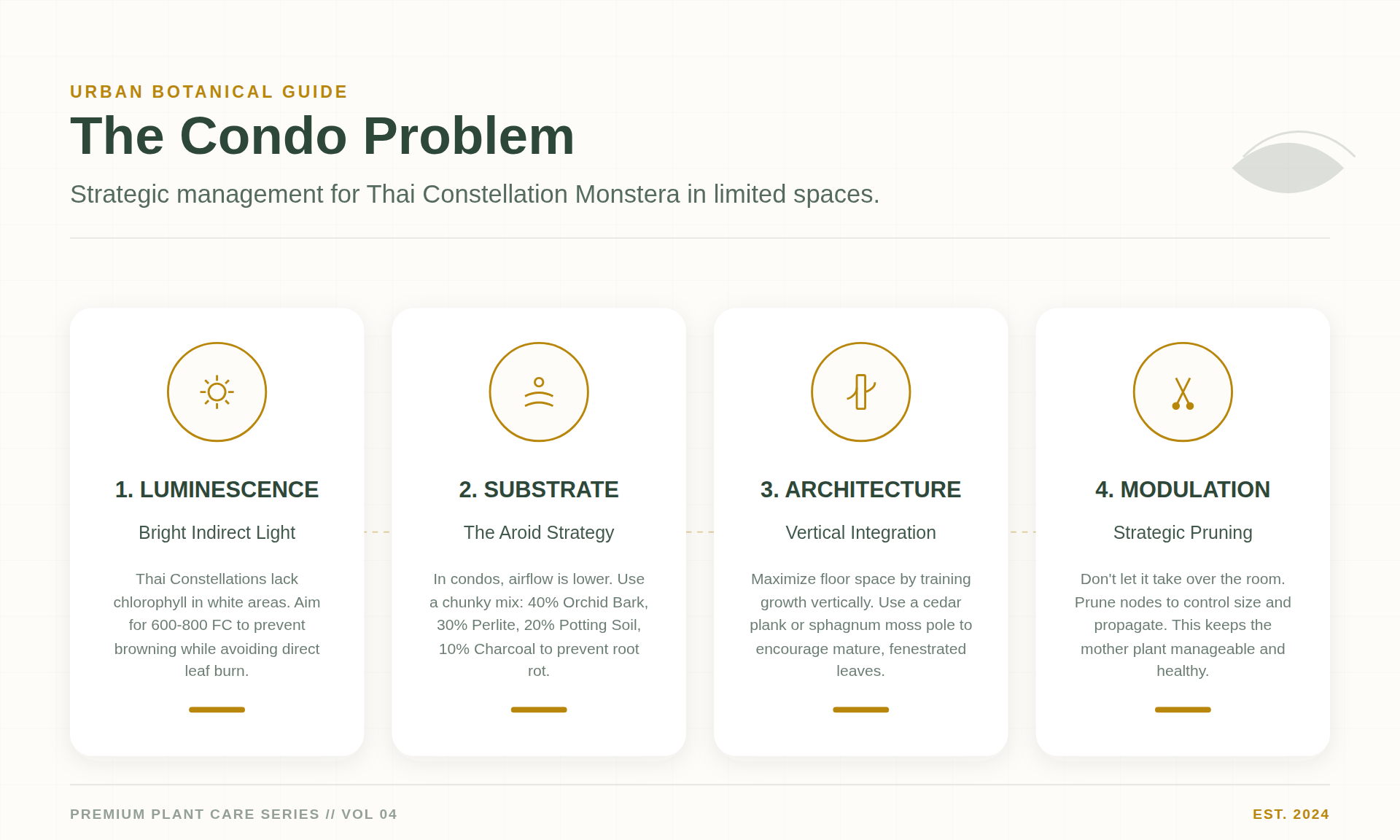
There’s a reason people end up donating these to offices or botanical gardens: they are massive. A mature Thai Constellation doesn’t just sit on a shelf; it colonizes the room. If you live in a condo or a small apartment, you need to think about verticality now, before the plant becomes a sprawling mess.
The Necessity of the Moss Pole
In the wild, Monstera use aerial roots to latch onto trees. These roots aren’t just for stability; they actually absorb moisture and nutrients. By providing a high-quality, moisture-retentive moss pole (not those dry coco coir poles that don’t hold water), you encourage the plant to grow vertically. This keeps the footprint small and, more importantly, triggers the plant to produce larger leaves with more complex fenestrations (the holes).
Node Spacing and Pruning
Thai Constellations have naturally tighter node spacing than the standard deliciosa, but they still get leggy if they are reaching for light. If your plant is getting too wide, don’t be afraid to prune. Just ensure you’re cutting below a node (the bump where the leaf meets the stem). You can propagate the cutting, though be warned: variegated cuttings take significantly longer to root than green ones.
Big Box Rescue: Acclimation and Recovery
It’s a weird time to be a plant collector. I remember when a Thai Constellation cost a month’s rent. Now, you can find them at Lowe’s for the price of a fancy steak dinner. But these “big box” plants are often stressed, root-bound, and pumped full of cheap fertilizers to make them look good on the shelf.
The First 14 Days
When you bring a new Thai home, do not repot it immediately. I know, I just told you the soil is bad. But the plant is already in shock from the move. Changing its environment and its soil at the same time is a recipe for a dead plant. 1. Quarantine: Keep it away from your other plants for at least two weeks. This is non-negotiable. I’ve seen thrip infestations wipe out decades-old collections because of one “deal” at a big-box store. 2. The Flush: Water the plant thoroughly until water runs out the bottom to flush out any excess salt buildup from cheap fertilizers. 3. The Smear Test: Check for mites immediately.
After 14 days, once the plant has adjusted to your home’s light and temperature, then—and only then—should you move it into the ‘Anti-Rot’ chunky mix. Be gentle with the roots; tissue culture plants often have more fragile, “stringy” root systems than those grown from cuttings.
Taking care of a Thai Constellation in the dead of winter is an act of defiance against the elements. It’s a bit of a struggle, sure, but when that new leaf unfurls with a perfect splash of cream right as the Portland sun finally decides to show up in May? It’s worth every frustrating second. Just ask Barnaby; he’s currently using the shadow of my largest leaf as a nap spot. He knows where the good vibes are.
I walked into a big-box hardware store last Tuesday, just to grab some weather stripping for my drafty Portland loft, and there it was. Nestled between a dying rack of ‘assorted foliage’ and some overwatered snake plants sat a tray of Monstera Thai Constellations. They were $39.99. In 2020, people were literally trading their cars for these plants. Now, they’re being sold like commodities in the same aisle as power drills and lawn mulch.
Guide Overview
- The Big-Box Death Trap: Why You Must Repot Your Thai Constellation Immediately
- The Failure of Peat-Heavy Soil
- The ‘Leo Vance’ Aroid Mix Recipe
- Variegation vs. Vitality: Solving the Light Paradox
- The Chlorophyll Deficit
- Measuring Foot-Candles and LUX
- Stopping the Rot: The Thai Constellation’s Fatal Flaw
- The Anatomy of a Hemiepiphyte’s Root System
- The Technical Protocol for Root Inspection
- Vertical Ambition: Using Moss Poles to Trigger Mature Fenestrations
- Understanding the Climbing Habit
- The Moss Pole vs. The Wooden Plank
- The $20 Rescue: Quarantining and Pest Management
- The 14-Day Iron Curtain
- Toxicity Warning: Protecting Pets from Calcium Oxalate
- The Mechanism of Raphides
- Keeping Barnaby Safe
- Winter Survival: Humidity and the Radiator Struggle
- Managing the Microclimate
But here is the cold, hard truth: those plants are currently sitting in a botanical death trap. Most of them won’t survive until Spring. I’ve spent years in humid Florida greenhouses and even more years as a curator, and if there’s one thing I’ve learned, it’s that mass-producers treat these high-end cultivars like they’re indestructible Pothos. They aren’t. They are genetically finicky hemiepiphytes that have been pumped full of growth hormones and shoved into the cheapest, wettest peat moss imaginable. If you just bought one and put it on your coffee table, you are essentially starting a countdown to root rot. Let’s fix that before you end up bitter like I did back in 2018 when I lost my first prize Monstera to a bad bag of ‘premium’ big-box soil.
The Big-Box Death Trap: Why You Must Repot Your Thai Constellation Immediately
The moment you bring that Thai Constellation home, you need to understand that the medium it is currently living in is your primary enemy. Commercial growers use a peat-heavy soil because it’s lightweight for shipping and holds water long enough to survive weeks in a hot truck. However, in a home environment—especially during a dry, cold Portland winter—that peat acts like a wet sponge wrapped around the roots. It suffocates them.
The Failure of Peat-Heavy Soil
Monstera deliciosa, including the Thai Constellation cultivar, are hemiepiphytes. In their natural habitat, they spend a large portion of their lives climbing trees, with their roots exposed to air or tucked into loose, decaying organic matter. They are not designed to sit in a dense, anaerobic muck. When you leave a Thai in that store-bought peat, the water occupies every pore space, leaving zero room for oxygen. This leads to the collapse of the root hairs and provides an open door for pathogens.
The ‘Leo Vance’ Aroid Mix Recipe
To save your plant, you need a chunky substrate that prioritizes gas exchange. Don’t go buy a bag of ‘Potting Soil’ and call it a day. You need to build a mix. Here is my personal ratio that I use for my most valuable specimens, including my Spiritus Sancti and my now-thriving Thais: – 40% Chunky Orchid Bark: This provides the structural integrity and large air pockets. – 30% Perlite or Pumice: Use the coarse stuff. This ensures drainage and prevents compaction. – 20% Coco Coir or Tree Fern Fiber: This holds just enough moisture so the plant doesn’t desiccate in our dry indoor heating. – 10% Horticultural Charcoal and Worm Castings: Charcoal helps filter impurities and prevents the ‘funky’ smell of stagnant water, while castings provide a gentle, slow-release nutrient base.
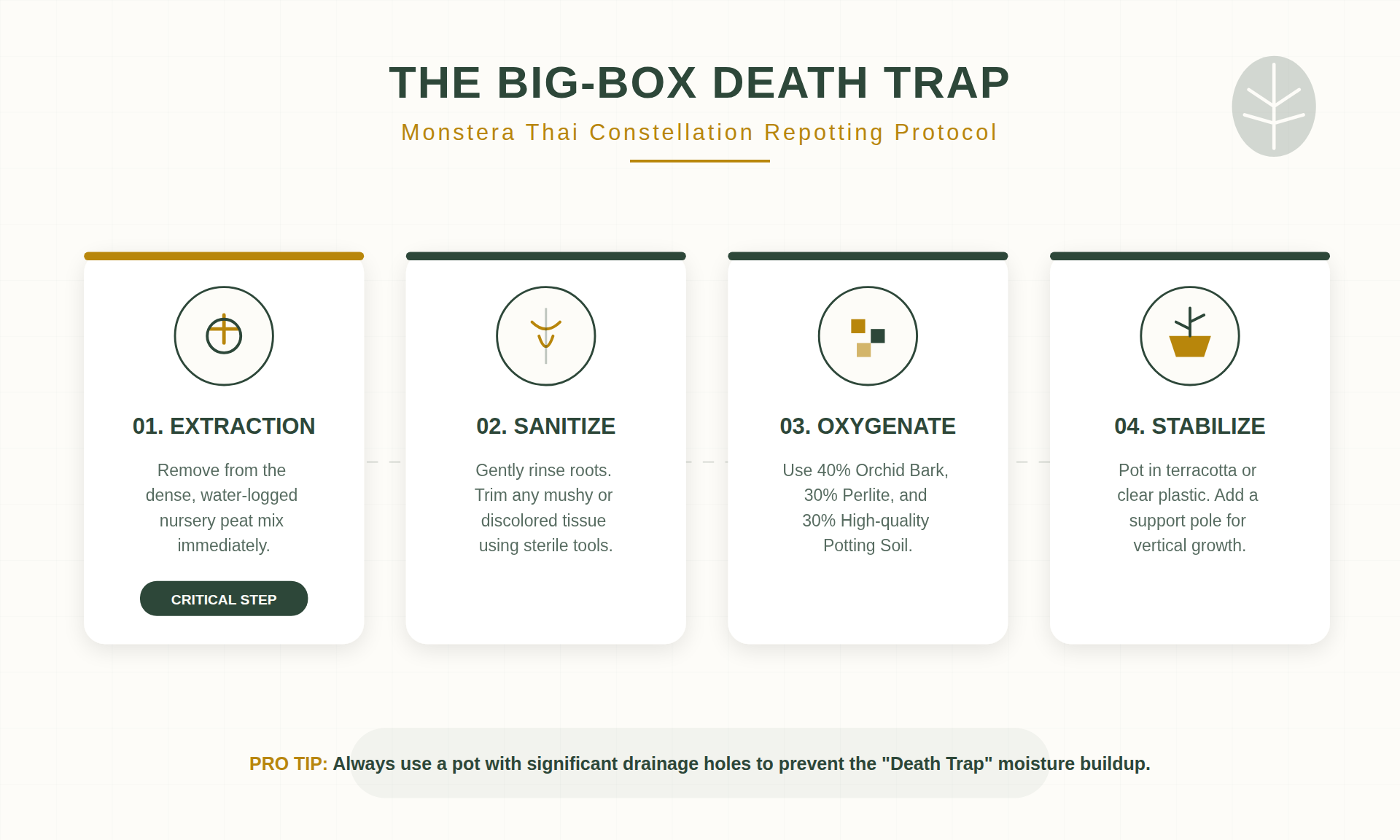
When you repot, do not just ‘up-pot.’ You must gently remove as much of that old nursery peat as possible. I use a chopstick to carefully tease the roots apart. If you find any mushy, brown, or foul-smelling roots, cut them off with sterilized shears immediately. This is the only way to reset the clock on the damage the big-box store has already started.
Variegation vs. Vitality: Solving the Light Paradox
There is a common misconception that because Monstera deliciosa is a ‘low light’ plant, the Thai Constellation can live in a dark corner. This is a lie that leads to brown leaves and heartbreak. The creamy-white splashes on your Thai—which I recently measured with a high-CRI light to perfectly match the #FFFDD0 hex code—are beautiful, but they are biologically useless to the plant.
The Chlorophyll Deficit
Chlorophyll is the green pigment responsible for photosynthesis. The white sectors of a Thai Constellation lack this pigment entirely. This means that for every square inch of white on a leaf, the plant has that much less ‘solar panel’ surface area to generate energy. To compensate, the green parts of the leaf have to work overtime. If you keep this plant in ‘bright indirect light’ (which in a Portland winter usually translates to ‘darkness’), the plant cannot produce enough glucose to maintain its own metabolism.
Measuring Foot-Candles and LUX
Stop guessing. During these short winter days, the light coming through a north-facing window is negligible. You should be aiming for at least 400 to 800 foot-candles for a Thai Constellation to actually thrive, not just survive. Since the sun is a rare guest here in February, I rely heavily on high-output LED grow lights. I keep my lights about 12-18 inches above the canopy.
If the plant doesn’t get enough light, it will begin to ‘sacrifice’ the white parts. Those beautiful constellations will turn brown and crispy. This isn’t a humidity issue; it’s a starvation issue. The plant is literally digesting its own variegated tissue to keep the green parts alive.
Stopping the Rot: The Thai Constellation’s Fatal Flaw
If the standard Monstera deliciosa is a tank, the Thai Constellation is a luxury sedan with a sensitive engine. This cultivar is notoriously susceptible to Pythium, a genus of parasitic oomycetes that cause significant root rot. Because the Thai Constellation is a lab-grown mutation (originally from tissue culture in Thailand), it lacks some of the ruggedness of its wild-type ancestors.
The Anatomy of a Hemiepiphyte’s Root System
In the wild, these plants produce two types of roots: terrestrial roots (which seek soil) and aerial roots (which seek support and moisture from the air). In a pot, these lines get blurred. When the substrate is too wet, the outer layer of the root—the velamen—begins to break down. Once the velamen is compromised, the vascular cylinder of the root is exposed to fungi and bacteria.
The Technical Protocol for Root Inspection
When you bring a big-box plant home, perform a ‘tug test.’ Gently pull on a root. If the outer sheath slides off like a wet noodle, leaving behind a thin, hair-like string, you have rot.
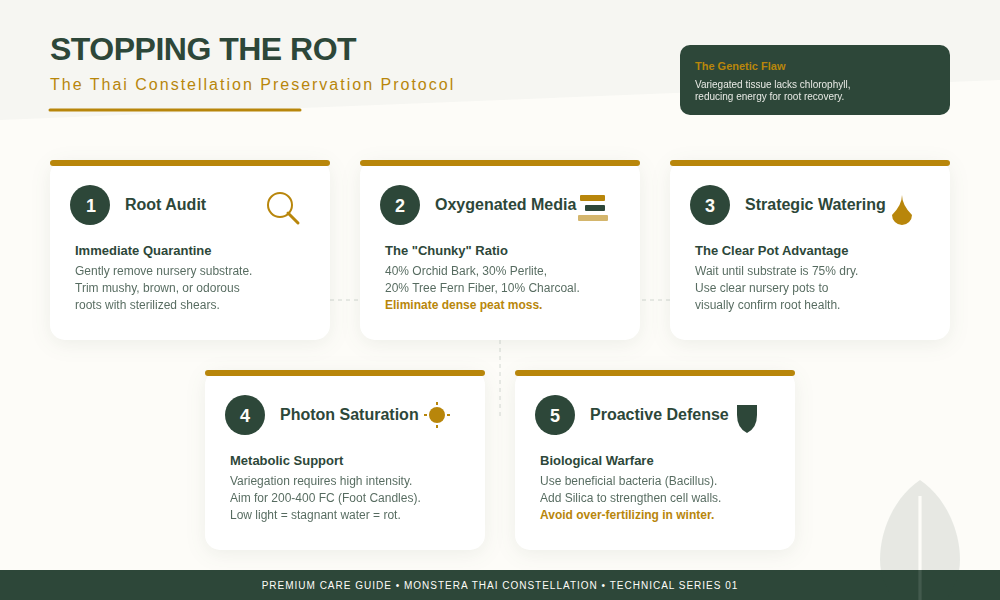
If you find rot, don’t panic, but act fast. 1. The Cleanse: Rinse the entire root system under lukewarm filtered water. 2. The Surgery: Cut back all necrotic tissue until you see white, firm ‘flesh’ inside the root. 3. The H2O2 Soak: Submerge the remaining roots in a solution of 1 part 3% hydrogen peroxide to 2 parts water for 15 minutes. This oxygenates the tissue and kills anaerobic bacteria on contact. 4. The Callus: Let the plant sit out on a paper towel for an hour or two to let the cuts ‘callus’ over before putting it into your new, chunky aroid mix.
Vertical Ambition: Using Moss Poles to Trigger Mature Fenestrations
I often see people complaining that their Thai Constellation is ‘crawling’ across the floor or that the leaves aren’t getting those iconic holes (fenestrations). This is because the plant thinks it’s still on the jungle floor. Without a vertical substrate to climb, the plant remains in its juvenile phase.
Understanding the Climbing Habit
Monstera are opportunistic climbers. In nature, they use their aerial roots to glue themselves to the bark of massive trees. As the plant moves higher toward the canopy, the light intensity increases. The plant ‘knows’ this and begins to produce larger leaves with more fenestrations to allow wind to pass through (preventing the leaves from acting like sails and ripping the plant off the tree) and to allow light to reach the lower, older leaves.
The Moss Pole vs. The Wooden Plank
A moss pole is the gold standard because it provides a moist environment for aerial roots to grow into. When an aerial root finds moisture and nutrients inside a moss pole, it undergoes a physiological change, becoming a secondary nutrient-gathering root. This extra boost of hydration and minerals is what triggers the massive, 20-inch wide leaves we all crave.
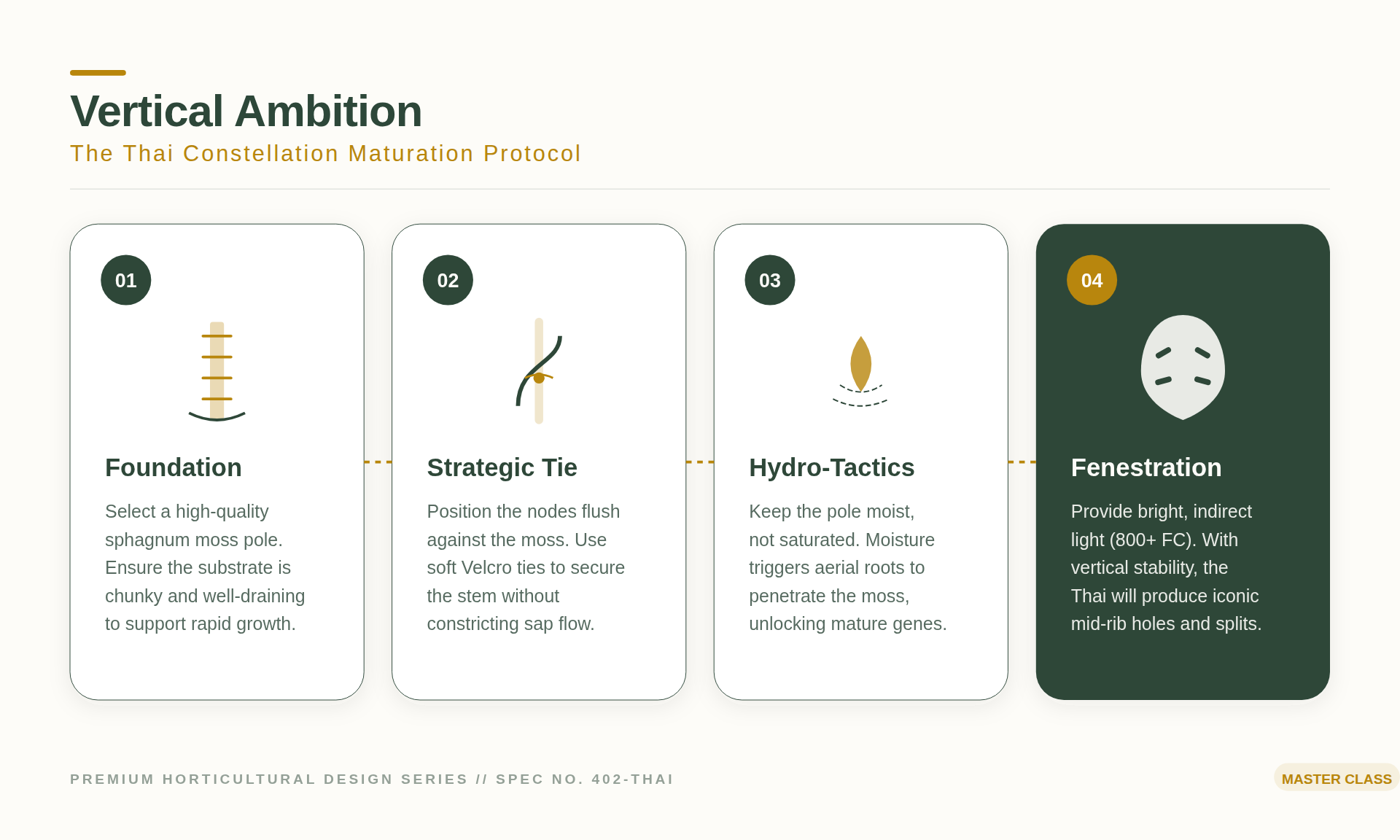
If you’re feeling lazy, a cedar plank works too, but you’ll need to manually tie the nodes to the wood. Avoid those flimsy coco-coir poles; they are hydrophobic and don’t provide the moisture the aerial roots need to truly ‘lock in.’
The $20 Rescue: Quarantining and Pest Management
Big-box stores are essentially a giant swap meet for pests. thrips, spider mites, and mealybugs move between plants with terrifying ease. Last year, a friend brought home a ‘steal’ of a Philodendron that ended up infecting her entire collection with thrips. It took her six months and hundreds of dollars in systemic pesticides to fix a $20 mistake.
The 14-Day Iron Curtain
Any plant from a mass-retailer must be quarantined. I keep my new arrivals in the bathroom or a separate room for at least two weeks. During this time, I treat the plant as if it already has pests.
- Step 1: The Shower. Wash the leaves (top and bottom) with a gentle stream of water to physically knock off any spider mites or thrips larvae.
- Step 2: The Systemic. Since Thais are prone to thrips (which lay eggs inside the leaf tissue), I use systemic granules containing Imidacloprid. These are absorbed by the roots and make the entire plant toxic to sap-sucking insects. Note: Never use systemics on plants that will go outside, as they harm pollinators.
- Step 3: The Jewelry Loupe. I use a 30x jeweler’s loupe to inspect the leaf axils. Spider mites look like tiny moving dust motes. Thrips look like microscopic yellow or black slivers. If you see them, hit them with a mix of isopropyl alcohol and water on a cotton swab.
Toxicity Warning: Protecting Pets from Calcium Oxalate
My cat, Barnaby, is 14 years old and mostly stays away from my collection, but even he gets curious when a new, flashy leaf enters the loft. You must be aware that all parts of the Monstera Thai Constellation are toxic. This isn’t just a ‘tummy ache’ situation; it’s a mechanical irritant.
The Mechanism of Raphides
Monstera cells contain raphides, which are needle-like crystals of calcium oxalate. When a pet (or a particularly misguided human) bites into the leaf, these crystals are ejected into the soft tissue of the mouth, tongue, and throat.
Imagine thousands of microscopic glass shards being fired into your gums. This causes immediate swelling, drooling, and intense pain. In severe cases, the swelling can restrict the airway. Because the oxalates are insoluble, they don’t just dissolve; they stay lodged in the tissue.
Keeping Barnaby Safe
If you have pets, the moss pole is actually a safety feature. It keeps the foliage high and out of reach. I also use decorative birdcages for smaller plants or keep my Thais on high industrial shelving. If you suspect your pet has nibbled on a leaf, look for pawing at the mouth or excessive drooling and call your vet immediately. Don’t wait for ‘symptoms’ to pass; those crystals are doing damage the second they touch a mucous membrane.
Winter Survival: Humidity and the Radiator Struggle
Right now, it’s late February in Portland. My humidity sensor is currently reading 22%. That is a desert-level environment that will kill a Thai Constellation faster than you can say ‘variegation.’ Central heating is the silent killer of tropical plants.
Managing the Microclimate
Do not put your Thai next to a heater or a drafty window. The temperature fluctuations will cause the plant to drop its oldest leaves. I run a large evaporative humidifier 24/7 during the winter months to keep the loft at a minimum of 50% humidity.
If you don’t have a humidifier, you can try a pebble tray, but let’s be honest—pebble trays are the ‘thoughts and prayers’ of the plant world. They don’t do much. A better solution is to group your plants together to create a small, humid micro-canopy through transpiration. Just make sure you’ve finished your pest quarantine before you start huddling them together.
Remember, your Thai Constellation is a living thing, not a piece of furniture. It’s a complex biological organism that has been ripped from its natural evolutionary path to sit in your living room. Treat it with the respect its biology demands, get it out of that big-box soil, and it might just grow into the monster it was meant to be.