TITLE: Distinguishing Between Dust and Spider Mites: A Diagnostic Guide
CONTENT:
This article was researched and reviewed by Leo, indoor plant specialist.
# Is It Dust or Spider Mites? A Diagnostic Guide
Low indoor humidity during winter creates optimal conditions for *Tetranychus urticae*, commonly known as the two-spotted spider mite. When indoor heating systems reduce relative humidity, monitoring plants with a 10x loupe is necessary to identify infestations before significant damage occurs.
Delayed identification of spider mites often leads to plant loss. An infestation initially appears as a fine, greyish-white powder on leaf surfaces, which can be mistaken for accumulated dust. By the time silken webbing is visible, the population is typically large. If left untreated, the mites remove chlorophyll from the leaves, leading to a loss of photosynthetic capacity and eventual plant death.
Identification: Distinguishing Mites from Dust
Spider mites are microscopic, sap-sucking pests that pierce individual plant cells to consume their contents. This process removes chlorophyll, which is critical for photosynthesis, especially during winter months when light levels are low.
To distinguish mites from dust, observe the distribution of the particles. Dust typically settles evenly on the upper surfaces of leaves. Spider mites congregate near leaf veins and in leaf axils. If particles are found on the underside of the leaf, it is likely a mite infestation rather than dust, as gravity prevents dust from accumulating on the undersides of foliage.
The White Paper Test for Identification
Visual inspection can be difficult in low-light conditions. The “white paper test” is a diagnostic tool for confirming the presence of mites.
Place a standard sheet of white paper directly under a leaf that appears dusty or discolored. Flick the leaf firmly to dislodge any organisms on the underside. Observe the paper for several seconds. If the specks begin to move, an infestation is present. Nymphs and adults are approximately the size of a period. Smearing these moving specks across the paper will leave a green or red streak, which is the plant fluid the mites have ingested.
Leaf Stippling: Early Warning Signs
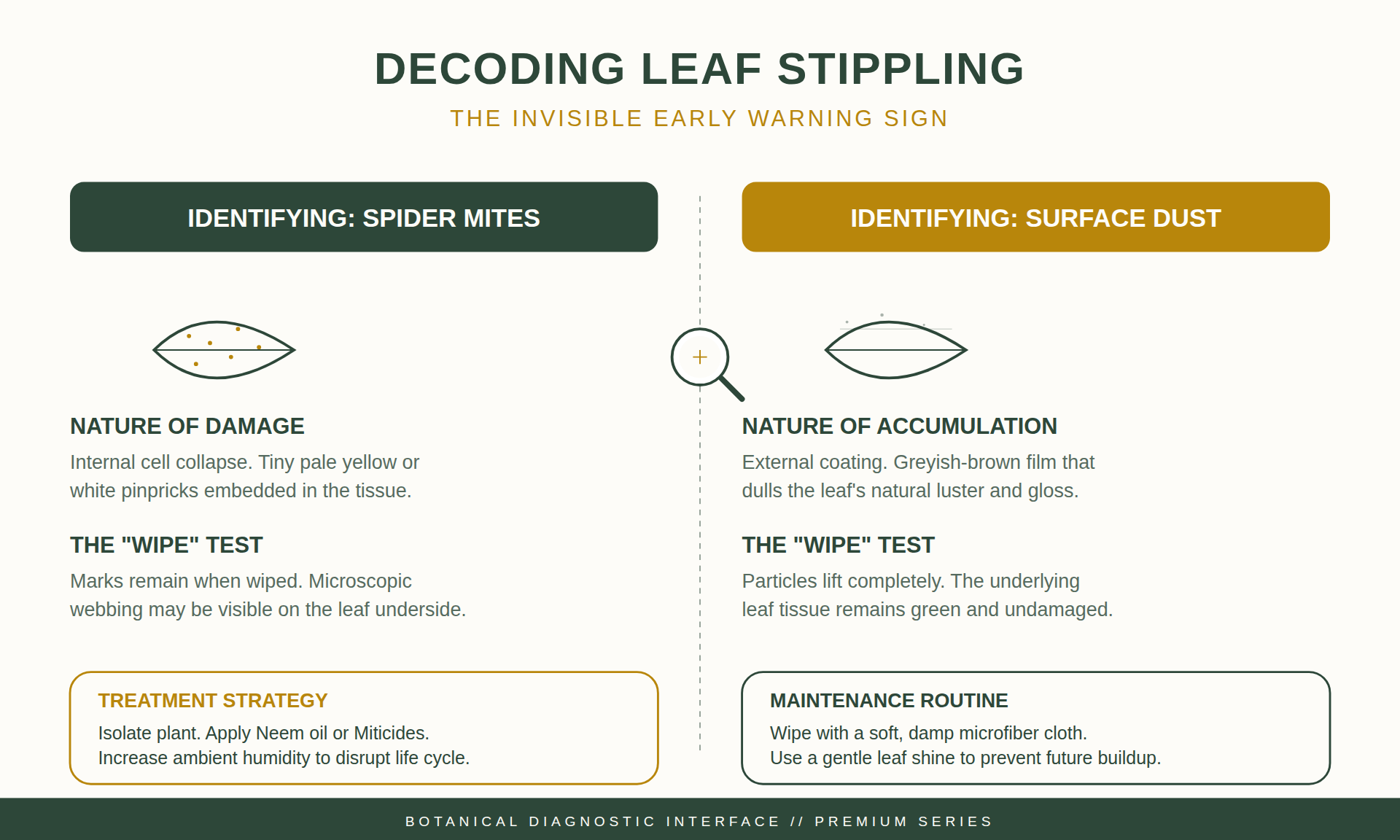
Before webbing appears, plants often exhibit stippling. This symptom consists of small, translucent or chlorotic spots on the leaf surface.
The Biology of Mite Feeding
Spider mites use their mouthparts to puncture the plant epidermis. They inject enzymes to liquefy cell contents before extraction. This leaves an air-filled pocket where chlorophyll was previously located. From the upper leaf surface, this appears as a pale yellow or silver spot.
Mite stippling is often irregular and typically begins near the leaf axils or along the midrib on the undersides of leaves. This differs from nutrient deficiencies, which usually follow specific patterns, such as interveinal chlorosis or symptoms localized to older growth.
Environmental Factors: Humidity and Heating
Spider mites thrive in arid environments. In outdoor settings, populations are regulated by rain, wind, and humidity. High humidity interferes with their reproductive cycle.
Indoor heating during winter creates low-humidity conditions that accelerate the spider mite life cycle. In humid conditions, the transition from egg to breeding adult may take 21 days. In dry indoor air, this cycle can be completed in five to seven days.
The Diapause Factor
Spider mites can enter diapause, a state of physiological dormancy, when environmental conditions are unfavorable. They can persist in the crevices of pots, shelving, or floorboards. When indoor temperatures rise and humidity drops, they exit diapause to feed. Maintaining high humidity via humidifiers can create an environment less conducive to mite reproduction.
Mechanical Control: Physical Removal Methods
Before applying chemical treatments, mechanical control should be used to reduce the population. High-pressure water can physically dislodge mites and their webbing.
The Foliar Rinse Protocol
Direct water at the undersides of the leaves. Use manual friction to ensure the webbing is broken, as webbing acts as a hydrophobic barrier that can repel chemical sprays. A thorough rinse can remove a high percentage of the adult population. This process should be repeated every few days for two weeks to address newly hatched mites.
Biological and Chemical Control Methods
Integrated Pest Management (IPM) for spider mites includes both biological and chemical options.
Biological Control: Phytoseiulus persimilis
*Phytoseiulus persimilis* are predatory mites that feed exclusively on other mite species, specifically the two-spotted variety. They are more mobile than spider mites and can reach pests in tight crevices, such as Hoya leaf folds or Philodendron sheaths, where topical sprays may not penetrate.
Application of Miticides and Neem
If biological controls are not used, miticides or Neem oil may be applied. Spider mites are known to develop resistance to chemical treatments. To prevent this, rotate active ingredients, such as alternating Neem oil with potassium soaps. These treatments must make direct contact with the pests to be effective, necessitating thorough coverage of all leaf surfaces.
Propagation as a Recovery Method
In cases of severe infestation where the foliage is heavily damaged, propagation may be required to save the specimen. If the root system remains healthy, the plant can be cut back to the healthiest nodes.
Quarantine Protocols
The remaining rootstock should be treated with a systemic pesticide, and cuttings should be placed in strict quarantine. Using a sealed propagation box can maintain humidity levels at 90% or higher, which suppresses mite activity while the cutting develops roots. Regular monitoring is necessary during this period to ensure the infestation does not recur.
Leo Vance
Leo Vance is a veteran botanical curator and rare plant collector with over 15 years of experience in biological engineering and hormonal optimization of indoor greenery. After a catastrophic loss of his collection in 2018, he dedicated his life to sharing technical, factual, and practical plant care strategies to help others build resilient indoor sanctuaries.