TITLE: Understanding the Difference Between Moist and Wet Soil for Houseplants
CONTENT:
This article was researched and reviewed by Leo, an indoor plant specialist.
## Soil Moisture Management: Distinguishing Between Moist and Saturated Substrates
In indoor horticulture, the distinction between “moist” and “wet” soil is critical for root health. Environmental factors, such as regional humidity and indoor climate control, affect evaporation rates. However, the primary cause of root decline is often an imprecise understanding of soil hydration levels.
The term “damp” is often used imprecisely to describe soil conditions. In practice, it frequently masks a stagnant, anaerobic environment. There is a specific biological threshold between “moist” and “wet” soil that must be maintained to ensure root health.
### The Wrung-Out Sponge Standard
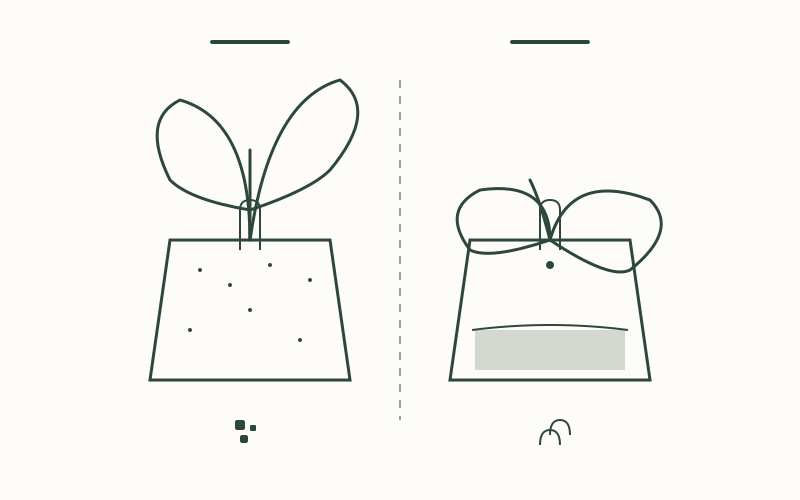
The technical standard for “moist” soil is comparable to a wrung-out sponge. When a sponge is fully saturated, it is heavy and actively dripping, with all pores filled with water. This represents a “wet” state. When the sponge is squeezed to remove excess water, the material remains dark and cool but contains both water and air. This balance is necessary for root function. Roots require oxygen for cellular respiration; therefore, maintaining air pockets within the substrate is as important as providing hydration. This is particularly relevant for sensitive species like the [Monstera Thai Constellation](https://www.plantgrowthguide.com/monstera-thai-constellation-care/).
### The Glossy Surface Warning Sign
A reflective or glossy appearance on the soil surface indicates total saturation. This gloss signifies that water surface tension has formed a continuous film, preventing gas exchange between the root zone and the atmosphere. Moist soil should maintain a matte appearance. Healthy soil structure is crumbly and dark; it should feel cool to the touch without leaving a muddy residue on surfaces. If the substrate has a sludge-like consistency, it is over-saturated.
### The Imprecision of the Term ‘Damp’
The word “damp” is problematic because it often leads to insufficient monitoring of the entire soil column. Soil moisture is a three-dimensional variable. Surface-level coolness does not accurately reflect the conditions at the bottom of the pot. In many indoor environments, the top inch of soil may dry rapidly due to heating systems, while the lower sections remain saturated. This leads to root fermentation in oxygen-deprived conditions.
## The Science of Soil Aeration: Field Capacity vs. Saturation Point
Root health depends on the ratio of water to air within the soil pores—the gaps between particles of peat, perlite, bark, or sand.
### Understanding Field Capacity (The Optimal State)
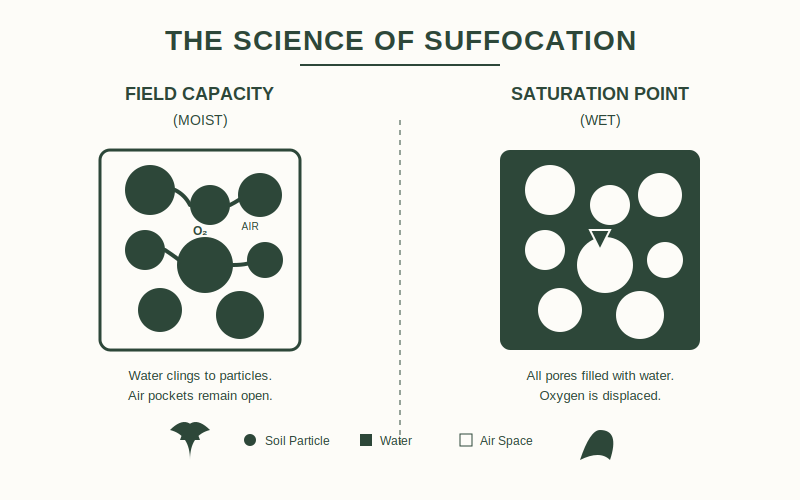
Field capacity refers to the volume of water a soil retains after excess water has drained away due to gravity. When a plant is watered, water fills all available gaps. Gravity then pulls the bulk of this water through the drainage holes. The remaining water, held by adhesion and cohesion to soil particles, represents the field capacity. In this state, macropores (large gaps) are filled with air, while micropores (small gaps) hold water. This allows for capillary action and aerobic respiration. Maintaining field capacity is essential when [propagating spider plants](https://www.plantgrowthguide.com/what-to-do-with-spider-plant-babies/) to prevent root decay.
### The Dangers of the Saturation Point
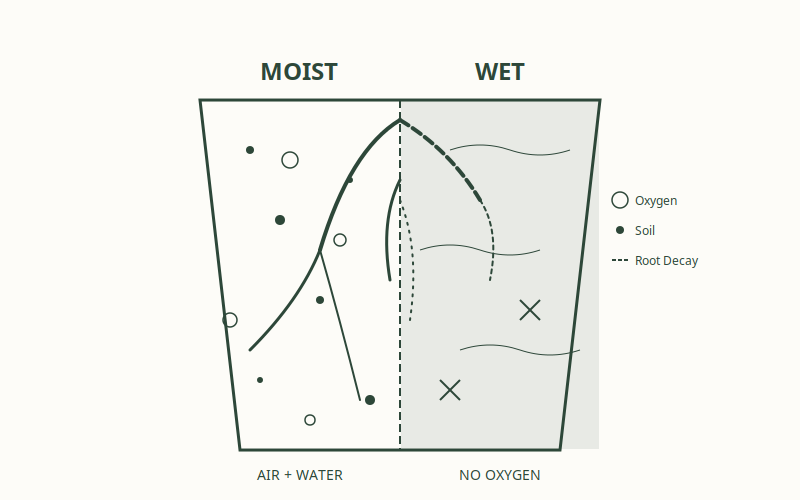
Saturation occurs when both macropores and micropores are filled with water, typically due to inadequate drainage or overly fine soil texture. In a saturated state, oxygen exchange ceases. Roots then switch from aerobic to anaerobic respiration. This process produces ethanol as a byproduct, which is toxic to the plant and dissolves root hair cell membranes, resulting in root rot.
### How Wet Soil Creates Anaerobic Conditions
Dead root tissue provides a substrate for opportunistic pathogens such as *Pythium* and *Phytophthora*. These water molds thrive in anaerobic environments and can spread to healthy tissue. Low temperatures exacerbate this issue, as stagnant water and reduced metabolic activity increase the plant’s vulnerability to these pathogens.
## The 3-Step Sensory Audit: Manual Moisture Assessment
Standard moisture meters measure electrical conductivity rather than direct water content, which can be skewed by fertilizer salt accumulation. Manual assessment provides more reliable data.
### The Finger Test 2.0: Subsurface Assessment
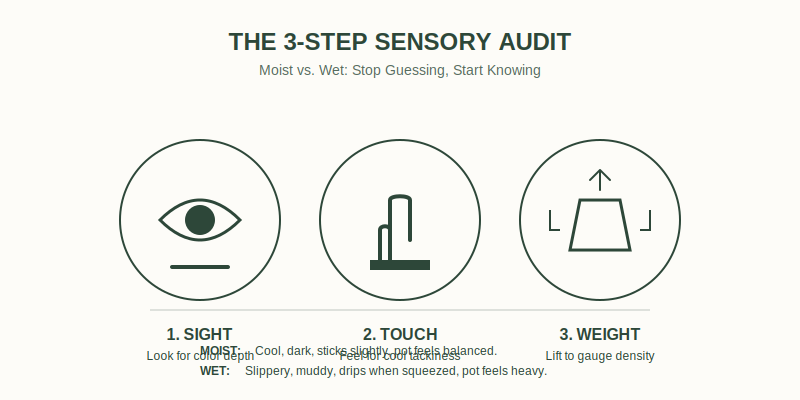
The “one inch” rule is often insufficient, as root systems are typically concentrated in the lower two-thirds of the container. To assess moisture accurately, a probe should reach at least three inches deep. Moist soil feels cool and has a crumbly texture. Wet soil feels cold and sticky. If the probe is coated in mud upon removal, the soil is wet; if only a few crumbs adhere, it is moist.
### Color Grading: Chromatic Indicators of Hydration
Peat-based mixes typically appear dark brown when moist and turn ashy grey as they dry. However, saturated soil often appears darker than moist soil and may exhibit an oily sheen. Localized dark patches can indicate soil compaction, where “plugs” of soil retain water while the surrounding medium dries.
### The Squeeze Test: Identifying Muddy Consistency
The squeeze test is a practical method for evaluating substrate consistency:
1. **Wet:** Water is expressed between the fingers. The soil retains a solid, muddy shape that does not break when probed.
2. **Moist:** No water is expressed. The soil holds its shape briefly but crumbles easily when disturbed.
3. **Dry:** The soil fails to hold any shape and behaves like loose sand.
This test ensures that a mix is at field capacity before potting.
## Fungus Gnats: Biological Indicators of Excess Moisture
The presence of fungus gnats is a reliable indicator of excessive soil moisture. These insects are attracted to decaying organic matter, which is a byproduct of overwatered soil.
### Larval Development in Saturated Organic Matter
Fungus gnat larvae (*Bradysia* species) consume fungi and decaying organic material. In cases of high population density, they may also consume plant root hairs. Saturated soil provides the necessary humidity for larval movement and keeps the surface soft enough for adult egg-laying.
### The Top-Inch Rule for Pest Mitigation
Allowing the top inch of soil to dry completely creates a physical barrier that prevents gnats from laying eggs. Some growers use a top layer of coarse sand or pumice to facilitate rapid surface drainage while maintaining moisture in the root zone. This is a mechanical approach to pest management. It is important to note that [fixed watering schedules](https://www.plantgrowthguide.com/houseplant-watering-schedule-myth/) are less effective than watering based on pot weight and pest activity.
### Disrupting the Life Cycle Through Controlled Desiccation
In cases of severe infestation, allowing the substrate to reach the wilting point can desiccate gnat larvae. While this carries a risk for thin-leaved plants, heartier species like Pothos or Monstera can tolerate this process to reset the soil ecosystem.
## Seasonal Adjustments: Watering Requirements in Low Light
During winter months, reduced light levels significantly alter a plant’s water requirements.
### Reduced Evapotranspiration Rates
Plants function as hydraulic systems. In high light, transpiration through the stomata creates a pull that moves water from the roots to the leaves. In low light, photosynthesis decreases and stomata remain closed for longer periods, slowing this process. If watering volumes are not adjusted, soil that was “moist” in summer will remain “wet” in winter because the plant cannot process the excess water.
### The Impact of Low Temperatures on Root Zone Activity
Cold soil reduces root metabolic activity. In cold climates, water in the soil can act as a heat sink, lowering the root zone temperature below the ambient room temperature. Cold, saturated soil is a primary cause of root failure in tropical species. Using insulating materials, such as cork mats, under pots can help maintain stable root temperatures.
### Adjusting Schedules for the Dormant Phase
During dormancy, drying periods should be extended. Waiting for initial signs of slight foliage drooping ensures the soil has transitioned from moist to dry-ish before re-watering. In some cases, [pruning large plants](https://www.plantgrowthguide.com/how-to-prune-monstera-too-tall/) can reduce their overall water demand during low-light months.
## Mechanical Solutions: Maintaining Optimal Soil Porosity
Physical fail-safes can help prevent soil saturation regardless of watering frequency.
### The Necessity of Drainage Apertures
Containers must have drainage holes to allow gravity to remove excess water from macropores. Without these, water pools at the bottom, creating a permanent saturated zone. Decorative pots should be used as cachepots, with plants housed in plastic nursery liners that can be removed for thorough watering and drainage to field capacity. This also assists in [managing plant placement around pets](https://www.plantgrowthguide.com/keep-cats-away-from-indoor-plants/).
### Aerating Compacted Soil via Manual Probing
Soil compaction occurs as organic matter decomposes and water weight compresses particles. This eliminates macropores. Periodically probing the soil with a wooden stick creates manual air channels, facilitating oxygen delivery to the root ball and ensuring even water distribution.
### Amending Mixes with Macropore-Increasing Aggregates
Standard potting soils are often formulated for high water retention. To ensure a “moist but not wet” state, the substrate should be amended with approximately 40% coarse aggregates:
* **Perlite:** Creates air pockets and is cost-effective.
* **Pumice:** Heavier than perlite; provides a porous surface for air and microbes.
* **Orchid Bark:** Increases structural integrity for epiphytic plants.
* **Horticultural Charcoal:** Increases surface area for oxygen and absorbs impurities.
Increasing macropore volume ensures that excess water drains away, leaving the substrate at the desired field capacity. Effective plant care relies on managing the balance of water and oxygen within the substrate.
Leo Vance
Leo Vance is a veteran botanical curator and rare plant collector with over 15 years of experience in biological engineering and hormonal optimization of indoor greenery. After a catastrophic loss of his collection in 2018, he dedicated his life to sharing technical, factual, and practical plant care strategies to help others build resilient indoor sanctuaries.