This article was researched and reviewed by Leo, an indoor plant specialist.
# Small Brown Worms in Houseplant Soil: Identification and Management of MillipedesIndoor environments often experience fluctuations in humidity and temperature. When heating systems are active, ambient air humidity decreases, while the soil in potted plants may remain damp. These conditions can attract various soil-dwelling organisms, including millipedes, which are frequently observed in species such as Philodendron spiritus-sancti and other tropical houseplants.
Guide Overview
- Is It a Millipede? Identification Criteria
- Thanatosis: The Coiling Defense Mechanism
- Morphology: The Two-Per-Segment Rule
- Cylindrical and Flattened Body Structures
- Locomotion and Movement Patterns
- Ecological Role: Millipedes as Detritivores
- Dietary Requirements of Millipedes
- Nutrient Cycling in Potting Media
- Consumption of Living Tissue in Specific Conditions
- Millipedes as Indicators of Soil Moisture
- Comparison: Millipedes vs. Centipedes
- Velocity: Scavengers vs. Predators
- Cephalic Anatomy: Forcipules and Mandibles
- Leg Attachment and Positioning
- Dietary Differences: Predatory Behavior in Chilopoda
- Etiology: Factors Attracting Millipedes to Potting Media
- Irrigation Frequency and Soil Saturation
- Outdoor-to-Indoor Migration Vectors
- Contaminated Commercial Potting Media
- Surface Debris and Mulch Accumulation
- 4-Step Management Protocol for Millipede Removal
- Step 1: Desiccation Strategy
- Step 2: Physical Removal and Sanitation
- Step 3: Application of Diatomaceous Earth
- Step 4: Sub-Irrigation (Bottom Watering)
- Long-Term Preventative Measures
- Quarantine Procedures
- Thermal Sterilization of Soil Media
- Humidity Management and Airflow
- Drainage and Container Material Selection
The presence of small, brown, coiled organisms in houseplant soil is a common occurrence. While they may be mistaken for parasitic worms or indicators of root rot, they are typically millipedes. These organisms are not primary plant pests but are indicators of specific environmental conditions within the potting medium.
Millipedes are often introduced through outdoor exposure or contaminated soil. While they do not pose an immediate threat to plant health, their presence suggests that the soil environment is consistently moist. This guide outlines the morphological identification of millipedes, their ecological role, and non-chemical methods for population management. For broader context on soil moisture management, refer to technical documentation on recovering overwatered Sansevieria.
Is It a Millipede? Identification Criteria
Accurate identification is necessary before implementing management strategies. Soil-dwelling organisms vary significantly; fungus gnat larvae are translucent with black cephalic capsules, while earthworms exhibit pinkish, soft-bodied morphology. Millipedes possess distinct morphological traits characteristic of the class Diplopoda.
Thanatosis: The Coiling Defense Mechanism
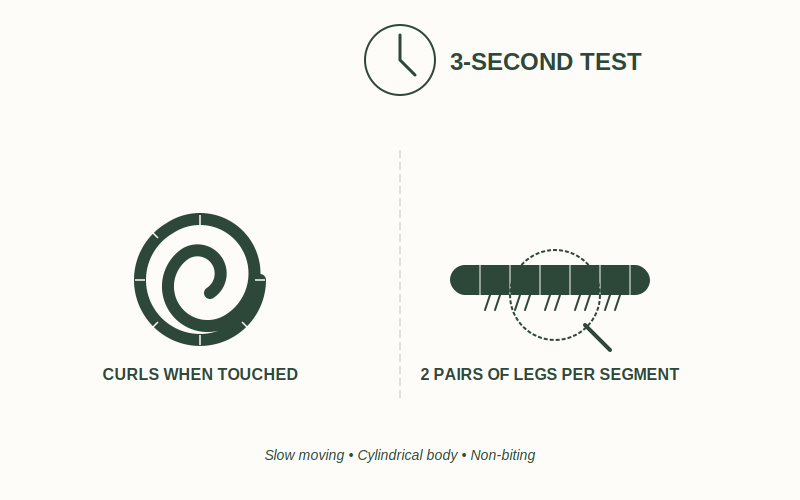
When disturbed, millipedes exhibit thanatosis, a defensive behavior where the organism remains immobile. They coil their bodies into a tight, flat spiral. This configuration protects the ventral surface and legs while exposing the calcified dorsal plates, known as tergites. This behavior distinguishes them from more mobile soil organisms.
Morphology: The Two-Per-Segment Rule
Millipedes are classified under Diplopoda, characterized by having two pairs of legs per body segment. Most species found in indoor plants possess between 30 and 400 legs. Upon close inspection, each visible body ring supports four legs (two on each side) due to the evolutionary fusion of segments. This anatomical structure provides the force required to burrow through compacted organic matter.
Cylindrical and Flattened Body Structures
The greenhouse millipede (Oxidus gracilis) is a common indoor species. It features a cylindrical body with lateral protrusions called paranota. The exoskeleton is composed of chitin and calcium carbonate, giving the organism a firm, non-slimy texture. Maintaining this exoskeleton requires a high-humidity environment to prevent desiccation.
Locomotion and Movement Patterns
Millipedes exhibit slow, rhythmic locomotion. Their legs move in metachronal waves, where movement ripples sequentially down the body. They do not exhibit the rapid, erratic scurrying characteristic of predatory centipedes (Chilopoda).
Ecological Role: Millipedes as Detritivores
Millipedes function as detritivores within the soil ecosystem. Their primary role is the decomposition of organic material rather than the consumption of healthy plant tissue.
Dietary Requirements of Millipedes
The diet of a millipede consists of decaying organic matter (DOM), including decomposing foliage, wood components in potting media, and fungal mycelium. Their mandibles are specialized for grinding softened cellulose. By breaking down complex organic molecules, they increase the bioavailability of nutrients such as nitrogen and phosphorus.
Nutrient Cycling in Potting Media
Millipedes process decaying material through their digestive tract, which contains a specialized microbiome of bacteria and enzymes. The resulting waste, or frass, serves as a nutrient-rich substrate. This process facilitates carbon cycling within the pot, potentially reducing the risk of anaerobic conditions that lead to root rot.
Consumption of Living Tissue in Specific Conditions
Millipedes may consume living root tissue under two specific environmental stressors: 1. Overpopulation: When high population densities exhaust available decaying organic matter. 2. Extreme Desiccation: Since millipedes are approximately 70% water and lack a waxy cuticle, they may consume water-filled root cells to maintain hydration during drought conditions.
Millipedes as Indicators of Soil Moisture
The presence of millipedes indicates a biologically active soil environment. However, it also serves as a bio-indicator of high moisture levels. Because millipedes require constant moisture to survive, their presence suggests that the soil medium is not drying out sufficiently between irrigation cycles.

Comparison: Millipedes vs. Centipedes
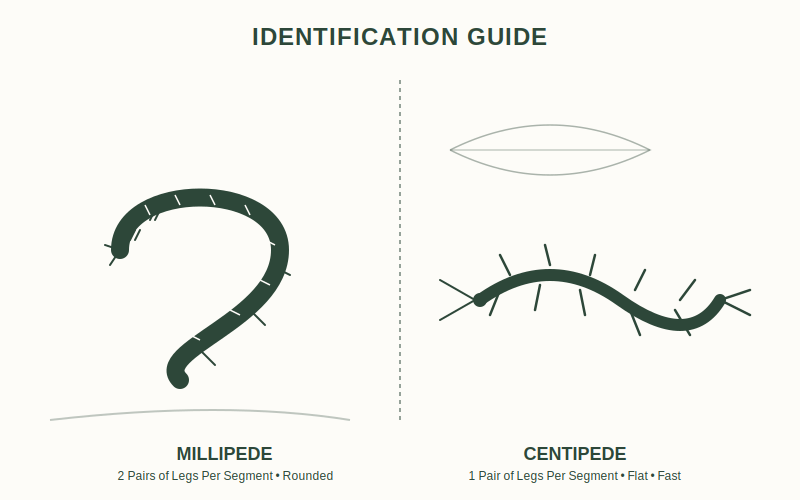
Distinguishing between millipedes and centipedes is critical for safety and management. While millipedes are scavengers, centipedes are venomous predators.
Velocity: Scavengers vs. Predators
Centipedes (Chilopoda) are adapted for high-speed locomotion to capture prey. Millipedes move at significantly lower velocities. Rapid movement upon disturbance generally indicates a predatory centipede.
Cephalic Anatomy: Forcipules and Mandibles
Centipedes possess forcipules, which are modified front legs functioning as venomous fangs used to paralyze prey. Millipedes lack these structures; their mouthparts are located ventrally and are designed for scraping organic material.
Leg Attachment and Positioning
Centipede legs are attached laterally, providing a wide base for sprinting. Millipede legs are positioned directly beneath the body, an adaptation for generating the upward force required for burrowing.
Dietary Differences: Predatory Behavior in Chilopoda
Centipedes prey on other soil organisms, including fungus gnats and spider mites. Their presence indicates a food source (other pests), whereas millipede presence indicates a suitable habitat (moist organic matter).
Etiology: Factors Attracting Millipedes to Potting Media
Irrigation Frequency and Soil Saturation
Millipedes are moisture-obligate organisms. If the upper layers of the soil medium remain saturated, it creates an ideal habitat for reproduction and survival. Consistent moisture prevents the natural desiccation that would otherwise limit their population.
Outdoor-to-Indoor Migration Vectors
Plants maintained outdoors during warmer months are susceptible to colonization by local soil fauna. Organisms often enter through drainage holes and reside in the lower, moist regions of the pot. These populations are then transported indoors when the plants are moved.
Contaminated Commercial Potting Media
Commercial soil products stored outdoors may become infested. Millipedes can enter bags through ventilation ports to exploit the moist, organic environment. This can lead to the introduction of eggs or larvae into indoor collections during repotting, including in sensitive species like Thai Constellation Monstera.
Surface Debris and Mulch Accumulation
Top-dressings such as sphagnum moss or wood chips reduce surface evaporation, creating a high-humidity microclimate. This, combined with decaying surface foliage, provides both habitat and a food source for detritivores.
4-Step Management Protocol for Millipede Removal
Population management can be achieved through environmental modification and mechanical controls rather than chemical pesticides.
Step 1: Desiccation Strategy
Reducing soil moisture is the most effective control method. Millipedes are highly susceptible to dehydration. By allowing the upper 2-3 inches of soil to dry completely, the environment becomes uninhabitable, forcing organisms to retreat or perish.
Step 2: Physical Removal and Sanitation
Remove all decaying organic matter, including dead leaves and old mulch, from the soil surface. Physical removal of visible millipedes is effective. Additionally, a “potato trap”—placing a raw potato slice on the soil surface overnight—can be used to aggregate millipedes for easy disposal.
Step 3: Application of Diatomaceous Earth
Diatomaceous Earth (DE) is a mechanical insecticide composed of fossilized diatoms. The silica shards abrade the millipede’s exoskeleton and absorb lipids, leading to lethal desiccation. DE must remain dry to be effective; it should be applied as a dust to the soil surface after the medium has dried.
Step 4: Sub-Irrigation (Bottom Watering)
Transitioning to sub-irrigation keeps the soil surface dry while providing moisture to the root zone. This limits the habitat available to millipedes and other surface-dwelling pests like fungus gnats.
Long-Term Preventative Measures
Quarantine Procedures
New plant acquisitions should be isolated for a minimum of 14 days. During this period, inspect the soil for movement and apply preventative measures if necessary. This prevents the introduction of pests into the primary collection.
Thermal Sterilization of Soil Media
Soil components, particularly those stored outdoors, can be thermally sterilized. Heating the medium to 180°F (82°C) for 30 minutes eliminates eggs, larvae, and adult organisms. This is a standard procedure for ensuring a sterile planting environment.
Humidity Management and Airflow
While tropical plants require high humidity, stagnant air promotes pest activity. Increasing airflow via oscillating fans facilitates surface evaporation in the soil while maintaining ambient humidity for the foliage. For more on physiological issues related to humidity, see the guide on Stromanthe Triostar tissue health.
Drainage and Container Material Selection
Porous materials like terracotta facilitate moisture evaporation through the container walls, reducing the likelihood of perma-damp conditions. In contrast, plastic and glazed ceramic trap moisture. Utilizing high-drainage substrates (e.g., aroid mixes) in breathable containers is a primary preventative measure against millipede colonization.
Millipedes are a natural component of the decomposition cycle. By managing soil moisture and removing organic debris, populations can be effectively controlled without the need for chemical intervention.