This article was researched and reviewed by Leo, our indoor plant specialist.
# Thrips Eradication: The aggressive Protocol for Large Plant Collections It’s late on a Tuesday in the dead of winter, and the Portland wind is rattling the glass of my loft windows. Inside, the furnace is humping along, stripping every ounce of moisture from the air until my own skin feels two sizes too small. This is the danger zone. While the rest of the world sees a “winter wonderland,” I see a desiccated habitat where my humidity-loving collection is one heater-cycle away from a crisis. I just spent the last hour hunched over my 14-year-old rescue cat, Barnaby—who, for the record, is currently judging my posture from the sofa—staring through a 10x jeweler’s loupe at a Thai Constellation that looks… off. There it is. A tiny, translucent sliver of a shadow moving with the calculated malice of a microscopic assassin. Thrips.Guide Overview
- The Thrips Mass Casualty Incident: Why Your Collection is Dying
- Identification: Distinguishing Thrips Damage from spider mites
- The Anatomy of the Scar
- The Frass Factor
- The Biological Trap: Why Neem Oil Fails Large Collections
- The Life Cycle Problem
- The aggressive Option: Systemic Treatment for 50+ Plant Collections
- Understanding Vascular Translocation
- Residual Activity and Safety
- Biological Warfare: Using Predatory Mites in Indoor Jungles
- The Specialized Assassins
- The Slow-Release Strategy
- The Spinosad Strike: The Only Organic Spray That Works
- Nervous System Overexcitation
- The Blue Sticky Trap Combo
- The Recovery Workflow: Quarantine and Post-Infestation Care
- The Silica Shield
- The Quarantine Protocol
The Thrips Mass Casualty Incident: Why Your Collection is Dying
If you’ve spent any time on the plant subreddits lately, you’ve seen the term “Mass Casualty Incident” (MCI) thrown around. It’s usually a photo of a kitchen full of plants, once a “personal jungle,” now a graveyard of yellowing leaves and sagging stems. For the uninitiated, thrips are members of the order Thysanoptera, and they are the closest thing to a biological apocalypse for an indoor gardener. Unlike spider mites, which are annoying but somewhat predictable, thrips are the ultimate tactical nightmare because of their unique biology. When I lost my prized Monstera Deliciosa back in 2018 to bad soil, it was a slow, agonizing rot. But thrips? They are fast. They don’t just eat your plant; they invade it. Female thrips practice something called endophytic oviposition. This is a fancy botanical way of saying they use a saw-like organ to slice open your plant’s tissue and inject their eggs *inside* the leaf. You can’t wash them off. You can’t wipe them away. They are literally part of the plant’s anatomy from birth.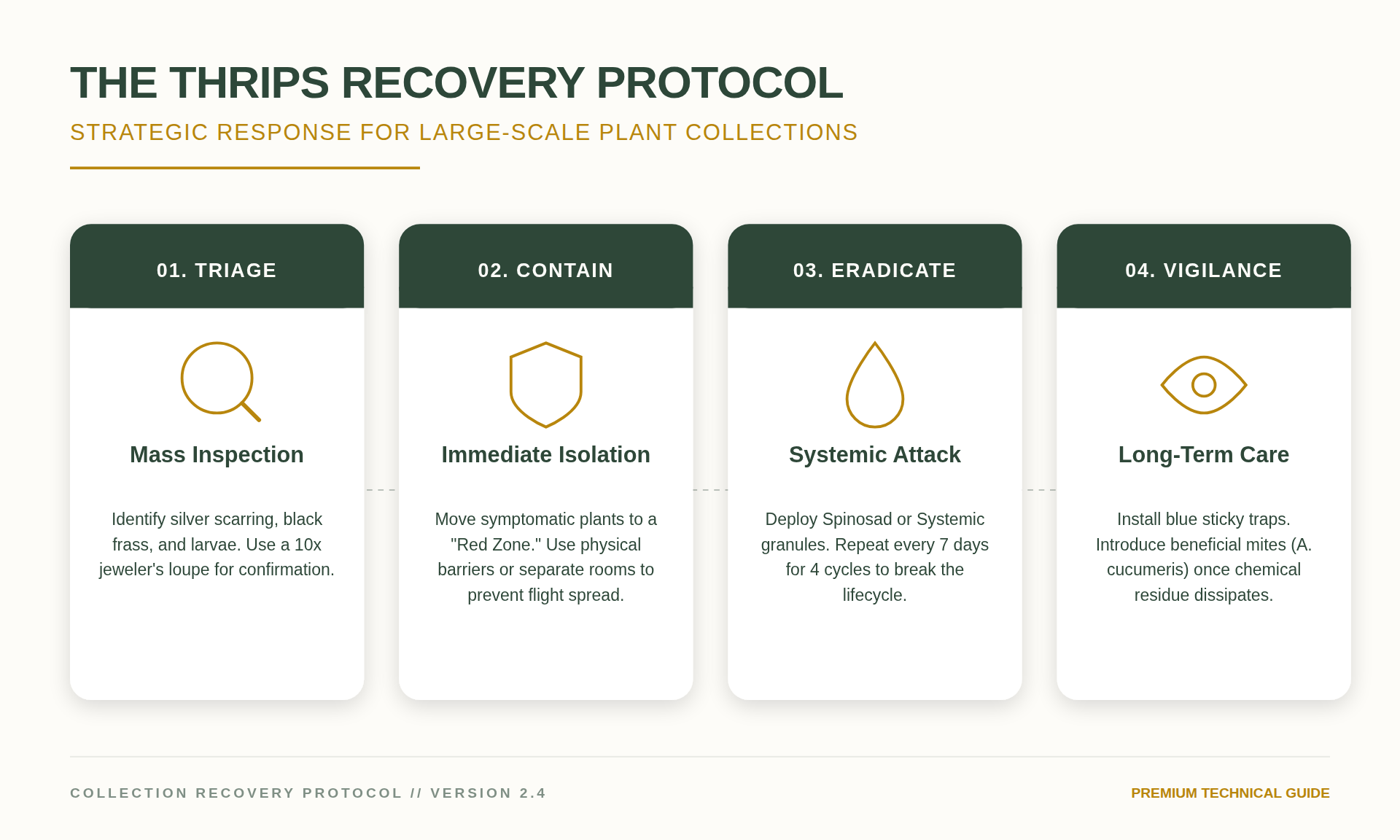
Identification: Distinguishing Thrips Damage from Spider Mites
One of the most common mistakes I see in my consulting work (and on the frantic “what is this?” posts online) is the confusion between thrips and spider mites. In this dry, drafty winter, both thrive, but the treatment protocols are worlds apart. Spider mites leave fine webbing and a dusty, stippled look on the leaves. Thrips, however, leave what we call silver scarring.The Anatomy of the Scar
Because thrips have piercing-sucking mouthparts, they don’t just chew. They explode the plant cells and suck out the contents, including the chlorophyll. This leaves behind air-filled pockets that reflect light, creating that characteristic silvery, metallic sheen on the leaf surface. If you see silver patches, you aren’t looking at a “cool mutation”; you’re looking at a hollowed-out corpse of a leaf sector.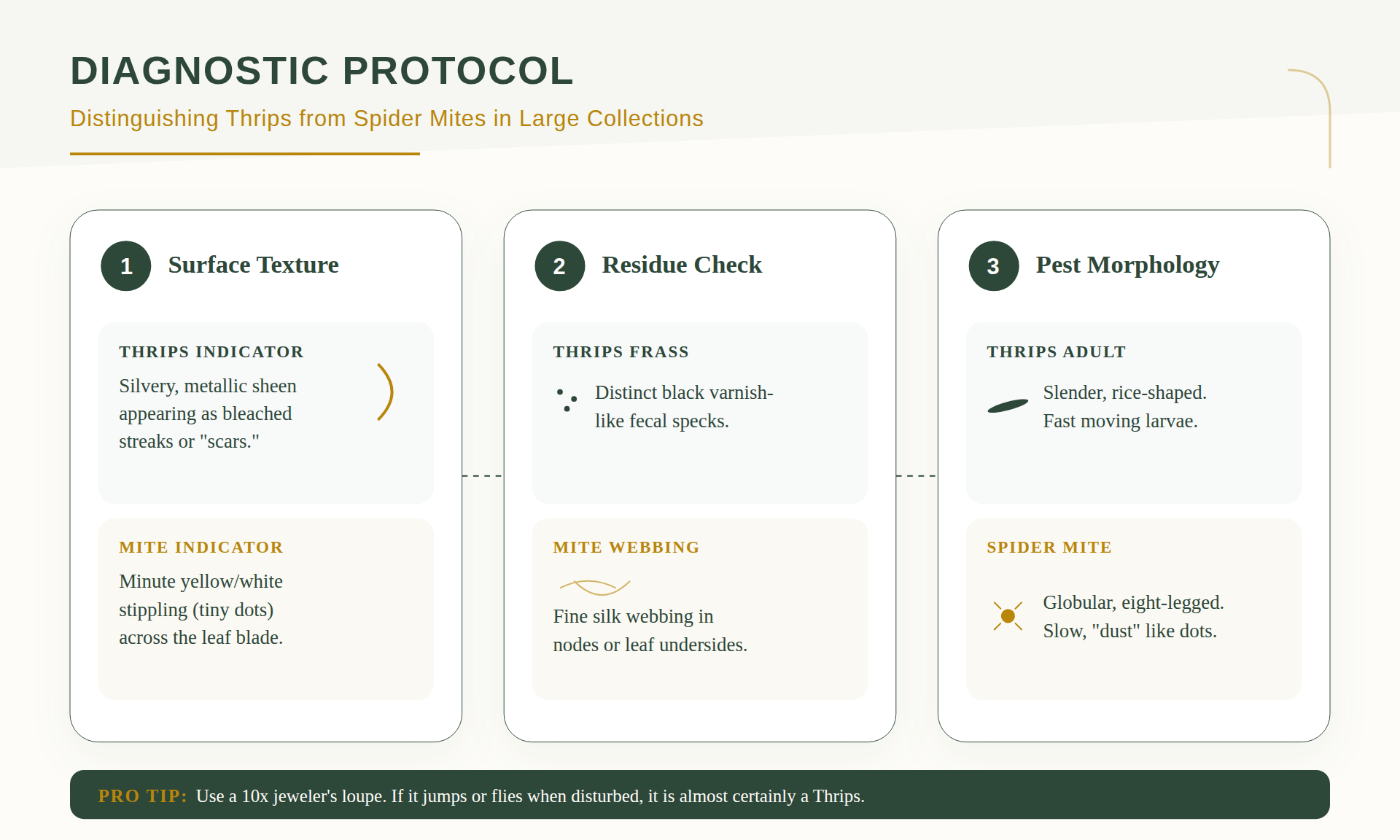
The Frass Factor
If the silvering doesn’t give it away, the black fecal spots will. Spider mites don’t leave these distinct, tar-like droplets. Thrips do. It’s their calling card. I always tell people to take a white paper towel, dampen it slightly, and wipe the underside of a suspect leaf. If you see streaks of black or dark green that weren’t there before, you have an active infestation. This isn’t just chlorophyll depletion; it’s a structural failure of the plant’s skin. While spider mites are like a rash, thrips are like a systemic infection.The Biological Trap: Why Neem Oil Fails Large Collections
I’m going to be blunt: if you have more than ten plants and an active thrips outbreak, put the neem oil back under the sink. Better yet, throw it away. I am tired of reading “all-natural” blogs recommending neem oil as a cure-all. Neem oil contains azadirachtin, which can work as a growth regulator, but it is a contact insecticide.The Life Cycle Problem
Thrips have a complex life cycle that involves several stages, and most of those stages are spent hiding where neem can’t reach. 1. **The Egg Stage**: Tucked safely inside the leaf tissue. 2. **The Larval Stages**: Actively feeding on the leaf. 3. **The Pupal Stage**: This is the kicker. Many thrips species drop into the soil to pupate. If you are only spraying the leaves, you are missing the eggs inside the tissue and the pupae in the soil. It’s a biological trap. You kill the adults, feel a false sense of security for four days, and then a new generation hatches from the “nursery” inside your variegated Monstera’s petioles. In a large collection, the labor required to maintain a neem-only regimen—spraying every 3 days for 6 weeks—is a recipe for burnout and eventual plant loss. You need systemic action, something that enters the plant’s “bloodstream” and waits for the bugs to take a bite.The aggressive Option: Systemic Treatment for 50+ Plant Collections
When you’re facing a “Mass Casualty Incident,” it’s time to stop playing nice. For serious collectors, the “aggressive Option” is a systemic insecticide, specifically those containing Imidacloprid. My go-to for years has been Bonide Systemic Houseplant Insect Control.Understanding Vascular Translocation
Systemics work through a process called vascular translocation. You apply the granules to the soil and water them in. The plant’s roots absorb the chemical, and it travels up through the xylem to every single leaf, stem, and new growth point. This turns the entire plant into a poison pill. When a thrips larva hatches inside the leaf and takes its first meal, it’s over.Residual Activity and Safety
The beauty of Imidacloprid is its residual activity. A single application can protect the plant for up to eight weeks. This covers multiple thrips life cycles without you having to lift a spray bottle every night. However, a word of caution for those with pets like Barnaby: systemics make the plant tissue toxic. If your cat or dog is a leaf-nibbler, you must move the treated plants to a completely inaccessible area or stick to biological controls. Barnaby knows better than to touch my Calatheas (mostly because they’re crispy enough to be unappealing in this dry heat), but I never take the risk with my lower-shelf plants.Biological Warfare: Using Predatory Mites in Indoor Jungles
If you’re running a basement jungle or a grow-tent setup where chemicals feel too heavy-handed, or if you simply have too many plants to safely use systemics with pets around, biological control is your best friend. This isn’t just “releasing ladybugs” (which is useless indoors). This is precision warfare using predatory mites.The Specialized Assassins
For thrips, you want two specific soldiers: *Amblyseius cucumeris* and *Amblyseius swirskii*. – **Amblyseius cucumeris**: These are the workhorses. They hunt the first-stage thrips larvae. They are cheap and effective for maintenance. – **Amblyseius swirskii**: These are the “special forces.” They are more expensive but can handle higher temperatures and will eat both thrips larvae and whitefly eggs.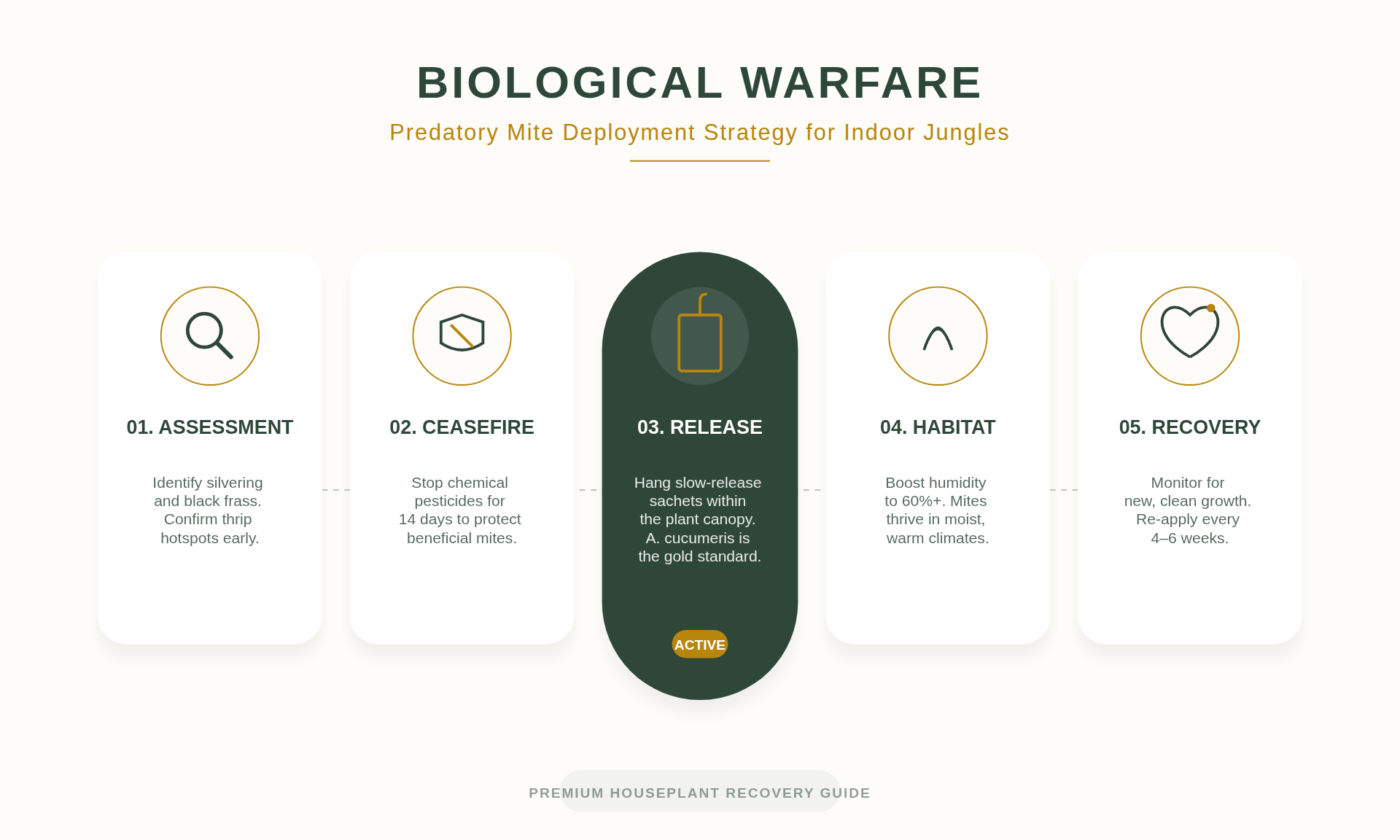
The Slow-Release Strategy
In a large collection, you don’t just dump a bag of mites and hope for the best. You use slow-release sachets. These little paper packets are mini-breeding colonies. You hang one on each large plant, and for a few weeks, a steady stream of predatory mites crawls out to patrol the foliage. If you’re a grower with high humidity (unlike my dry loft), *Orius insidiosus* (the minute pirate bug) is another savage option—they will eat adult thrips, which mites usually can’t handle.The Spinosad Strike: The Only Organic Spray That Works
If you’re caught in the middle—neem is too weak, but you aren’t ready for systemics—there is one organic-certified solution that actually commands respect: Spinosad. Derived from a soil bacterium, this stuff is the primary ingredient in Captain Jack’s Deadbug Brew.Nervous System Overexcitation
Spinosad is fascinating from a biological perspective. It works by causing nervous system overexcitation in the thrips. They basically lose control of their muscles, stop feeding, and die within a day or two. Unlike neem, it has a translaminar effect, meaning if you spray the top of the leaf, some of the solution can soak into the upper layers of the tissue to reach those hidden larvae.The Blue Sticky Trap Combo
When using Spinosad, I always pair it with blue sticky traps. Why blue? Research shows that thrips are specifically attracted to the blue spectrum, whereas fungus gnats prefer yellow. These traps won’t end an infestation, but they are your early-warning system. In my “Diagnostic Thursday” protocol, if I see even one tiny body on a blue trap, the Captain Jack’s comes out immediately. Just remember: Spinosad is susceptible to light degradation. If you spray under high-intensity LEDs or mid-day sun, the efficacy drops. Spray at night or when the lights go off to give the bacteria time to work.The Recovery Workflow: Quarantine and Post-Infestation Care
Eradicating the bugs is only half the battle. The “post-thrips” phase is where many collectors lose their plants to secondary infections. Thrips damage creates thousands of tiny open wounds on your plant—perfect entry points for fungi and bacteria.The Silica Shield
During recovery, I swear by silica supplements. Adding a high-quality silica to your watering routine helps the plant build thicker cell walls. Think of it as armor. It makes the tissue harder for the next generation of thrips to pierce and helps the plant maintain its structure even when it’s been “bled” by pests.The Quarantine Protocol
If you have 50+ plants, you need a “hard” quarantine protocol. Any new plant—even from a reputable local nursery—must be isolated for at least three weeks. During this time, I treat them with a preventive round of Spinosad and check the nooks of the petioles with a soft-bristle makeup brush. Only after a 21-day “pest-free certification” do they get to join the main collection in the loft. Don’t let the “Mass Casualty” stories scare you off the hobby. Thrips are a rite of passage for the serious collector. They force you to stop being a “plant owner” and start being a “plant curator.” They demand that you understand biology, life cycles, and the chemistry of your treatments. It’s frustrating, it’s expensive, and it might make you want to throw your variegated Monstera out the window into the snow—but once you master the aggressive protocol, you’ll never fear a silver leaf again.The Thrips Crisis: Why Your ‘Indoor Jungle’ is a Death Trap
It’s late afternoon in Portland, the sun is already sinking behind the West Hills, and the radiator in my loft is hissing like a disgruntled cobra. This dry, artificial heat is the exact environment where my nightmares—and yours—thrive. If you’ve found a single, tiny, yellowish-brown speck crawling on the underside of your variegated Monstera, I have bad news: you aren’t looking at a bug. You’re looking at a biological inevitability. Thrips are not like spider mites or aphids. You can’t just spray them off with a hose and call it a day. Back in 2018, I lost a Thai Constellation that I’d nurtured for three years because I treated a thrips infestation like a minor nuisance. I used “gentle” methods. I listened to the Pinterest infographics. By the time I realized I was in a war, the plant was a hollowed-out husk of necrotic tissue. I’m still bitter about it.The Internal Parasite Problem
What makes thrips the ultimate “end-boss” of the plant world is their method of operation. They aren’t just sitting on the surface like a scale insect. They are essentially internal parasites. The female thrips uses a saw-like organ called an ovipositor to cut a slit into your plant’s leaf tissue and inject her eggs *inside* the mesophyll. Your plant isn’t just a host; it’s a nursery, a buffet, and a tomb.Parthenogenesis: The Math of Doom
Here is the truly terrifying biological reality: many thrips species are capable of parthenogenesis. This means a single female doesn’t need a mate to start a colony. She can land on your Alocasia, crawl into a leaf crease, and begin pumping out clones of herself immediately. In the warmth of a heated apartment in the middle of winter, their life cycle accelerates. What takes weeks in the wild happens in days in your living room. If you have multiple houseplants, you don’t have a few “sick” plants; you have a systemic breach of your entire collection’s perimeter.Triage and the 48-Hour Quarantine Protocol
When you realize the infestation has jumped from your “sacrificial” Pothos to your high-value specimens, your first instinct is panic. You want to start spraying everything with whatever is under the sink. Stop. You need a tactical roadmap. When you’re dealing with multiple houseplants, you have to stop thinking about them as individuals and start treating the entire room as a single, contaminated unit.Establishing the Isolation Zone
The moment you find thrips on more than two plants, the room they are in is officially the “Red Zone.” If you have a separate room with no plants, that is your “Green Zone.” Any plant that shows zero signs of damage under a 30x jeweler’s loupe (and I mean zero) gets moved to the Green Zone after a thorough preventative wash. Everything else stays. Do not move plants back and forth. You are the primary vector for cross-contamination. I’ve caught Barnaby brushing against a Philodendron and then wandering over to my Calatheas—he’s essentially a furry bus for larval thrips. Keep the pets out, and change your clothes after you handle the infested group.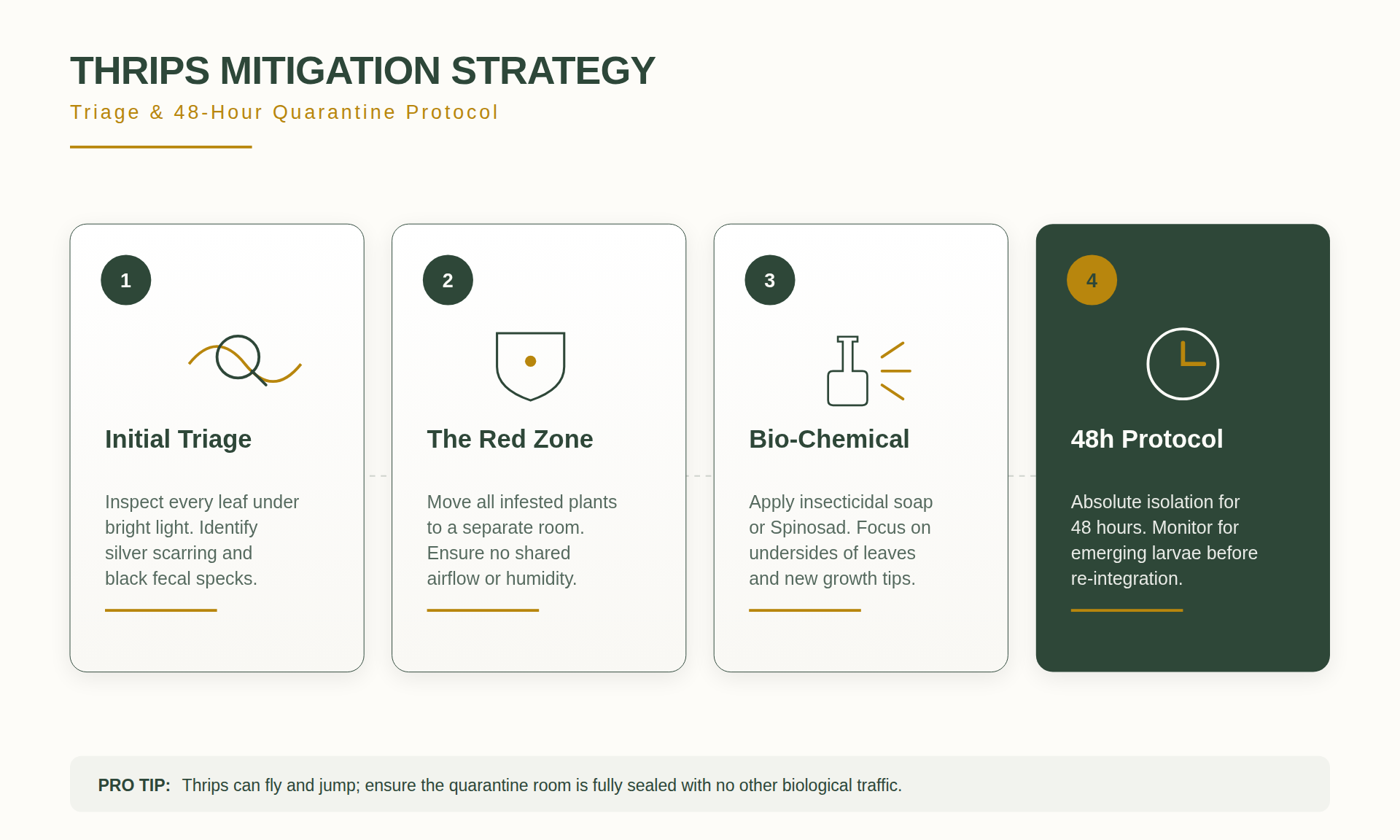
The Sanitization Sweep
Thrips larvae are incredibly small and can be knocked off onto shelves, saucers, and even the fabric of your curtains. During the first 48 hours of your “aggressive” response, you must sanitize every surface around the plants. I use a diluted isopropyl alcohol solution to wipe down the shelves. If you have moss poles, they are a major liability. Thrips love the humidity of the moss and will hide in the crevices. In this winter dry spell, those poles are like little luxury hotels for pests. If the infestation is heavy, you might have to consider stripping the moss or, at the very least, drenching the entire pole in your treatment solution.Why Neem Oil Fails: The Science of Systemic Eradication
I’m going to say this as clearly as I can: Neem oil is for people who want to feel like they are doing something while their plants slowly die. On a technical level, Neem oil is a contact killer and an antifeedant. It works by coating the insect and suffocating it, or by making the leaf taste bad.The Oviposition Shield
Remember what I said about eggs being laid *inside* the leaf? Neem oil cannot reach them. You can soak your plant in the highest grade cold-pressed Neem, but the next generation of thrips is currently developing safely behind a wall of plant tissue, completely shielded from your “organic” spray. This is why people get stuck in a “Neem loop”—they spray, the adults die, they think they won, and then five days later, a fresh batch of larvae emerges from the leaves, and the cycle repeats until the plant’s vigor is totally depleted.The Case for Systemics
To truly eradicate thrips on a collection scale, you need a systemic insecticide. This is a chemical that the plant absorbs through its roots or leaves and distributes throughout its entire vascular system. When the thrips—whether they are larvae or adults—take a bite of the plant, they are consuming the toxin. For serious collectors, chemicals like Imidacloprid are the heavy hitters. They provide weeks of protection from the inside out. However, I know a lot of people are hesitant to use chemicals indoors, especially with pets like Barnaby around. If you go this route, you must be surgical. I don’t use granules in pots that Barnaby can reach. But if you want a 100% kill rate on a variegated Monstera that cost you half a month’s rent, you have to acknowledge that “natural” isn’t always “effective.”The Spinosad Solution: The Professional’s Choice
If you want the efficacy of a systemic without the environmental baggage of heavy chemicals, Spinosad is your best friend. It’s a natural substance derived from a soil bacterium, and for some reason, thrips absolutely hate it. It’s the active ingredient in Captain Jack’s Deadbug Brew, which has become the gold standard for indoor jungle hobbyists.Nervous System Disruption
Spinosad works by exciting the insect’s nervous system. It causes involuntary muscle contractions and tremors until the insect eventually dies of exhaustion. The beauty of Spinosad is that it has both contact and ingestion properties. It also has a “translaminar” effect, meaning if you spray the top of a leaf, it can penetrate into the leaf tissue to reach the larvae hiding on the underside or just beneath the surface.Application Protocol in Winter
Because it’s winter and the air is bone-dry, your foliar sprays will evaporate quickly. You want the Spinosad to stay wet on the leaf as long as possible to maximize absorption. I wait until the evening when the grow lights are off—this prevents leaf scorch and slows down evaporation. 1. **The Initial Soak**: Spray every square inch of the plant until it is dripping. Focus on the “crotches” where the leaf meets the stem; this is the thrips’ favorite hiding spot. 2. **The Residual Effect**: Spinosad has a decent residual life, but you need to re-apply every 5-7 days. Why? Because you need to catch the ones that were in the egg stage during your last spray. 3. **The Rotation**: If you have a massive infestation, thrips can actually develop resistance to Spinosad. I like to rotate it with a soap-based spray or a different class of insecticide every third treatment just to keep them off balance.Biological Warfare: Deploying Predatory Mites
Sometimes, spraying 50 plants in a small loft is simply not feasible. The smell, the moisture, the sheer labor—it’s exhausting. This is where you call in the mercenaries. Biological control is the practice of introducing “good bugs” to eat your “bad bugs.” It’s how I managed the conservatory back in my curator days, and it’s how I handle my larger Alocasia specimens now.Amblyseius cucumeris: The Thrips Specialist
These tiny predatory mites are the front-line infantry. They don’t fly; they just crawl around the leaves looking for thrips larvae to eat. They are particularly effective because they target the first-stage larvae—the youngest, most vulnerable stage of the thrips.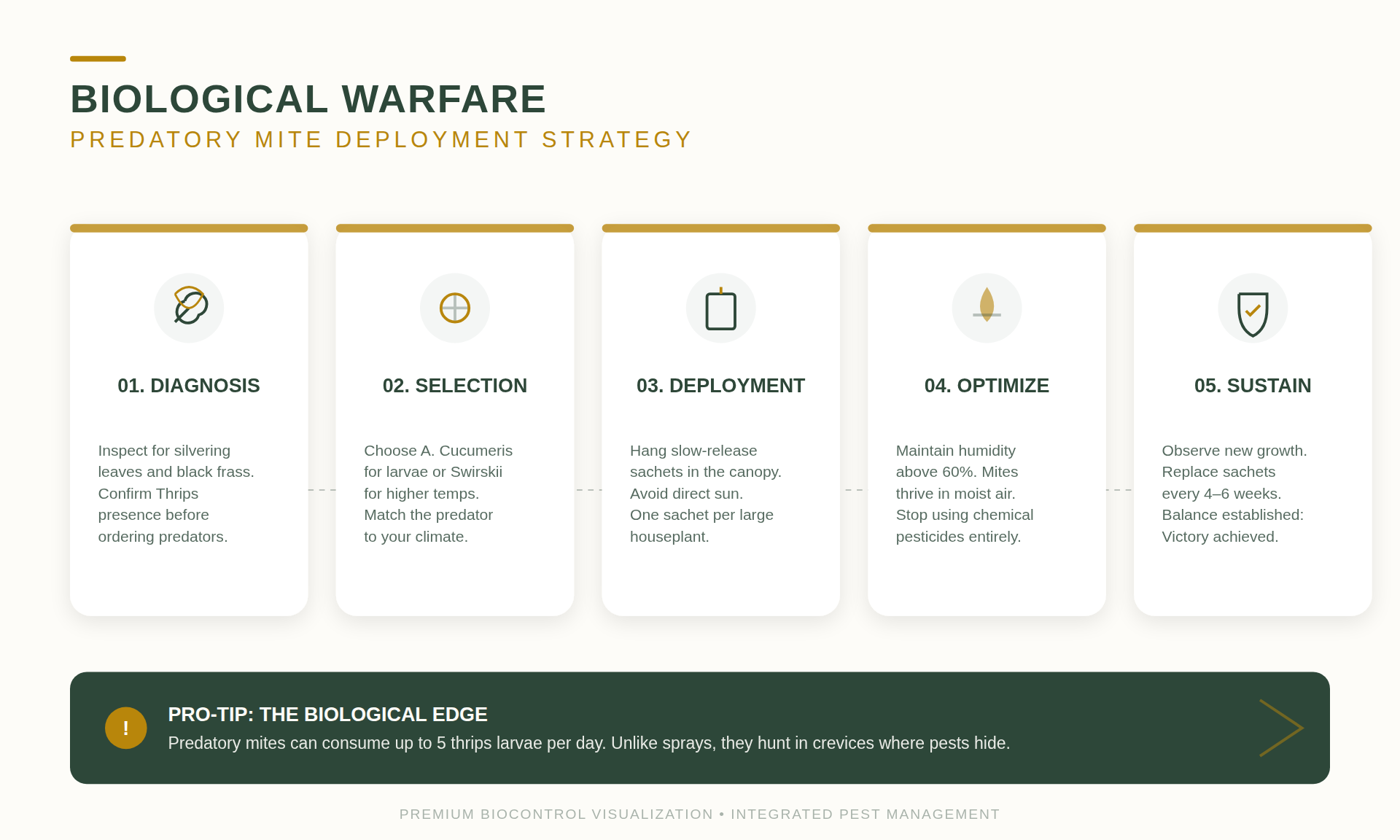
The Humidity Trap
Here is the catch: most predatory mites require high humidity to thrive. In my drafty loft with the heater blasting, the humidity can drop to desert levels. Predatory mites will simply shrivel up and die in those conditions. If you choose biological warfare, you *must* run a humidifier and get that room to at least 50-60%. I use slow-release sachets that hang on the plants, which act as “breeding stations” for the mites, allowing them to emerge over several weeks. It’s a beautiful, clean way to fight, but it requires you to manage the environment as much as the pest.The Soil Phase: Killing Thrips Where They Hide
This is the part everyone forgets. You spray the leaves, you see the adults die, and you think you’ve won. Then, ten days later, a new army appears. Where did they come from? The soil.The Pupal Stage
In the thrips life cycle, after the larval stages, they often drop off the plant and fall into the top inch of the soil to pupate. They become immobile, non-feeding “cocoons” that are immune to foliar sprays. If you aren’t treating the growing medium, you are leaving a literal sleeper cell in every pot.Soil Drenches and Nematodes
To kill the pupae, you have two real options: * **Beneficial Nematodes (*Steinernema feltiae*)**: These are microscopic worms that you mix with water and pour into the soil. They hunt down thrips pupae, enter their bodies, and release a bacteria that kills them. It sounds like science fiction, and it works incredibly well. Plus, they kill fungus gnats as a bonus. * **Diatomaceous Earth**: If you prefer a mechanical kill, you can top-dress your soil with a thick layer of food-grade diatomaceous earth (DE). It’s made of fossilized algae with razor-sharp edges that slice through the exoskeletons of insects. However, DE only works when it’s bone-dry. In a humid plant room, it often clumps up and becomes useless. For my collection, I prefer the nematode drench. It’s clean, it’s biological, and it reaches the corners of the pot where powders can’t.Monitoring and Long-Term Jungle Defense
How do you know when the war is over? You can’t just trust your eyes. Thrips are experts at hiding in the meristem—the tightly curled new growth of a plant where you can’t see them without a microscope. This is where my jeweler’s loupe comes in. Every Saturday morning, I make a cup of coffee, sit down with my plants, and check the “Unit Testing” points: the newest leaf, the nodes, and the undersides of the oldest leaves.The Power of Blue Sticky Traps
You’ve seen yellow sticky traps for fungus gnats. They are useless for thrips. Thrips have a specific response to the color blue. If you hang blue sticky traps just above the canopy of your plants, you will catch the winged adults. These traps aren’t just for killing; they are your early warning system. If I see even one thrips on a blue trap, I immediately restart the Spinosad protocol for the entire room.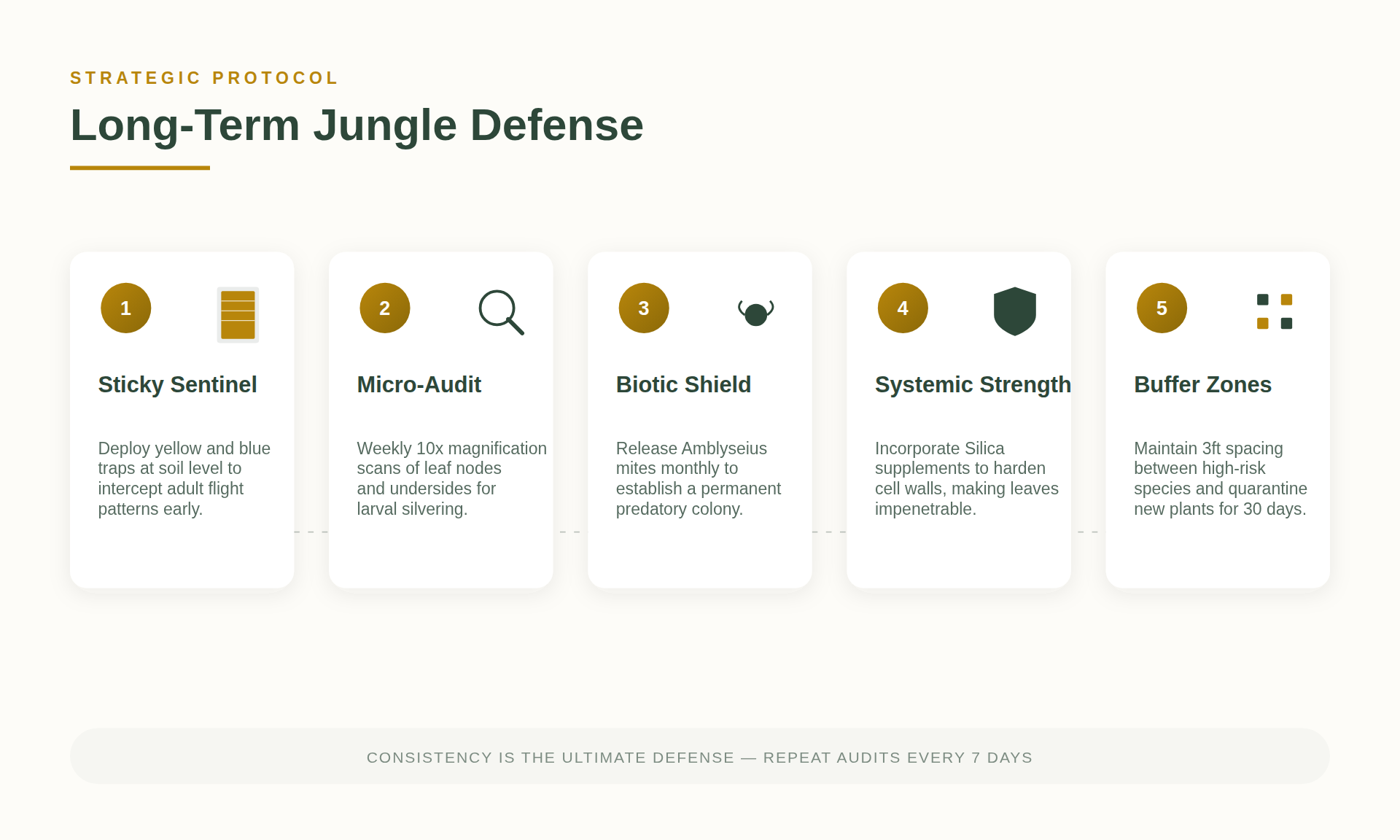
Identifying the ‘Silvering’
If you see a silvery, metallic sheen on your leaves, that’s not a cool new variegation. That’s “silvering,” caused by thrips sucking the chlorophyll out of the individual cells and replacing it with air. You’ll also see “frass”—tiny black dots of bug poop. If you see those black dots, the infestation is already advanced. Dealing with thrips on multiple houseplants is a marathon, not a sprint. It takes at least 6 to 8 weeks of consistent treatment to ensure you’ve broken the life cycle across all generations. It’s exhausting, it’s expensive, and it makes you want to throw your whole collection out the window and take up knitting. But when that new, pristine leaf finally unfurls on your Monstera—free of scars, free of silvering, and perfectly healthy—you’ll remember why we do this. Just keep the cat away from the blue traps; Barnaby once got one stuck to his tail, and that was a whole other kind of crisis.The Macro-ID Blueprint: Distinguishing Thrips from Look-Alike Pests
It’s 3:00 AM in Portland, the radiator in my loft is clanking like a possessed typewriter, and the hygrometer next to my desk is mocking me with a reading that basically means the air is as dry as a bone. This is “Thrips Weather.” While most collectors are worried about their Calatheas crisping up, I’m hunting. In this dry, stagnant indoor winter air, thrips don’t just arrive; they colonize. But before you go full scorched-earth with the chemicals, you have to know exactly what you’re looking at. I see too many people on Reddit freaking out over a bit of physiological edema or a stray grain of dust, nuking their plants for no reason, while the actual thrips are laughing in the crevices. Thrips are the ultimate ninjas of the insect world. Unlike the obvious webbing of spider mites or the fluffy white clumps of mealybugs, thrips hide their crimes in the very texture of the leaf. The primary indicator is what I call the “Silver Sheen.” Because thrips possess piercing-sucking mouthparts, they don’t just bite the leaf; they explode the individual plant cells and suck out the chlorophyll and cellular fluid. This leaves behind air-filled pockets that reflect light, creating a distinctive silvery or bronzed scarring. If you see a patch of leaf that looks like it’s been lightly sanded with metallic grit, stop what you’re doing.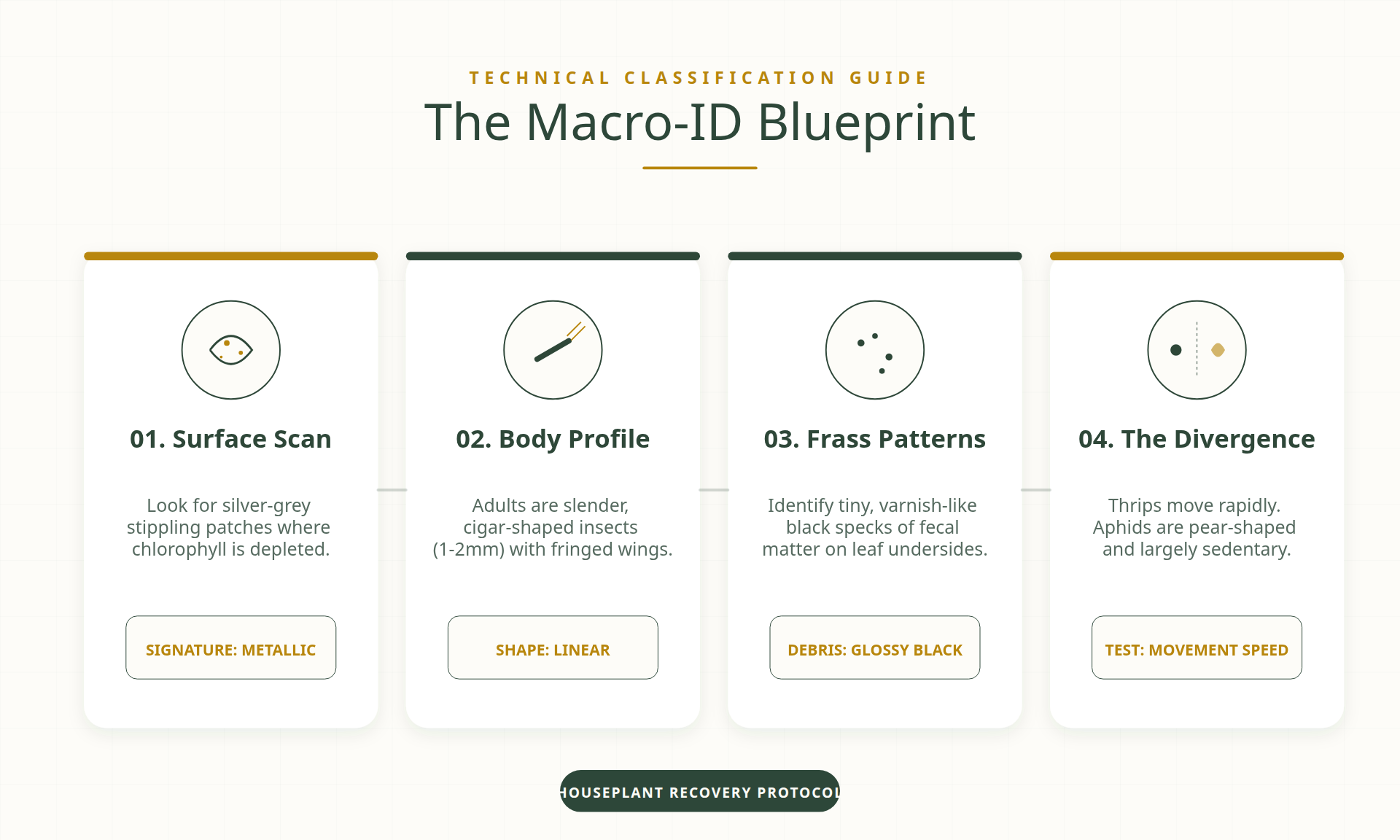
The Invisible Enemy: Why Surface Sprays Fail Against the Thrip Life Cycle
This is where my 2018 heartbreak comes back to haunt me. I thought I could just spray some Neem oil and call it a day. I was wrong. I lost a Monstera that was older than some of my friendships because I didn’t respect the thrip life cycle. To kill thrips, you have to understand that you are only ever seeing about 20% of the population at any given time. The rest are literally inside the plant or buried in the dirt. Let’s talk about the ovipositor. The female thrip has a saw-like organ she uses to slice into the soft tissue of your plant’s leaves and stems. She deposits her eggs *inside* the leaf. Think about that. No contact spray, no matter how expensive or “organic,” is going to touch an egg encased in leaf tissue. They are shielded by the plant’s own anatomy. These eggs have an incubation period that varies based on temperature—in my warm-ish Portland loft, they can hatch in as little as 3 to 5 days.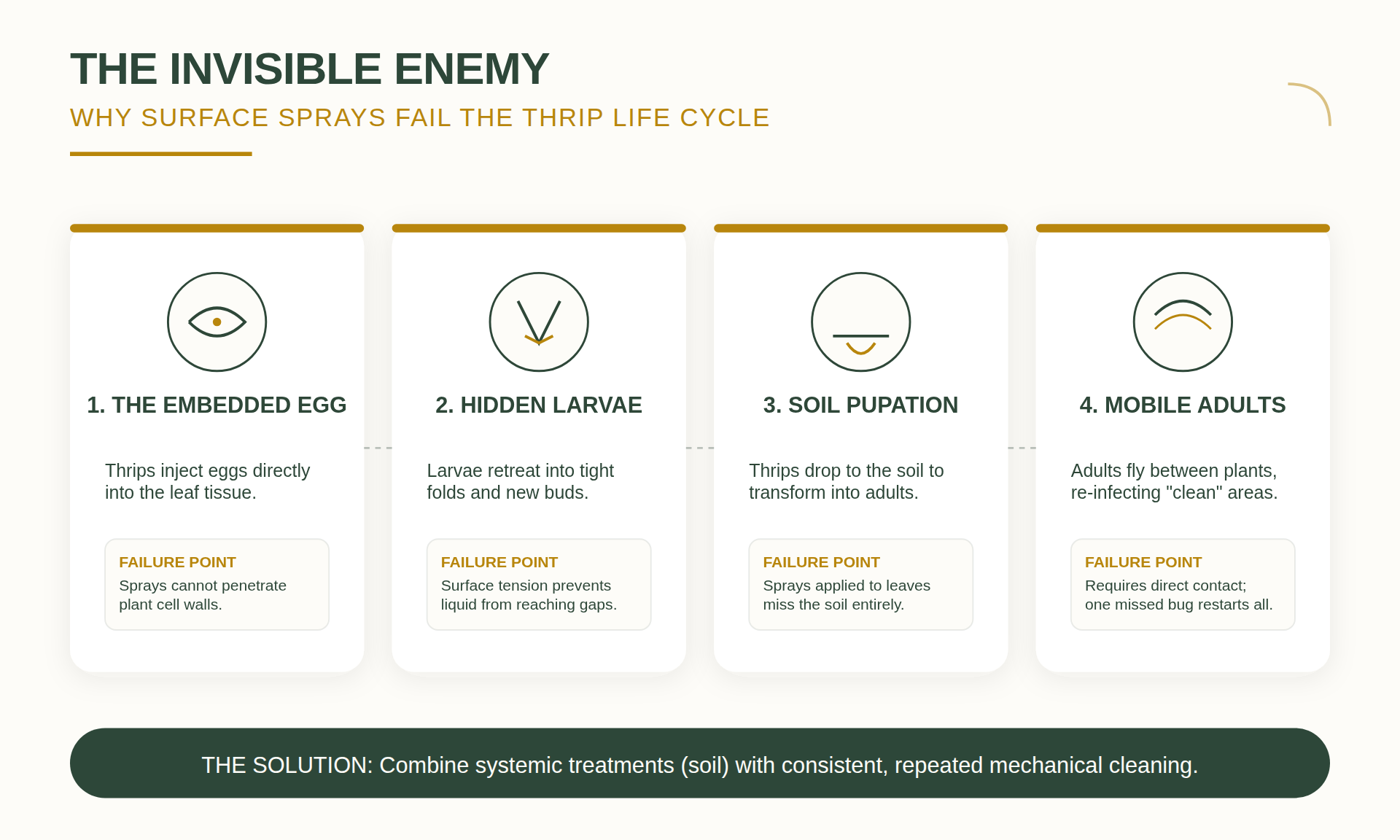
The aggressive Rotation: Using Spinosad and Systemics Without Resistance
If you’re dealing with a “Mass Casualty Incident”—and if you’ve found thrips on more than three plants, you are—it’s time to put away the dish soap. We need to talk about Integrated Pest Management (IPM) and the prevention of pesticide resistance. Thrips are notorious for evolving resistance to chemicals faster than almost any other pest. If you use the same spray every three days for a month, you aren’t killing them; you’re breeding “Super Thrips.” My “aggressive Rotation” relies on a two-pronged attack: Systemics and Spinosad.The Systemic Foundation
First, we use a systemic insecticide. You apply this to the soil. The plant absorbs the toxin through its roots and translocates it into the vascular system. Now, the plant itself is poisonous. When a thrip pierces a cell or a female tries to lay eggs, they ingest the toxin. This is your “always-on” defense. However, systemics take time to work—often 7 to 10 days to reach effective levels in the upper leaves.The Spinosad Strike
While the systemic is loading, we use Spinosad. Spinosad is a natural substance made by a soil bacterium, and it is the gold standard for thrips. It’s a nerve poison that works on contact and through ingestion. But here’s the Leo Vance rule: You spray Spinosad exactly twice, seven days apart. No more. If you keep spraying it, the survivors will develop an enzyme that breaks it down, rendering it useless for your entire collection forever. By rotating the systemic (which stays in the tissue) with a targeted Spinosad contact spray, you hit them from the inside and the outside. You catch the larvae as they feed and the adults as they emerge. This rotation disrupts their ability to adapt. During this winter dry spell, I’ve found that the systemic is especially vital because the plants are drinking more water to compensate for the radiator heat, which pulls the insecticide up into the canopy much faster than it would in the summer.Biological Warfare: Deploying Amblyseius Cucumeris in a Home Environment
Maybe you don’t want to turn your living room into a chemical lab. Or maybe, like me, you have a 14-year-old cat named Barnaby who thinks every dangling leaf is a snack. In that case, we go biological. Enter *Amblyseius cucumeris*. These are predatory mites. They are tiny, pear-shaped, and they live for one thing: eating thrip larvae. But hobbyists usually fail with biologicals because they treat them like a “set it and forget it” solution. Biological control agents are living creatures with specific environmental needs. If your loft is bone-dry, your *cucumeris* mites aren’t going to hunt; they’re going to die of thirst. To make *Amblyseius cucumeris* work in a dry winter, you have to create micro-climates. I use slow-release sachets—little paper bags that act as breeding colonies. I hang them deep in the foliage where the relative humidity is naturally higher. I also take a spray bottle and lightly mist the *stems* (not the leaves, we don’t want fungus) to give the mites a drink. These predators are most effective against the first-stage larvae—the tiny ones fresh out of the egg. They won’t touch the adults, which is why you still need to be diligent about mechanical control or using blue sticky traps to catch the flyers. If you go the biological route, you CANNOT use the Spinosad rotation mentioned above. Spinosad is broad-spectrum enough that it will wipe out your expensive predatory mites just as fast as the thrips. You have to pick a side: Chemical Warfare or Biological Warfare. Mixing them is just throwing money into the compost bin.The 14-Day Quarantine Exit Protocol: Preventing Re-Infestation
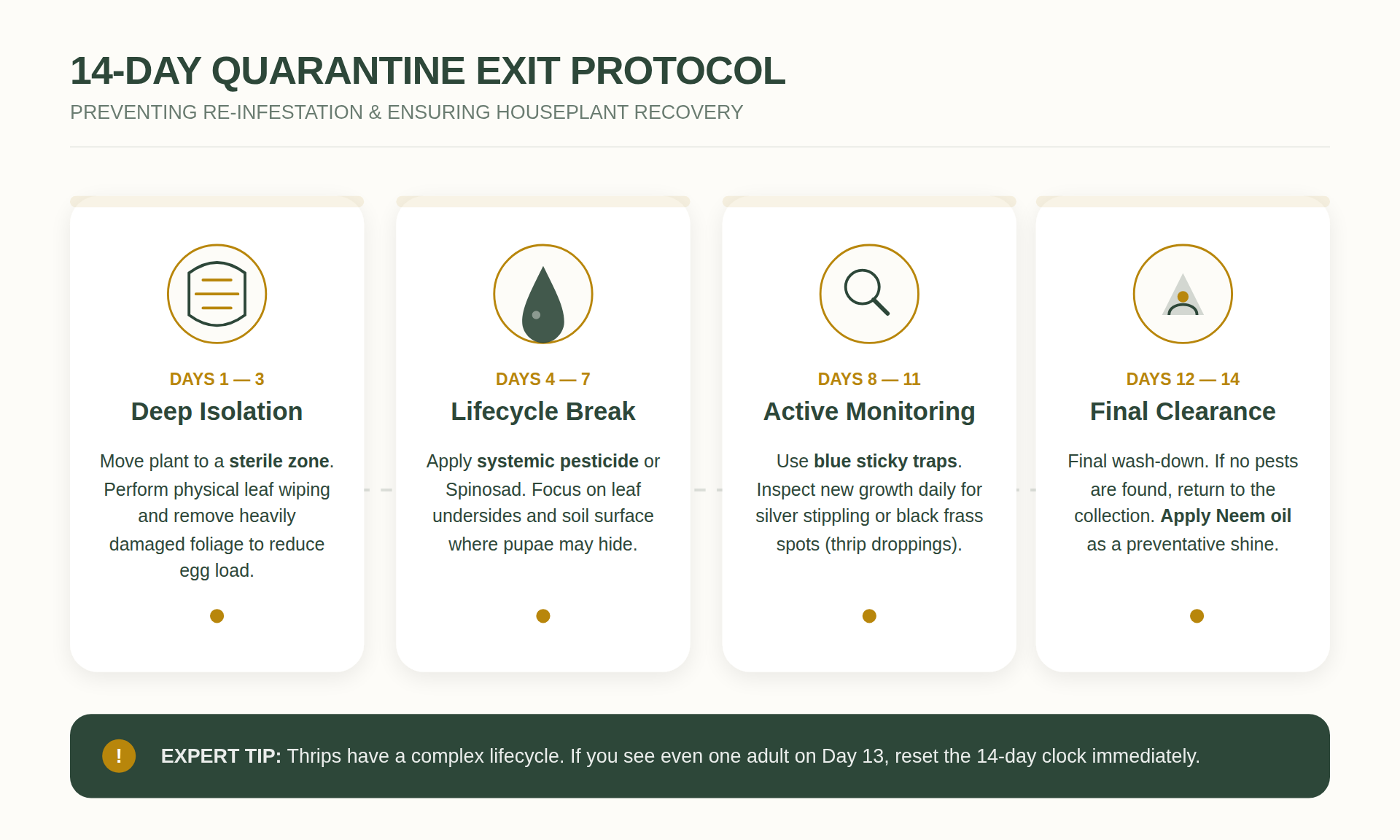
The biggest mistake people make is seeing no bugs for three days and moving the plant back to the “inner sanctum”—the main collection. This is how you lose everything. You must follow the 14-Day Rule. Why 14 days? Because that covers at least one and a half life cycles at average room temperature. It accounts for the eggs hidden in the tissue and the pupae chilling in the soil.