This article was researched and reviewed by Leo, an indoor plant specialist.
In low-humidity indoor environments during winter, *Monstera deliciosa* specimens often exhibit vertical growth that exceeds available space. When a Monstera reaches structural boundaries like ceilings or beams, the upper growth frequently becomes spindly. This indicates that the plant has reached the limit of its current support system and requires a structural intervention to maintain health and aesthetic density.Guide Overview
- The Hemi-Epiphyte Problem: Why Your Monstera Won’t Stop Climbing
- Breaking Apical Dominance: The Science of Bushier Growth
- The Surgical Cut: Identifying Nodes and Axillary Buds
- Finding the ‘Eye’
- Sterilization and Phytosanitary Standards for Pruning
- The Leo Vance Sanitization Protocol
- Propagating the Top: Turning Height into New Plants
- Water vs. Sphagnum Moss
- Post-Prune Recovery: Managing Light and Nutrients
- Winter Light Adjustments
The Hemi-Epiphyte Problem: Why Your Monstera Won’t Stop Climbing
*Monstera deliciosa* is classified as a hemi-epiphyte. This botanical classification describes a plant that begins its life cycle in the soil but eventually transitions to an epiphytic existence, utilizing host trees for vertical support. During the juvenile phase, these plants demonstrate negative skototropism. Unlike most phototropic plants that grow toward light, juvenile Monsteras grow toward shadows, which in a natural habitat signify the presence of a large tree trunk. Upon contact with a host, the plant utilizes aerial roots for attachment and climbs toward the canopy.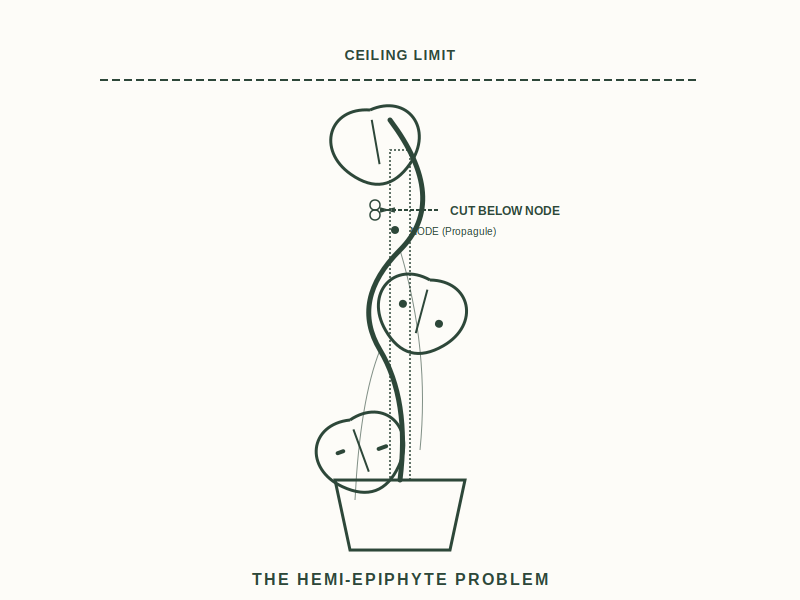
Breaking Apical Dominance: The Science of Bushier Growth
To achieve a denser growth habit, one must interrupt apical dominance. The terminal meristem, located at the apex of the plant, produces auxins. These hormones migrate downward through the stem tissue. High concentrations of auxins suppress the development of lateral buds, also known as axillary buds, located at each node. While the terminal meristem remains active, it sends chemical signals that maintain the dormancy of lower buds. Pruning the top of a Monstera removes the primary source of auxins. When the terminal meristem is removed, auxin levels in the remaining stem decrease significantly. This hormonal shift triggers the activation of dormant lateral buds. Metabolic energy is then redistributed to multiple points along the stem, resulting in a multi-stemmed, bushier architecture. This is a standard endocrinological response to the removal of the primary growth point.The Surgical Cut: Identifying Nodes and Axillary Buds
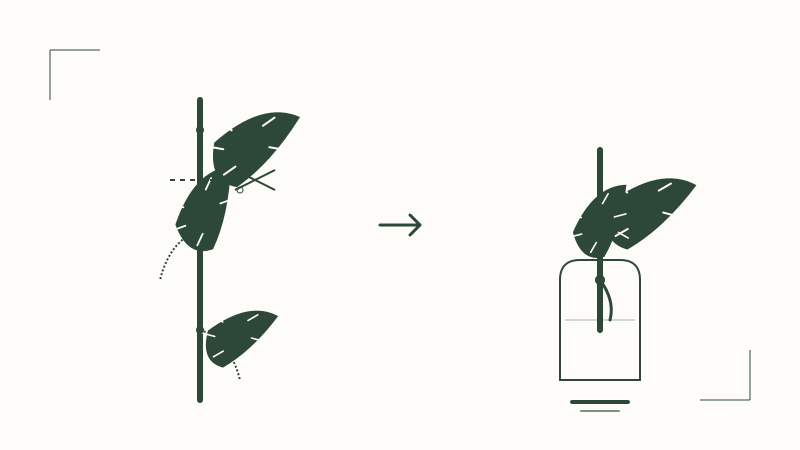
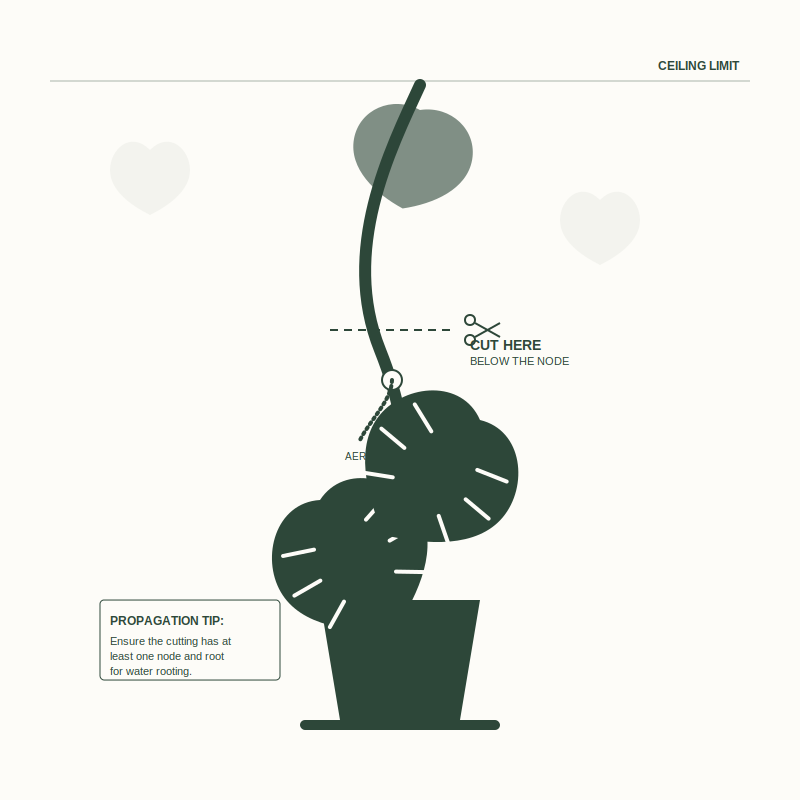
Precise cutting is required to ensure successful regrowth and propagation. Cutting through a petiole (leaf stem) or too close to a node can damage the growth point and prevent plant cuttings from rooting in water. Identify the nodes, which are the thickened, swollen sections of the main vine. Nodes contain the genetic material for leaves, aerial roots, and axillary buds. The section between nodes is the internode. A cutting must include at least one node to be viable; an internode section without a node will not produce new growth.Finding the ‘Eye’
The axillary bud, or “eye,” appears as a small, raised bump on the node. This is the site of future vegetative growth. When pruning, the cut should be made approximately one to two inches below the node of the section being removed.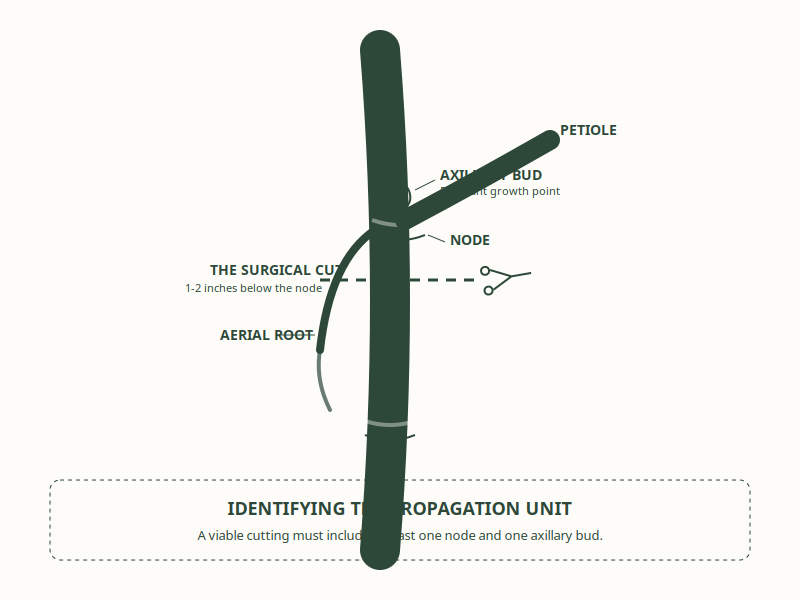
Sterilization and Phytosanitary Standards for Pruning
Using unsterilized tools introduces significant risk of infection. Pathogens such as *Fusarium* or *Pythium* can cause stem rot, leading to the rapid degradation of the plant’s vascular system. Pruning creates an open wound that is susceptible to bacterial and fungal colonization.The Leo Vance Sanitization Protocol
1. **Isopropyl Alcohol (70% or higher):** Thoroughly clean the blades. Mechanical scrubbing is necessary to remove organic debris. 2. **Heat Sterilization:** Passing the blade through a flame provides an additional layer of sterilization for sensitive or high-value specimens. 3. **Callus Formation:** Allow the wound to air-dry for two to four hours before placing the cutting in a medium or returning the parent plant to a high-humidity environment. The formation of a dry, woody callus acts as a barrier against pathogens and prevents overwatered snake plant style rot. A healthy cut will remain firm and eventually develop a brown, suberized surface. White or soft growth on the wound indicates localized infection.Propagating the Top: Turning Height into New Plants
The apical section of the plant contains high concentrations of growth hormones, making it an ideal candidate for propagation. During winter months, propagation requires adjustments for lower temperatures. Adding activated charcoal to water propagation vessels helps maintain water quality by reducing bacterial growth and managing stagnant conditions.