This article was researched and reviewed by Leo, our indoor plant specialist.
The Physics of Growth: Why ‘One Size Fits All’ Distance is a Myth
It is currently 4:15 PM in Portland, and the sky outside my loft is the color of a wet sidewalk. The sun has essentially clocked out for the season, leaving my botanical collection entirely dependent on the artificial suns I’ve bolted to my ceiling and shelving units. I’m sitting here with Barnaby—who is currently vibrating with a purr that sounds like a faulty compressor—watching the purple-white glow of my LED arrays. If there is one thing that boils my blood more than the memory of my 2018 monstera rot disaster, it’s the generic ‘hang your light 12-24 inches away’ advice you see on every cheap box of grow lights.
Guide Overview
- The Physics of Growth: Why ‘One Size Fits All’ Distance is a Myth
- The Photon Density Paradox
- LED vs. HID vs. Fluorescent: Calculating Heat and Intensity Gaps
- Thermal Radiation vs. Photon Pressure
- The Efficiency Trap
- The Variegated Monstera Rule: Distance for High-Value Foliage
- The Buffer Zone for Variegation
- Succulents and Echeveria: Preventing the ‘Leggy’ Basement Death Spiral
- Auxins and Elongation
- Visual Red Flags: How Your Plant Tells You the Light is Wrong
- The Diagnostic Checklist
- The Pro’s Toolkit: Using Lux Meters and PAR Apps for Precision
- The Smartphone Revolution
- Lux vs. PAR
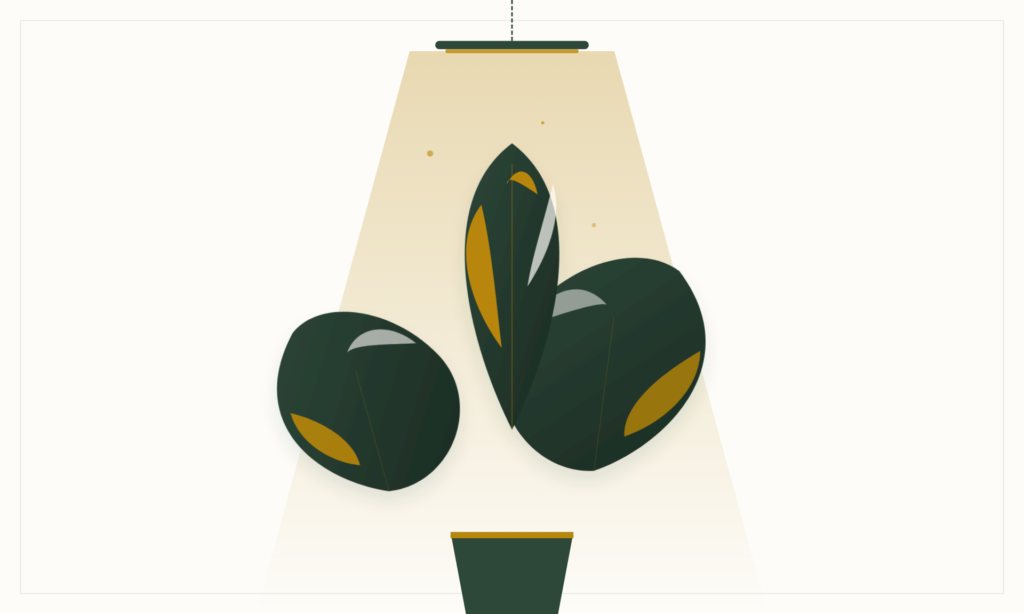
That advice is, quite frankly, dangerous. It’s the botanical equivalent of saying ‘everyone should wear a size medium shirt.’ It ignores the fundamental physics of light, specifically the Inverse Square Law. This isn’t just nerdy math; it’s the difference between a thriving Philodendron and a crispy, light-bleached mess. The Inverse Square Law states that the intensity of light changes in inverse proportion to the square of the distance from the source. If you double the distance between your light and your plant (say, moving it from 1 foot to 2 feet), the plant doesn’t get half the light. It gets one-fourth. Conversely, if you drop that light just a few inches closer, you aren’t just giving it a ‘little boost’—you are potentially quadrupling the photon bombardment on the leaf surface.
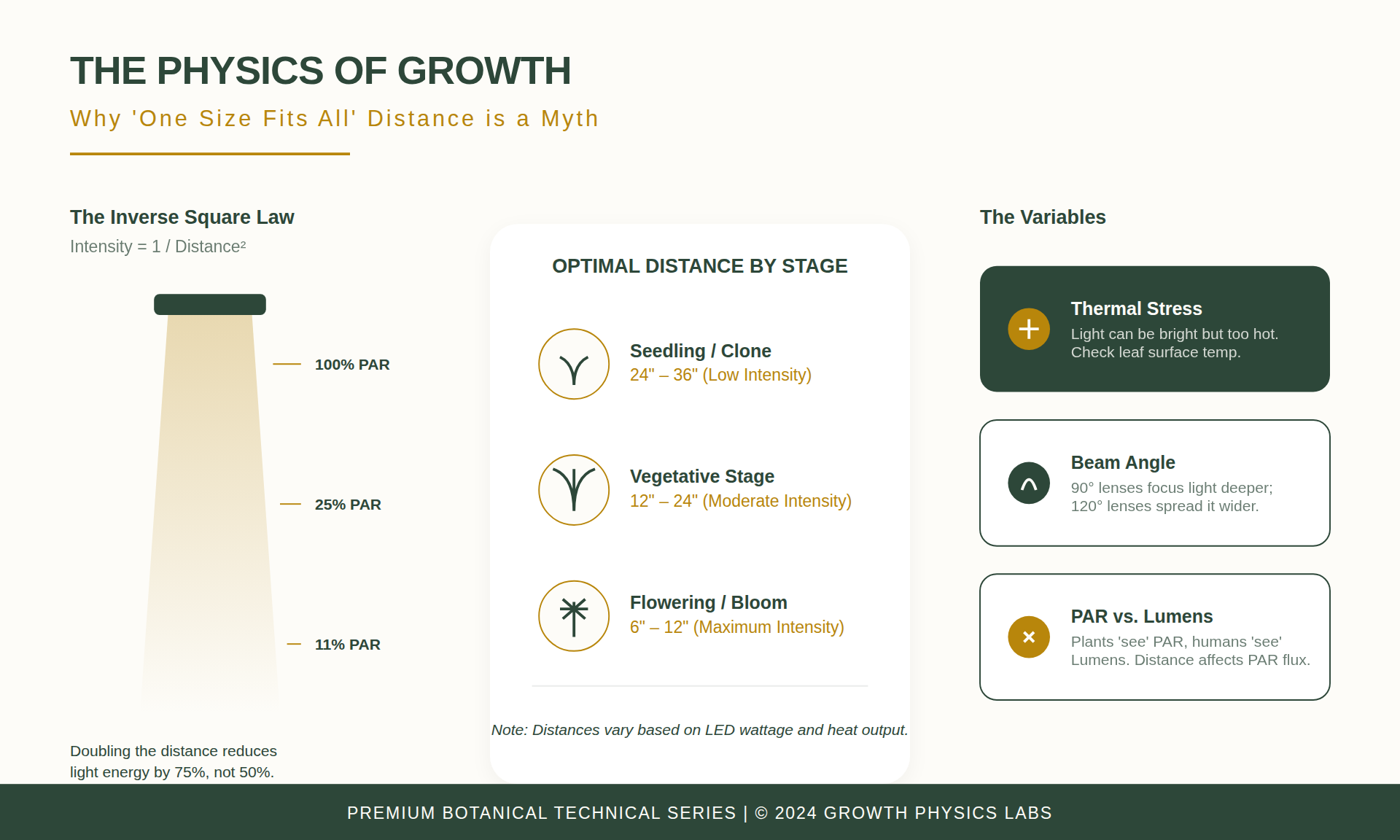
When we talk about light for plants, we aren’t talking about how ‘bright’ it looks to our human eyes. We care about Photosynthetic Photon Flux Density (PPFD). This measures the number of photosynthetically active photons that actually hit a given surface area each second. In the middle of this Portland winter, my plants are starving for these photons. But here’s the kicker: every species has a saturation point. If you push the PPFD too high by hanging a powerful light too close, you overwhelm the plant’s ability to process those photons. The Calvin cycle—the dark reaction of photosynthesis—can’t keep up with the light reaction. The result? Reactive oxygen species form, the cellular machinery breaks down, and you get ‘light burn’ or chlorosis. On the flip side, if the light is too far, the Daily Light Integral (DLI)—the total amount of light received over a 24-hour period—drops below the plant’s metabolic ‘break-even’ point. The plant then begins to consume its own stored sugars just to stay alive, leading to the slow, agonizing decline I see in so many ‘basement jungles.’
The Photon Density Paradox
Think of photons like raindrops. If you’re standing directly under a showerhead, you’re getting drenched. Step just two feet away, and suddenly you’re barely getting misted. Most hobbyist growers treat their lights like a campfire—something the plant just needs to be ‘near.’ In reality, you need to treat it like a targeted biological fuel source. During these short February days, I have to be even more meticulous. Because the ambient light from my windows is practically zero, the ‘fall-off’ at the edges of my grow light footprints is lethal. I’ve had to cluster my Hoya collection directly under the center of my COB LEDs because even six inches to the left results in a 40% drop in PPFD, which is enough to stall their winter growth entirely.
LED vs. HID vs. Fluorescent: Calculating Heat and Intensity Gaps
Back when I was curate-ing for the botanical gardens, we used old-school High-Pressure Sodium (HPS) and Metal Halide (MH) lamps. Those things were essentially space heaters that happened to emit light. If you put a plant within 18 inches of an HPS bulb, you’d essentially be sous-viding your foliage. The thermal radiation—the actual infrared heat—was as much of a factor as the light intensity.
Today, most of us in the collector community have switched to LEDs. But there’s a trap here. People think that because an LED feels ‘cool’ to the touch (or at least doesn’t radiate the searing heat of an HID), they can jam it right up against the leaves. This is a massive mistake. High-efficiency LEDs, especially COB (Chip on Board) LEDs and high-end quantum boards, are incredibly dense photon cannons. They might not burn the leaf with heat, but they will ‘bleach’ it with intensity.
Thermal Radiation vs. Photon Pressure
When you’re setting your distance, you have to diagnose which threat you’re managing. With T5 Fluorescents, the threat is almost non-existent; you can practically let the leaves touch the tubes because the light is so diffuse and the heat is so low. This is why I still use T5s for my delicate propagation trays where I’m rooting rare Aroid cuttings. But with my 300W full-spectrum LED, I have to maintain a ‘buffer zone.’
Light bleaching happens when the light intensity is so high that it destroys the chlorophyll faster than the plant can replace it. The leaf turns a ghostly white or pale yellow, but unlike a nutrient deficiency, it only happens on the parts of the plant directly facing the light. If you see your top leaves turning pale while the lower ones stay lush green, your light is too close, regardless of how ‘cool’ the fixture feels. In this dry Portland loft, the lack of humidity makes this even worse. Dry leaves are less resilient; their stomata often close to conserve moisture, which slows down the plant’s internal cooling system (transpiration). If the plant can’t transpire, it can’t shed the energy it’s absorbing, and that’s when the cellular damage accelerates.
The Efficiency Trap
I’ve seen a lot of people buy those cheap ‘blurple’ lights from big-box stores. They think because the light is dim to their eyes, they should move it closer. But those lights often have terrible spectrums and high ‘hot spots’ in the center. I always tell people: if you’re using a high-quality LED, start at 24 inches and move down an inch every few days. Watch the plant. Don’t be the person who cooks a $500 Anthillium because they wanted to ‘speed up’ growth in the middle of February.
The Variegated Monstera Rule: Distance for High-Value Foliage
Let’s talk about the ‘White Leaf Tax.’ I’m still bitter about my 2018 Monstera, but my current Thai Constellation is my pride and joy. Barnaby knows better than to go near it, though he did give it a suspicious sniff yesterday while I was cleaning the leaves. Variegated plants—especially those with high-contrast white sectors—are the divas of the plant world.
From a biological standpoint, those white sectors are parasitic. They contain no chlorophyll, meaning they cannot perform photosynthesis. They rely entirely on the green parts of the leaf to feed them. This creates a precarious balancing act for light distance. If the light is too far away, the green parts can’t produce enough excess energy to support the white parts, and the white sectors will ‘melt’ or turn brown (necrosis) as the plant sacrifices them to survive. However, if the light is too close, the white sectors—which lack the protective pigments like anthocyanins that often help green tissue buffer against light—will scorch almost instantly.
The Buffer Zone for Variegation
For my variegated Aroids, I implement what I call the ‘1.5x Rule.’ Whatever distance I would normally keep a solid green Monstera Deliciosa from the light, I increase that by 50% for my variegated specimens. If the green one is happy at 18 inches, the variegated one stays at 27 inches. You are looking for ‘indirect bright light,’ even when it’s artificial.
I’ve seen those Reddit threads where someone scores a variegated Monstera at a big-box store and then fries it under a shop light within a week. It’s unfortunate. The white tissue is structurally weaker and much more prone to leaf scorch. During these dry winter months in the loft, the risk is even higher. I keep a dedicated humidifier pointed toward my variegated shelf specifically to keep the dew point high enough that those white sectors don’t desiccate under the grow lights. If you see the edges of your variegation turning crispy and brown while the soil is still moist, your light distance is likely the culprit, not your watering schedule.
Succulents and Echeveria: Preventing the ‘Leggy’ Basement Death Spiral
If Aroids are the divas, succulents are the sun-worshippers that never think it’s bright enough. This is where most indoor gardeners fail. They put an Echeveria on a shelf 18 inches below a weak LED and wonder why, two weeks later, it looks like a pale, stretched-out pine tree. This process is called etiolation, and it is the plant’s desperate, last-ditch effort to find a light source before it runs out of energy.
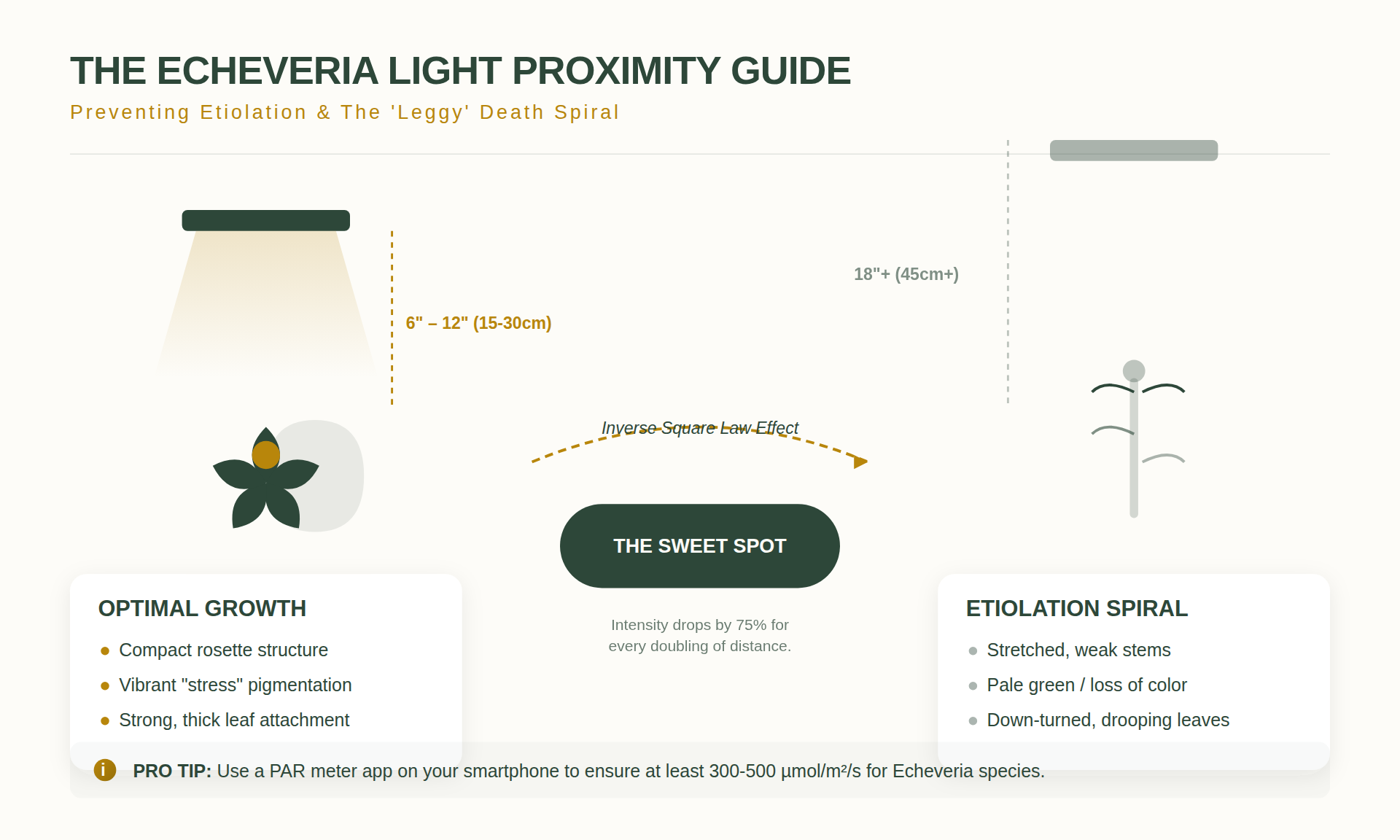
Succulents are evolutionarily designed for ‘Full Sun Equivalent’ light. In their native habitats, they are bombarded with thousands of micromoles of light. When we bring them into a Portland basement or a dim loft in February, we are essentially putting them in a sensory deprivation tank. To grow a compact, vibrant Echeveria indoors, you need your lights close. We’re talking 6 to 10 inches, depending on the wattage.
Auxins and Elongation
When a succulent doesn’t get enough light, its internal hormones—specifically auxins—concentrate in the shaded side of the stem or the growing tip, causing cells to elongate rapidly. This is why the plant ‘stretches.’ Once a plant has etiolated, you can’t ‘fix’ it. You can give it better light to stop the stretching, but that long, weak neck will stay there forever until you behead it and start over.
I’ve turned my small guest bathroom into a ‘succulent nursery’ for the winter, and the light intensity in there is blinding. I’m running high-output T5s just 4 inches above the rosettes. This is the only way to maintain those deep purples and reds. Those colors are actually a stress response—the plant producing pigments to protect itself from high light. If your succulent turns plain green, it’s telling you it’s hungry for more photons. If it starts to lean, it’s literally reaching for the light. Move the light closer, or better yet, get a stronger light. In the succulent world, there is almost no such thing as ‘too close’ with standard consumer LEDs, provided you have enough airflow to manage the heat.
Visual Red Flags: How Your Plant Tells You the Light is Wrong
I’m a big believer in ‘Diagnostic Thursdays.’ Every Thursday, I do a slow walk-through of the loft, checking every leaf. This is where you have to play detective. Is that yellowing leaf a sign of overwatering, a nutrient deficiency, or a light distance issue?
One of the most common mistakes I see (and I saw a lot of this house-sitting for a friend last month) is misdiagnosing spider mites for light stress. Spider mites cause a fine ‘stippling’—tiny white or yellow dots across the leaf. Light burn, however, usually looks like a broad, bleached patch or a localized ‘tan’ on the highest points of the plant.
The Diagnostic Checklist
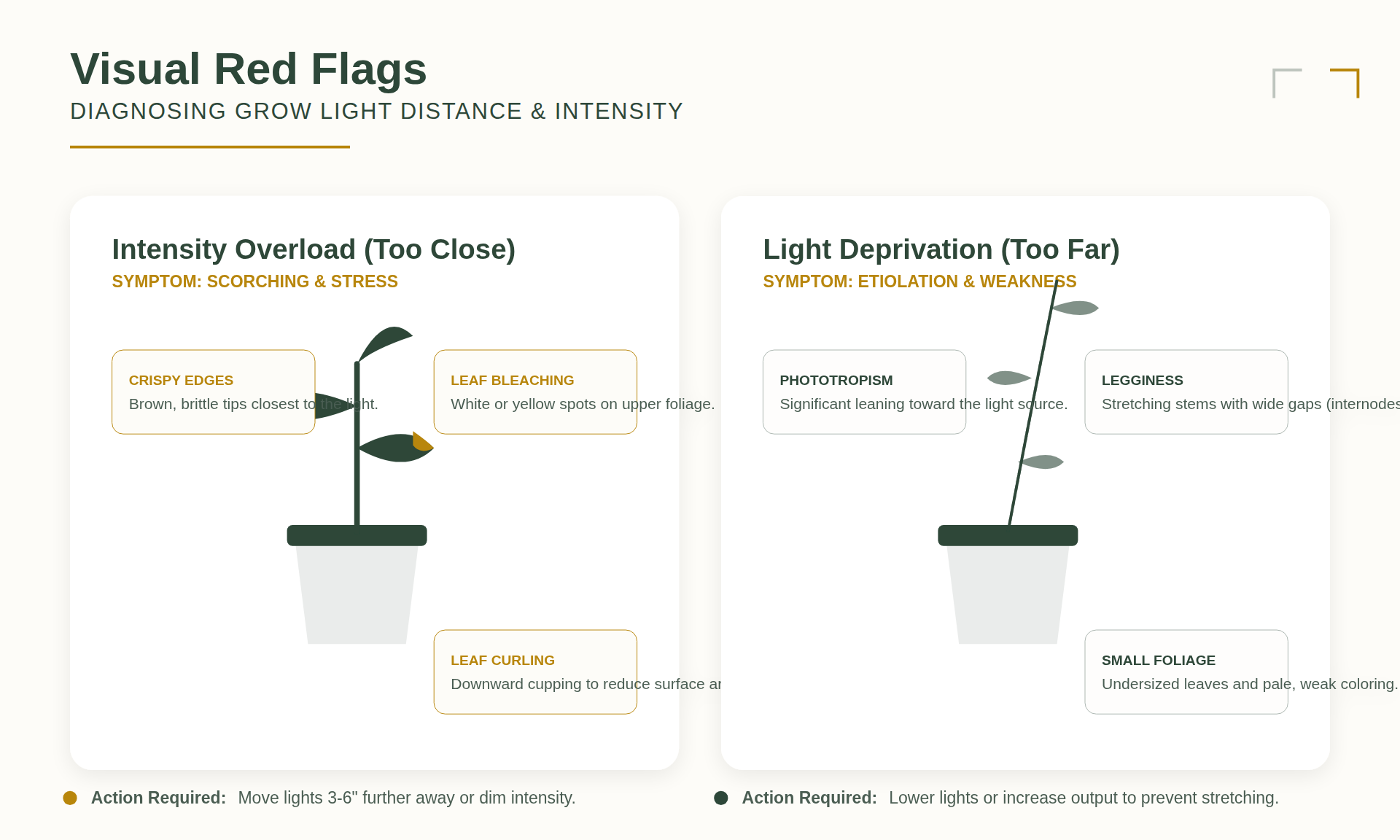
Here is my mental framework for diagnosing light distance issues during my winter rounds:
- Internodal Spacing: Look at the distance between the leaves on the stem. If the plant looks ‘leggy’ or has long gaps of bare stem, the light is too far away. The plant is hunting for photons.
- Leaf Orientation: Some plants, like Calatheas or Marantas, will actually fold their leaves up or down to hide from too much light. If your ‘prayer plant’ is staying folded during the day, your light is too close. It’s trying to reduce its surface area to avoid damage.
- Chlorosis vs. Bleaching: If the whole leaf is turning yellow but the veins stay green, that’s usually a nutrient issue (magnesium or iron). If the part of the leaf closest to the light is turning white or crispy brown while the rest of the leaf is green, that’s a light distance issue.
- The ‘Weight Method’ for Water/Light Balance: Remember that more light equals more thirst. If you move your lights closer, your plant’s metabolic rate increases, and it will dry out faster. I use the ‘Weight Method’—lifting the pot to feel its heft—to make sure I’m not letting them go bone-dry now that I’ve cranked the LEDs for the winter.
The Pro’s Toolkit: Using Lux Meters and PAR Apps for Precision
Stop guessing. Seriously. I spent years eyeing my light setups, and I was wrong about 40% of the time. Our eyes are terrible at measuring light because our pupils dilate and contract to make everything look ‘fine.’ A room that looks bright to you might be a dark cave to a Fiddle Leaf Fig.
To get serious, you need to measure micromoles (µmol/m²/s). For a long time, this required a $500 PAR meter (a quantum sensor), which was out of reach for most hobbyists. But things have changed.
The Smartphone Revolution
I now use the Photone app on my iPhone. It’s not as perfect as a laboratory-grade Apogee sensor, but it’s remarkably accurate if you use a paper diffuser over the camera. It allows you to measure PAR/PPFD directly. When I’m setting up a new plant in the loft, I don’t guess the distance. I hold my phone at the leaf level and adjust the light until I hit the target number.
- Low Light (Pothos, snake plants): 50-100 µmol/m²/s
- Medium Light (Monsteras, Philodendrons): 150-300 µmol/m²/s
- High Light (Hoyas, Ficus lyrata): 400-600 µmol/m²/s
- Very High Light (Succulents, Citrus): 600-1000+ µmol/m²/s
Lux vs. PAR
You might see people using cheap Lux meters. Lux measures brightness for humans (weighted toward green light), whereas PAR measures the light plants actually use (blue and red). While you can convert Lux to PAR using a conversion factor (usually dividing Lux by about 50-70 for LEDs), it’s an extra step you don’t need to take anymore.
Setting the correct grow light distance is the single most impactful thing you can do for your indoor jungle this winter. Don’t let the gray Portland skies—or wherever you are—dictate your plants’ health. Get the light close enough to matter, but far enough to respect the biology of the leaf. And for heaven’s sake, keep an eye on your cat. Barnaby just knocked my moisture meter off the shelf, so I think that’s my cue to stop typing and go play. Keep growing.
This article was researched and reviewed by Leo, our indoor plant specialist.
The Inverse Square Law: Why Your 12-Inch Gap is Killing Growth
It’s currently 4:00 PM in Portland, and the sky is a shade of bruised-plum grey that makes me want to crawl into a sensory deprivation tank. My radiator is clanking like a Victorian ghost, and the humidity in my loft has dropped to a bone-dry 28%. This is the season where light—actual, usable, high-energy light—becomes the most precious commodity in my life, second only to Barnaby’s favorite brand of salmon-flavored treats.
Guide Overview
- The Inverse Square Law: Why Your 12-Inch Gap is Killing Growth
- The Geometry of Photon Decay
- PAR vs. Lumens: Measuring What Your Plants Actually Consume
- The PPFD Deep Dive
- The Variegation Tax: Positioning for Thai Constellation and Albo Varieties
- Balancing Intensity with Tissue Damage
- Ending Etiolation: Stop Your Succulents from Stretching
- Internodal Spacing and Anthocyanins
- Thermal Stress Management: Avoiding the Leaf-to-Air Gradient Trap
- The Stomatal Deadlock
- Footprint vs. Intensity: The Geometry of a Basement Jungle
- Maximizing the Uniformity Ratio
- The 16-Hour Rule: Why Constant Light is a Growth Killer
- Photoperiodism and Stress
I see it every single day on Reddit: someone posts a photo of their ‘low-light’ corner where a monstera is slowly stretching its neck like a desperate swan, and the owner is baffled because they have a grow light ‘nearby.’ Listen, ‘nearby’ is a word for neighbors, not for photons. If you aren’t calculating the Inverse Square Law, you aren’t growing plants; you’re just giving them a decorative nightlight while they slowly starve to death.
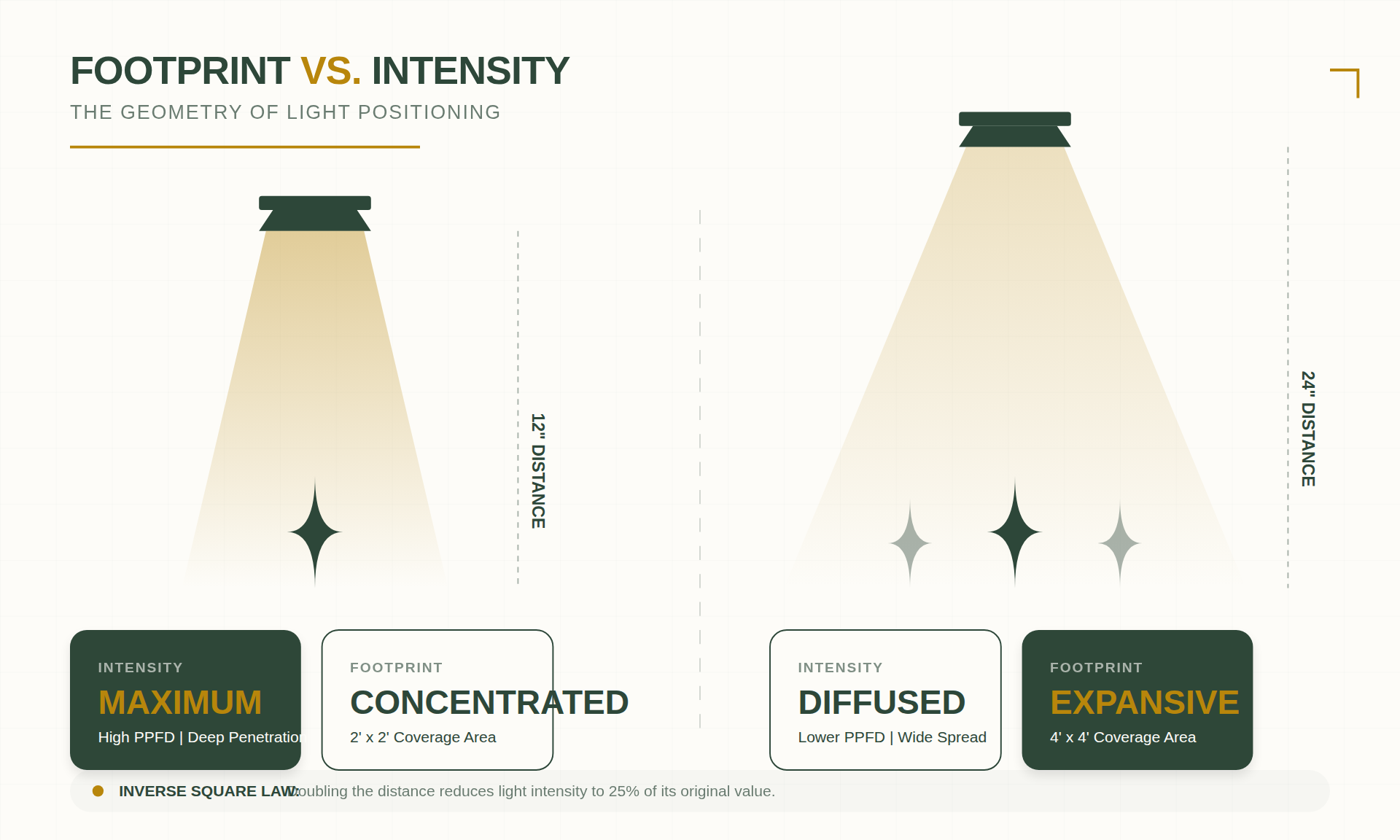
The Inverse Square Law is the most severe piece of physics an indoor gardener has to face. In its simplest form, it states that the intensity of light is inversely proportional to the square of the distance from the source. If you double the distance between your LED and your plant, you don’t just lose half the light. You lose three-quarters of it. You’re left with a pathetic 25% of the original intensity.
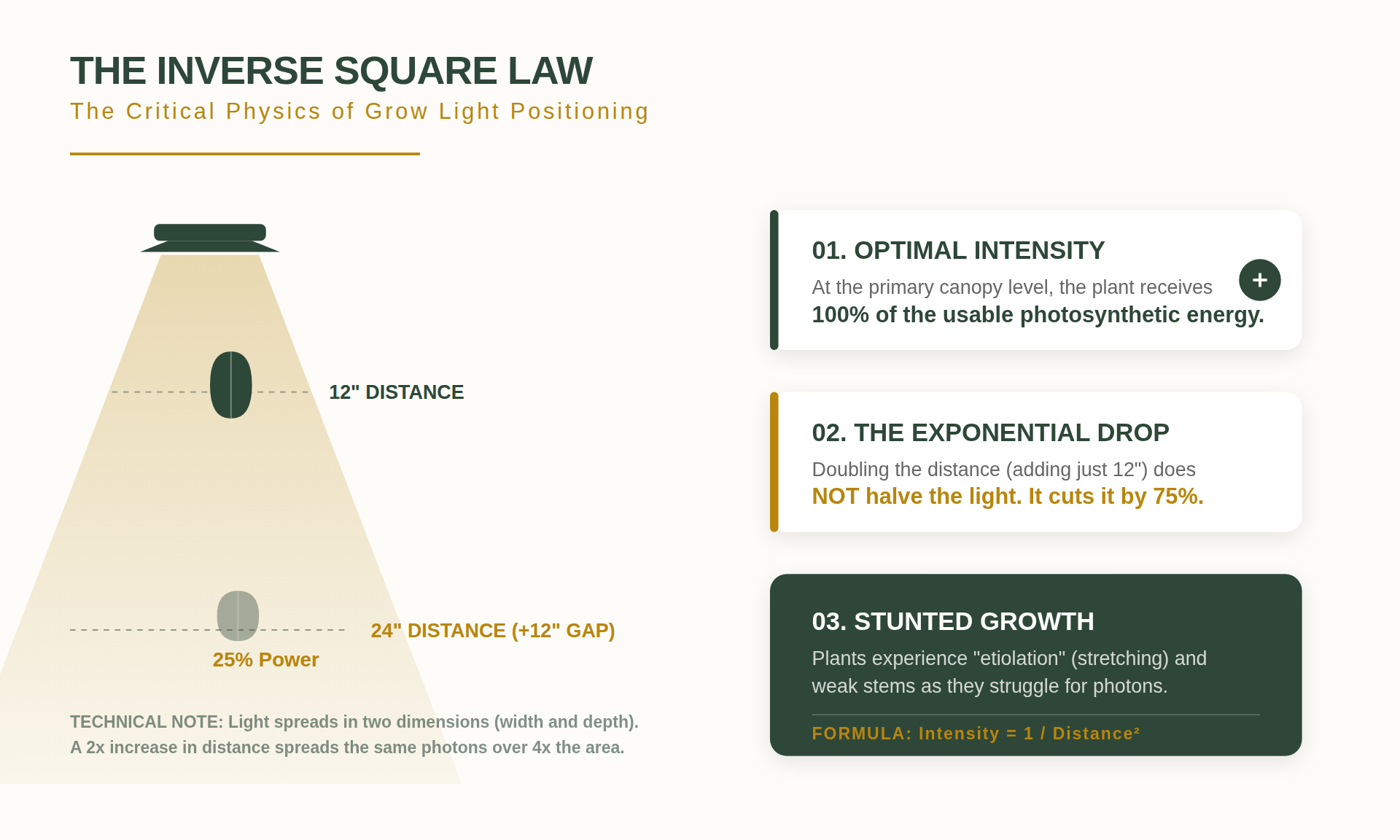
When I see someone hanging a 100W equivalent LED bulb three feet above a succulent, I want to scream. By the time those photons travel through three feet of dry Portland air, they’ve scattered and decayed to the point of being functionally invisible to the plant’s chloroplasts. In 2018, before I knew better, I lost a prized Monstera Deliciosa—the one that started it all—not just to the abysmal big-box soil it came in, but because I thought a ‘bright’ room was enough. I was eyeballing it. I was wrong. Light follows the laws of geometry, and geometry doesn’t care about your aesthetic preferences for high ceilings. If you move your light from 6 inches to 12 inches away from the canopy, you have effectively nuked your plant’s energy budget.
The Geometry of Photon Decay
Think of light as a spray of water from a nozzle. Close up, the pressure is enough to strip paint. Move back just a few steps, and it’s a gentle mist. For a plant, that ‘pressure’ is what drives the light-dependent reactions of photosynthesis. When you increase the distance, you are asking the plant to perform the same metabolic miracles with a fraction of the fuel. This is why my spiderettes near the radiator are currently looking a bit peaked; even though they’re under lights, I moved the shelf back two inches to clear the heater, and that tiny shift was enough to trigger a noticeable drop in their vigor.
PAR vs. Lumens: Measuring What Your Plants Actually Consume
One of my biggest pet peeves as a former curator is the obsession with ‘Lumens.’ If I hear one more person tell me their grow light is ‘super bright,’ I might actually lose my mind. Lumens are a metric designed for human eyes. Evolutionarily, our eyes are most sensitive to green and yellow light—the stuff that plants actually reflect (which is why they look green to us). Using a lumen meter to measure grow light effectiveness is like trying to measure how much a cat likes its food by weighing the bowl. It tells you something, but it’s the wrong metric entirely.
Plants care about PAR: Photosynthetically Active Radiation. Specifically, the 400 to 700 nanometer waveband. This is the spectrum where the magic happens. Inside those leaves, chlorophyll $a$ and $b$ are waiting for specific wavelengths to kickstart the electron transport chain. They don’t give a damn if the room looks ‘bright’ to you while you’re drinking your morning coffee.
The PPFD Deep Dive
To really understand positioning, you have to talk about PPFD—Photosynthetic Photon Flux Density. This is the measure of how many micromoles of photons are actually hitting a square meter of your leaf surface every second ($\mu mol/m^2/s$). When I’m in my loft during these dark winters, I’m not looking at my plants with my eyes; I’m looking at them through my quantum sensor.
A high-quality spectroradiometer will show you that a cheap ‘blurple’ light might have a high lumen count but an abysmal PPFD at 12 inches. Conversely, a high-output white LED might look softer to us but be delivering a concentrated stream of 600 $\mu mol/m^2/s$ directly to the meristem. If you’re serious about this, stop using the light meter app on your phone. It’s calibrated for photography, not for the complex absorption peaks of a Thai Constellation.
The Variegation Tax: Positioning for Thai Constellation and Albo Varieties
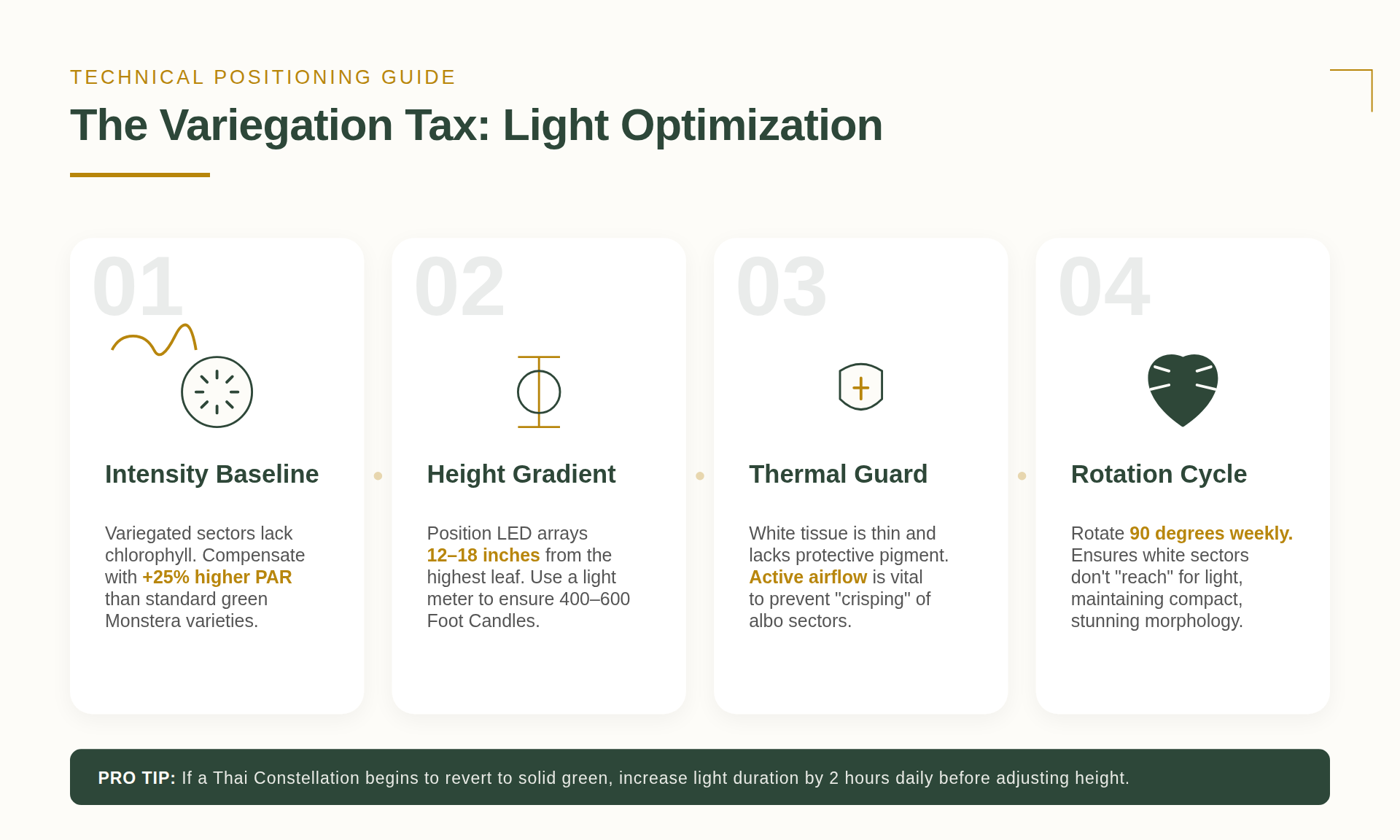
Let’s talk about the ‘Variegation Tax.’ This is the biological reality that makes owning a Monstera Thai Constellation or a Philodendron Albo a high-stakes game of light management. Every white patch on those leaves is a metabolic dead zone. Those cells lack chlorophyll. They are essentially ‘freeloaders’ that the green parts of the plant have to support through cellular respiration.
Because variegated plants have less photosynthetic surface area, they need significantly higher light intensity to produce the same amount of energy as their solid green cousins. If you position your light too far away, the green sections can’t keep up with the energy demands of the entire leaf. The result? The plant starts a process of programmed cell death in the white areas to save itself. This is why your beautiful Albo leaves turn brown and ‘melt’ at the edges. It’s not always a humidity issue (though Portland’s dry heat doesn’t help); it’s often a literal energy crisis.
Balancing Intensity with Tissue Damage
I keep my Thai Constellation exactly three feet away from a high-output ultrasonic humidifier, but more importantly, I keep its grow light positioned to deliver roughly 400-500 PPFD to the variegated sections. However, there is a catch. Because the white tissue lacks the protective pigments found in green tissue, it’s more prone to photo-oxidation—basically, a plant sunburn. You have to find the ‘Goldilocks zone’ where the light is intense enough to fuel the green cells but not so close that the radiant heat or high-energy photons cook the white cells. It’s a delicate dance I perform every winter morning, adjusting the ratchets on my light hangers as the new leaves unfurl.
Ending Etiolation: Stop Your Succulents from Stretching
There is nothing that breaks my heart quite like a ‘leggy’ Echeveria. You know the look: instead of a tight, beautiful rosette that looks like a stone flower, it starts to stretch upward, showing huge gaps of naked stem between the leaves. This is etiolation. It is the plant’s desperate, last-ditch effort to find a light source before it runs out of stored sugars.
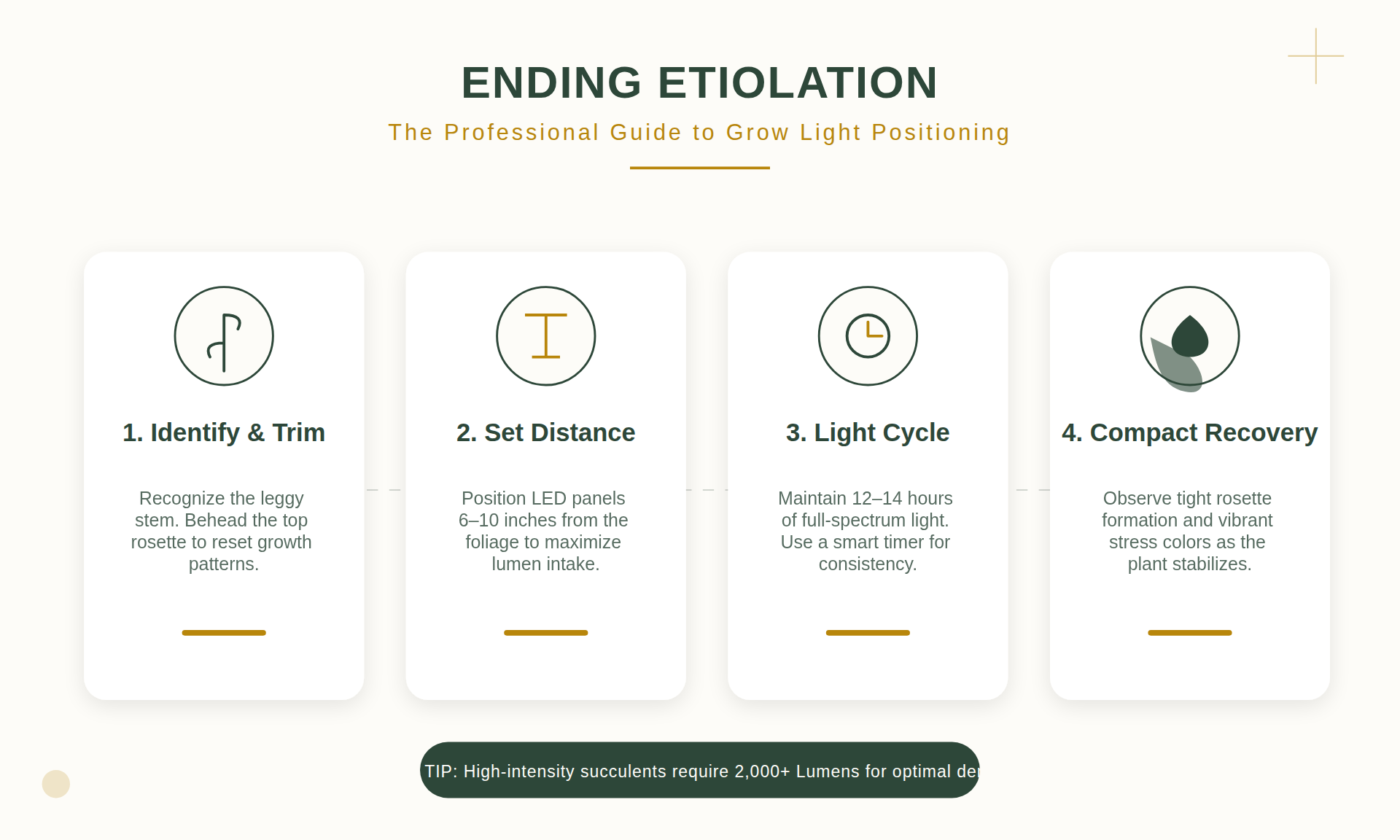
Succulents are high-light addicts. They evolved in environments where the sun is an oppressive, unrelenting force. When we bring them into our cozy, dim lofts, we are essentially putting them in a sensory deprivation tank. To keep an Echeveria compact, you need light levels that would make a Calathea burst into flames. We’re talking 600 to 1,000 PPFD.
Internodal Spacing and Anthocyanins
When the light positioning is correct—usually meaning the LED is just 4 to 8 inches above the plant—the internodal spacing (the distance between leaves) remains tight. This is governed by a blue-light response that inhibits stem elongation. Furthermore, high light intensity triggers the production of anthocyanins. These are the pigments responsible for those ‘stress colors’—the pinks, purples, and deep reds that succulent collectors crave. If your succulent is turning plain green, it’s telling you that the light is too far away. It’s clearing out the ‘sunscreen’ (anthocyanins) to try and absorb every single stray photon it can find. During these Portland winters, I have to keep my succulents on a dedicated shelf with lights so close they almost touch the tips, just to maintain that compact geometry.
Thermal Stress Management: Avoiding the Leaf-to-Air Gradient Trap
One of the most dangerous myths in the hobby is that LEDs don’t produce heat. While they are significantly cooler than old-school HID lights, they still generate heat, and more importantly, they change the ‘leaf-to-air temperature gradient.’ This is a technical way of saying the leaf gets warmer than the air around it.
When a leaf gets too warm because the grow light is positioned too close, the plant reacts by closing its stomata—the tiny pores on the underside of the leaf. It does this to prevent excessive transpiration (water loss). But there’s a massive downside: when the stomata close, the plant can no longer take in $CO_2$. Without $CO_2$, photosynthesis stops dead in its tracks, no matter how much light you’re blasting it with.
The Stomatal Deadlock
I’ve seen collectors wonder why their plants are ‘stalled’ despite having top-tier lights. Often, the light is so close that the leaf surface temperature is hitting 85-90°F while the room is 65°F. This creates a massive vapor pressure deficit (VPD) issue. The plant is essentially holding its breath. To avoid this, you need to ensure convective cooling—basically, a small fan that breaks up the boundary layer of air around the leaf. In my loft, I have a small oscillating fan that runs 24/7 during the winter. It prevents that stagnant, hot air from building up under the LED panels, allowing me to keep the lights closer without triggering a stomatal shutdown.
Footprint vs. Intensity: The Geometry of a Basement Jungle
If you’re lucky enough to have a ‘basement jungle’ or a dedicated plant room, you have to deal with the geometry of the ‘light footprint.’ Every light has a beam angle—usually between 60 and 120 degrees. The closer you move the light to the plant, the more intense the light is, but the smaller the ‘footprint’ (the area covered) becomes.
This is where people get into trouble. They move the light closer to help one struggling plant, and in doing so, they cast three other plants into the shadows. It’s a zero-sum game unless you understand overlapping coverage.
Maximizing the Uniformity Ratio
In a professional setting, we aim for a high ‘uniformity ratio.’ You don’t want a ‘hot spot’ in the middle and darkness at the edges. To achieve this in a home setup, you’re better off using multiple lower-wattage lights spaced out rather than one massive ‘sun’ in the center of the room. I also use reflective surfaces—not those tacky Mylar blankets that make your loft look like a survivalist bunker, but simply painting the walls a matte white. White paint has a surprisingly high reflectivity (often over 85%) and helps bounce those stray photons back into the ‘edge’ plants that are outside the primary footprint. Barnaby hates the extra brightness, usually retreating to his cat tree in the one dark corner I have left, but the plants love the diffuse light.
The 16-Hour Rule: Why Constant Light is a Growth Killer
Finally, we have to talk about the ‘dark period.’ I’ve met some obsessive collectors who think that if 12 hours of light is good, 24 hours must be twice as good. This is a fast track to killing your collection. Plants are not machines; they are biological organisms with circadian rhythms, just like us.
During the day, the plant is in ‘production mode,’ building up stores of ATP and NADPH through photosynthesis. But the ‘construction’ happens at night. This is when the plant engages in respiration, breaking down those sugars to build new cell walls, roots, and leaves. If you never turn the lights off, you disrupt the plant’s photomorphogenesis—the way light affects its growth and development.
Photoperiodism and Stress
Leaving lights on 24/7 puts the plant in a state of perpetual oxidative stress. It never gets a chance to ‘reset.’ Most tropical plants (the stuff we collectors obsess over) thrive on a 12-to-16-hour light cycle. In the winter, I lean toward 16 hours to compensate for the lack of any meaningful natural light from my north-facing windows. But at 10:00 PM, the timers click off. The loft goes dark. This gives the plants time to move the photosynthates from the leaves down to the roots. It’s also the only time Barnaby stops squinting at the grow lights and finally settles down on my lap. Respect the dark; it’s just as important as the light for long-term health.
I’m still bitter about that 2018 Monstera, but every time I check the PPFD on my current collection and see those tight internodes and vibrant variegation, I know I’ve finally learned the lesson: light positioning isn’t just about where the lamp looks good. It’s about the physics of energy and the biology of survival.