This article was researched and reviewed by Leo, an indoor plant specialist.
Maintaining a Monstera deliciosa in an indoor environment requires an understanding of structural support and gravitational forces. In high-humidity, high-light environments, such as commercial nurseries in tropical climates, plants develop denser tissues and more robust stems. In indoor settings with lower humidity and inconsistent light, plants often exhibit reduced structural integrity. This leads to leaning, lodging, or horizontal growth patterns. Providing external support is necessary to maintain vertical orientation and prevent stem failure on indoor surfaces.
Guide Overview
- Structural Assessment: Identifying Causes of Plant Lean
- Phototropism: Auxin Distribution and Light Orientation
- Etiolation and Secondary Growth Deficiencies
- Mechanical Loading in Hemiepiphytic Species
- Substrate Stability and Root System Integrity
- Selecting Support Hardware: Moss Poles, Trellises, and Stakes
- Sphagnum Moss Poles for Epiphytic Climbers
- Bamboo and Hardwood Stakes for Arborescent Plants
- Metal Trellises for Vining Species
- Decomposition Risks and Pest Management
- The Root-Safe Installation Protocol
- Identifying the Anchor Point
- Bypassing the Primary Root Mass
- Container Stabilization Techniques
- Substrate Compaction for Stability
- Bracing Techniques: Preventing Vascular Constriction
- The Figure-Eight Tension Method
- Comparative Analysis of Binding Materials
- Placement Strategy: Nodal vs. Internodal Attachment
- Accommodating Secondary Growth and Lignification
- Species-Specific Support Strategies
- Monstera Deliciosa: Petiole Management
- Pothos and Philodendron: Vertical Training
- Ficus Lyrata: Trunk Reinforcement
- Dracaena Trifasciata: Grouping Methods
- Maintenance and Long-Term Structural Correction
- Rotation for Growth Uniformity
- Periodic Adjustment of Bindings
- Facilitating Aerial Root Integration
- Criteria for Support Upgrades
Staking is a structural intervention designed to support the internal architecture of a plant. It involves managing the transport of water and nutrients through the xylem and phloem while counteracting gravitational forces. Proper staking techniques allow for the development of vertical specimens that meet specific aesthetic and biological standards. This guide details the technical requirements for stabilizing leaning plants and ensuring long-term structural health.
Structural Assessment: Identifying Causes of Plant Lean
Before implementing support structures, it is necessary to identify the underlying cause of the deviation. Leaning is typically the result of either structural failure or biological responses to environmental stimuli. Accurate diagnosis is required to ensure the chosen support method addresses the specific biological needs of the plant.
Phototropism: Auxin Distribution and Light Orientation
Phototropism is a growth response mediated by the hormone auxin. Auxin regulates cell elongation and is sensitive to light exposure. When light is directional, auxin accumulates on the shaded side of the stem, causing cells on that side to elongate more rapidly than those on the illuminated side. This differential growth results in the stem bending toward the light source.
In indoor environments with fixed light sources, such as windows, plants frequently exhibit this behavior. If the plant is not rotated regularly, the vascular system—specifically the xylem and phloem—can become compressed on the concave side of the bend and overextended on the convex side. Long-term phototropic leaning creates a structural imbalance that requires mechanical correction through staking and light management.
Etiolation and Secondary Growth Deficiencies
Etiolation refers to the development of elongated, weak stems in response to insufficient light. In this state, the plant prioritizes primary growth (height) over secondary growth (stem thickening via lignin deposition). This is an evolutionary adaptation to reach higher light levels in a forest canopy.
The resulting stems lack the structural integrity to support the plant’s weight, often appearing pale and spindly. This condition is frequently observed in plants sourced from low-light retail environments. Correcting etiolation requires a combination of increased light intensity and mechanical support. For further information on managing these specimens, refer to this 7-step recovery protocol.
Mechanical Loading in Hemiepiphytic Species
Many common indoor species, including *Monstera deliciosa* and various *Philodendron* species, are hemiepiphytes. In their natural habitat, these plants utilize external structures, such as trees, for support. They are not evolutionarily designed to maintain a self-supporting vertical habit at maturity.
In a container, the plant must support its own mass. As leaf surface area and biomass increase, the center of gravity shifts, increasing the mechanical load on the lower stem. If the load exceeds the stem’s critical buckling point, structural failure occurs. This risk is exacerbated by fluctuations in turgor pressure; a loss of internal water pressure can lead to immediate stem collapse in top-heavy plants. This represents a significant risk to the plant’s vascular continuity.
Substrate Stability and Root System Integrity
Leaning may also originate from the substrate. If the potting medium has low bulk density or if the root system has not sufficiently colonized the volume of the pot, the plant may shift at the base. This is termed “root lean.” This movement is detrimental as it can shear microscopic root hairs, which are the primary sites for water and nutrient absorption.
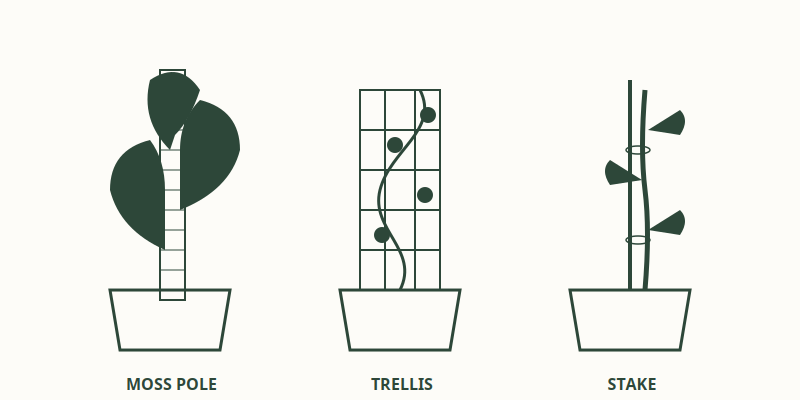
Selecting Support Hardware: Moss Poles, Trellises, and Stakes
Support hardware must be matched to the plant’s growth habit and the ambient environmental conditions. Material selection impacts the longevity of the support and the health of the plant’s root and stem systems.
Sphagnum Moss Poles for Epiphytic Climbers
For climbing Aroids, a moss pole is the preferred support method. Commercial poles utilizing coco-coir often lack the moisture retention necessary for root penetration. A functional moss pole should consist of long-fiber sphagnum moss maintained at a consistent moisture level.
This method utilizes thigmotropism—the plant’s growth response to mechanical sensation. When aerial roots contact a moist, textured substrate, they integrate into the pole. This establishes a secondary root system that assists in hydration and nutrient uptake while providing physical stability. If moisture levels cannot be maintained, alternative support methods should be considered, as dry moss provides no biological advantage.
Bamboo and Hardwood Stakes for Arborescent Plants
Arborescent plants, such as Ficus elastica or Dracaena, are best supported by bamboo or hardwood stakes. Bamboo offers a high strength-to-weight ratio and natural decay resistance.
Only kiln-dried, treated, non-toxic stakes should be used. Untreated wood or branches collected from the environment may introduce wood-boring insects or pathogens into the indoor space. For information on managing soil-borne organisms, see the guide on identifying soil macrofauna.
Metal Trellises for Vining Species
Metal trellises are suitable for small-leaf vining plants like Hoya or Ceropegia woodii. Metal is durable and resistant to biological degradation. However, metal has high thermal conductivity; in high-light areas, metal supports can reach temperatures capable of causing thermal damage to plant tissues. Coated or painted metal is recommended to mitigate heat absorption.
Decomposition Risks and Pest Management
Untreated wooden stakes are susceptible to decay when in contact with moist substrate. This decomposition process supports the growth of fungi, which serves as a food source for Sciaridae (fungus gnat) larvae. To reduce the risk of infestation, utilize plastic-coated steel or high-quality bamboo supports.
The Root-Safe Installation Protocol
Improper installation of support structures can cause mechanical damage to the root system. A systematic approach is required to minimize root trauma during the staking process.
Identifying the Anchor Point
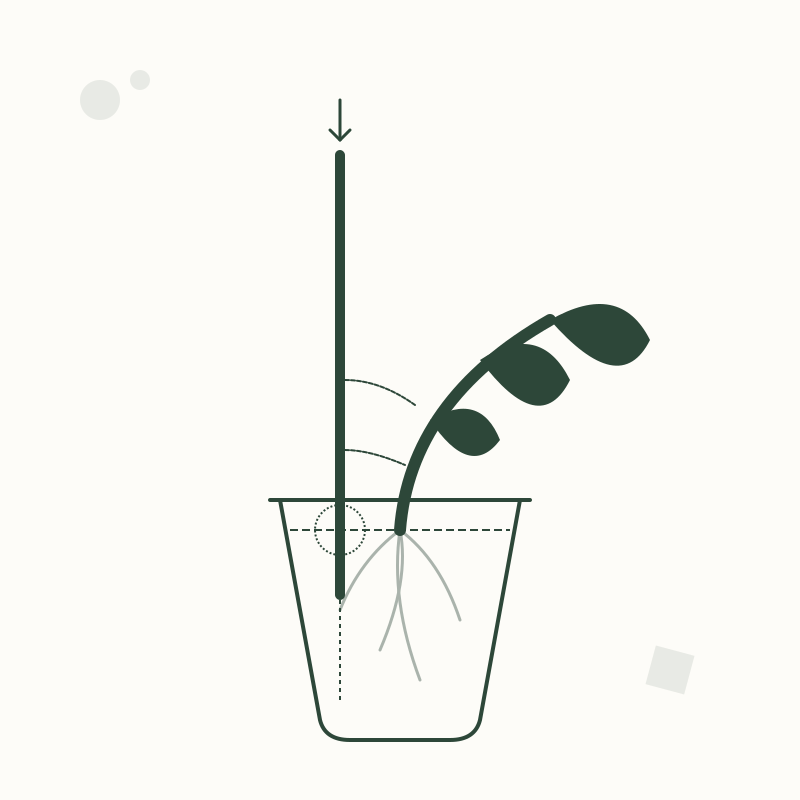
Before inserting a stake, use a sterile probe to locate a path through the substrate. If resistance is encountered, it indicates the presence of a primary root. The insertion point should be adjusted until the probe moves freely, ensuring the stake does not sever major structural roots.
Bypassing the Primary Root Mass
The root flare—the junction where the stem meets the root system—is the most sensitive area. Stakes should be positioned 2-3 inches from the main stem. If support is needed closer to the upper plant, the stake can be angled slightly toward the center while maintaining distance at the base.
Container Stabilization Techniques
The stability of the support is dependent on the container’s mass. Lightweight plastic pots may tip when supporting large plants. Utilizing a heavy ceramic or stone outer container (cachepot) provides the necessary counterweight. For permanent installations, stakes can be anchored to the base of the container using wire before the addition of substrate.
Substrate Compaction for Stability
After insertion, the substrate around the base of the stake must be manually compacted. This eliminates air pockets and increases the friction holding the stake in place. Insufficient compaction allows the stake to shift under the plant’s weight, negating the support’s effectiveness.
Bracing Techniques: Preventing Vascular Constriction
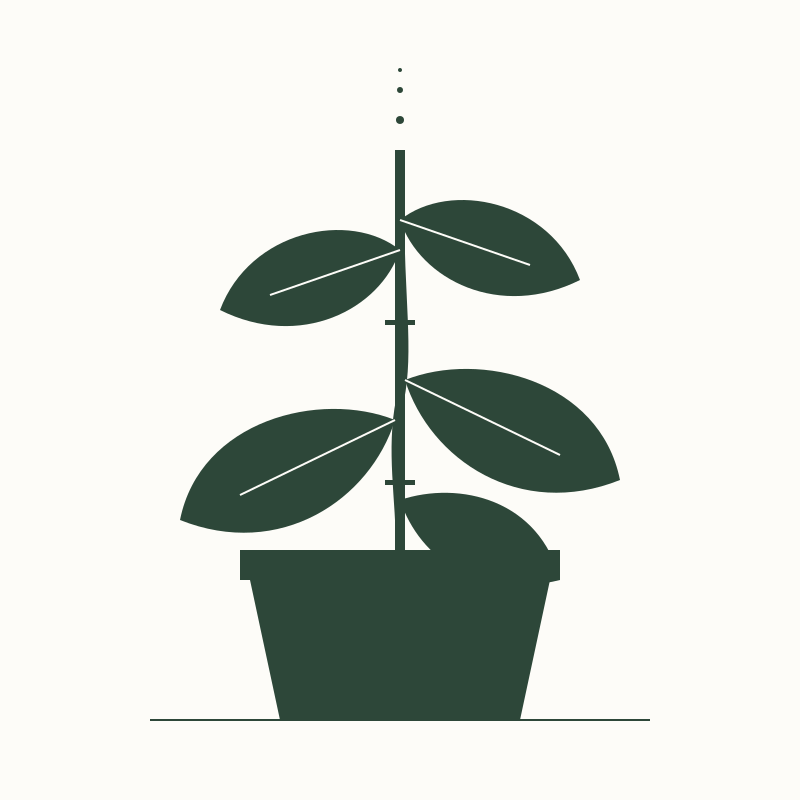
Bindings must be applied with sufficient slack to accommodate growth. Tight bindings can cause girdling, which restricts the flow of nutrients through the phloem and can lead to localized tissue death or stem failure.
The Figure-Eight Tension Method
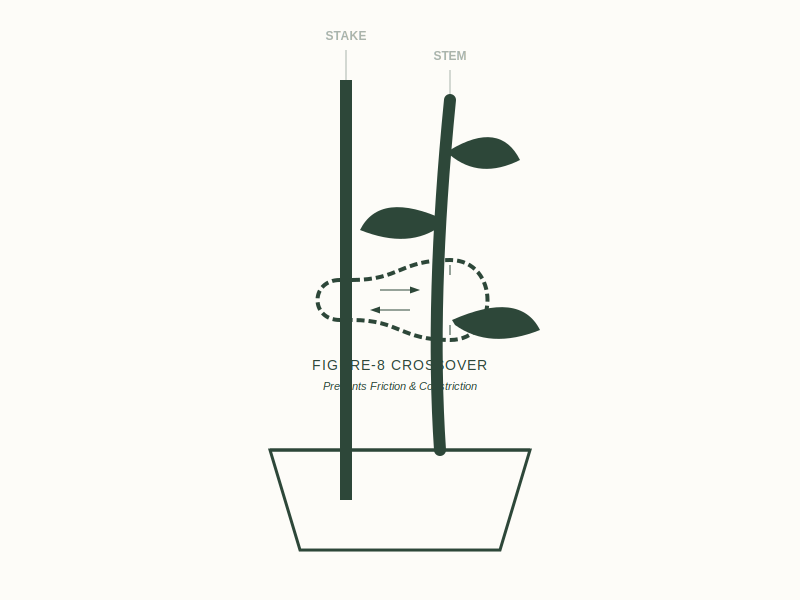
The figure-eight technique is the standard for securing stems to supports:
1. Wrap the tie material around the stake and cross it once to create a spacer.
2. Secure the ends around the plant stem with a loose knot.
This creates a buffer that prevents direct friction between the stem and the stake, reducing the risk of callousing or infection. This method is applicable to both soft-tissued Aroids and woody species. Similar precision is required when managing other stressors, such as pest management in seedlings.
Comparative Analysis of Binding Materials
Jute and other organic twines are suboptimal for indoor use. They retain moisture against the stem, increasing the risk of bacterial rot, and can be abrasive to soft tissues.
Double-sided hook-and-loop fasteners (plant Velcro) are preferred. They distribute pressure over a larger surface area, are adjustable, and do not retain moisture. They also provide a degree of mechanical “give” during physical disturbances. For households with pets, managing plant safety is a separate but related concern; see the guide on deterring domestic animals.
Placement Strategy: Nodal vs. Internodal Attachment
Bindings should be placed immediately distal to a node. The nodal swelling prevents the tie from sliding down the stem. Bindings should never be applied to the petiole, as petioles must remain mobile for solar tracking. Mechanical stress on the petiole can lead to premature leaf abscission.
Accommodating Secondary Growth and Lignification
As plants mature, the vascular cambium produces new tissue, increasing stem diameter. This process, lignification, strengthens the stem. Bindings must be inspected monthly and loosened if they begin to indent the tissue. Permanent indentations create structural weak points.
Species-Specific Support Strategies
Support strategies must be adapted to the specific morphology and growth habit of the species in question.
Monstera Deliciosa: Petiole Management
Monstera specimens exhibit distinct polarity. Aerial roots emerge from the abaxial (back) side of the stem, while leaves emerge from the adaxial (front) side. Supports should be placed against the abaxial side.
This orientation allows aerial roots to engage with the support while leaves remain unobstructed. Large specimens may require heavy-duty supports, such as cedar planks, to manage the significant biomass of the mature leaves.
Pothos and Philodendron: Vertical Training
Small-leaf climbers like Epipremnum aureum are best supported by trellises or wire grids. To achieve a shingling growth habit, a flat support such as a wooden plank is required. Maintaining moisture on the support surface is necessary to encourage the attachment of adventitious roots.
Ficus Lyrata: Trunk Reinforcement
*Ficus lyrata* often lacks trunk rigidity due to the absence of mechanical stress (wind) in indoor environments. This prevents the formation of reaction wood.
Staking should provide a safety limit rather than total immobilization. Loose bindings combined with regular manual agitation of the trunk can simulate wind stress. This triggers lignin production and increases trunk diameter. Once the trunk is self-supporting, the stake can be removed.
Dracaena Trifasciata: Grouping Methods
In low-light or overwatered conditions, *Dracaena trifasciata* (Snake Plant) leaves may lose turgidity and lodge. A perimeter support method is most effective: place several thin stakes around the plant and connect them with a single line of monofilament. This maintains the upright cluster without individual leaf bindings.
Maintenance and Long-Term Structural Correction
Staking is a component of a broader environmental management strategy. Long-term success requires addressing the factors that caused the initial lean. During winter months, specific seasonal care protocols should be followed to prevent tissue brittleness.
Rotation for Growth Uniformity
To ensure balanced auxin distribution and prevent phototropic leaning, plants should be rotated 90 degrees during each irrigation cycle. This promotes a symmetrical and self-supporting structure.
Periodic Adjustment of Bindings
As the plant increases in height, the mechanical leverage changes. Bindings must be moved upward to maintain support. The highest binding should generally be located at approximately two-thirds of the plant’s total height to balance support with natural flexibility.
Facilitating Aerial Root Integration
When using moss poles, the objective is biological integration. Regular hydration of the pole and gentle positioning of aerial roots against the substrate will facilitate attachment. Once integrated, the plant can access additional resources through the pole, often resulting in increased leaf size and stem diameter.
Criteria for Support Upgrades
When a plant exceeds the height of its support, two options are available:
1. Support Extension: Utilizing modular or stackable poles to increase height.
2. Propagation: Removing the apical section for rooting and restarting the growth cycle on a new support. This maintains the specimen within the spatial constraints of the indoor environment.
Effective staking requires an application of botanical and mechanical principles. By monitoring growth patterns and adjusting supports as needed, indoor specimens can achieve optimal structural health and vertical orientation.