This article was researched and reviewed by Leo, our indoor plant specialist.
# Stop Waiting: Why Your Thanksgiving Cactus Won’t Bloom (6-Week Fix)
## The Biological Failure: Why Your Cactus Thinks It’s Still Summer
I’m sitting here in my Portland loft, watching the rain smear against the glass and listening to Barnaby—my 14-year-old rescue cat and the bane of my botanical existence—try to chew on a particularly crispy Calathea leaf. The air in here is bone-dry, a far cry from the swampy, heavy air of the Florida greenhouses where I grew up. Back then, Thanksgiving cacti (*Schlumbergera truncata*) bloomed like clockwork because the environment forced them to. In a modern apartment, we are essentially gaslighting our plants into a state of perpetual vegetative confusion.
If your Thanksgiving cactus is a lush, green bush but hasn’t shown a hint of a bud, it’s not because you’re a bad plant parent. It’s because the plant’s internal chemistry is stuck in “growth mode.” You’ve provided it with a comfortable, climate-controlled, artificially lit environment that mimics a never-ending summer. To a *Schlumbergera*, the signal to bloom isn’t a date on a calendar; it’s a specific chemical shift triggered by the environment.
### The Science of Photoperiodism in Schlumbergera
To understand why your cactus won’t bloom, we have to look at photoperiodism. This isn’t just about “light” and “dark.” It’s a sophisticated biological counting mechanism. Thanksgiving cacti are “short-day” plants, which is a bit of a misnomer. They are actually “long-night” plants. They don’t measure the hours of sun; they measure the hours of uninterrupted darkness.
In their native habitat—the Organ Mountains of Brazil—these plants grow as epiphytes on trees. As autumn approaches, the nights lengthen. This shift in the light-to-dark ratio triggers a hormonal cascade. The plant stops producing new green phylloclades (those leaf-like segments) and starts diverting all its energy into the development of flower buds. If you keep your living room lights on until late at night, you are effectively breaking that countdown every single evening.
### Why 12 Hours of Light is Killing Your Bloom Cycle
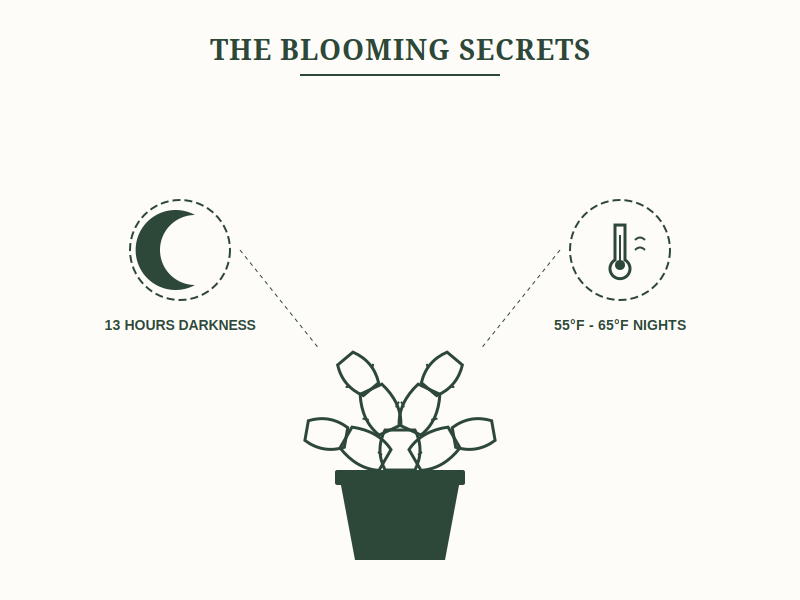
A common mistake is thinking that 12 hours of light and 12 hours of dark is enough. It isn’t. For a *Schlumbergera truncata* to move from leaf growth into flowering, it generally requires at least 13 to 14 hours of continuous, pitch-black darkness.
When the plant receives more than 10 hours of light, it stays in a high-metabolic state. It continues to push out new segments. While a bushy plant is nice, those new segments come at the cost of flower buds. The plant simply doesn’t “believe” it’s time to reproduce because the daylight hasn’t shrunk enough to signal the coming of the cool season. You are essentially keeping the plant in a state of arrested development.
### The ‘Streetlight Effect’: How Artificial Light Ruins Everything
This is where my Portland loft becomes a nightmare. Between the streetlights outside and the glow of my computer monitors, there is rarely “true” darkness. Even a small amount of light—less than what you’d need to read a book—is enough to reset the plant’s internal clock. This is the “Streetlight Effect.”
If your cactus is sitting on a windowsill where a streetlamp shines through, or in a kitchen where the under-cabinet lights stay on for late-night snacking, the plant’s sensors are constantly being stimulated. To the plant, that dim light is still “day.” The biochemical bridge required to cross over into blooming is never built. I learned this the hard way years ago, wondering why my grandmother’s heirloom cactus looked like a head of lettuce while mine remained stubbornly green. It was the glow from my router. One tiny blue LED was enough to kill the bloom cycle.
### Phytochrome: The Internal Switch for Flower Production
Let’s get microscopic. The “switch” I’m talking about is a protein called phytochrome. It exists in two forms: one that absorbs red light and one that absorbs far-red light.
During the day, sunlight is rich in red light, converting the plant’s internal switch into its active form. This tells the plant to grow leaves and stems. When the sun goes down, this switch slowly—very slowly—reverts back. This conversion happens only in total darkness. If the night is long enough (14 hours), the levels drop low enough to trigger the production of the flowering hormone.
If you turn on a light for even sixty seconds to find your TV remote, you instantly flip the switch back. The clock is reset to zero. The plant thinks, “Oh, the sun is back, let’s keep growing leaves.” You have to be persistent about the darkness.
## The Temperature ‘Chill’ Secret Competitors Miss
While most people obsess over light, they completely ignore the second half of the equation: temperature cycles. In my Florida days, the “chill” was a relative term—maybe it dropped to 60°F. But here in Portland, temperature management is a delicate dance.
Back in 2018, I lost my entire rare Aroid collection to a power outage during a winter storm. It was a massacre. While I’m still bitter about my variegated Monstera turning into a black pile of mush, that event taught me something about *Schlumbergera*. While my tropicals died, the Thanksgiving cacti near the drafty window actually thrived afterward. Why? Because the cold triggered a massive bud set.
### The 55°F Sweet Spot for Bud Initiation
Temperature can actually override light requirements. If you keep your Thanksgiving cactus at a steady, chilly temperature between 50°F and 55°F, it will often set buds regardless of how many hours of light it gets. At these lower temperatures, the plant’s metabolism slows down, and the flowering trigger happens more efficiently.
However, most of us don’t live in a house that cold. We live in comfortable, warm environments. At these human-comfortable temperatures, the plant *requires* those 14 hours of darkness. If you can combine the two—cool nights and long darkness—you get a bloom that is so dense you can’t see the green segments.
### Why Central Heating is the Enemy of Thanksgiving Blooms
Central heating is a double-edged sword. Not only does it keep the plant too warm to trigger the “chill” response, but it also nukes the humidity. In the Brazilian rainforest, these plants are bathed in cool, misty night air. In a city loft with a furnace kicking on every twenty minutes, the air is parched.
Dry air causes the plant to lose moisture at an accelerated rate. To save itself, the plant will often kill off the tiny, microscopic bud starts before you even see them. If your plant is sitting right above a heating vent, you can forget about flowers. The heat fluctuations tell the plant it’s in a volatile environment, and blooming is a luxury it can’t afford.
### Thermoperiodism: Balancing Day and Night Temps
The ideal cycle is a “diurnal swing.” You want the daytime to be around room temperature and the nighttime to drop significantly. This temperature difference mimics the natural transition into winter. If the temperature remains the same day and night, the plant doesn’t receive the secondary biological cue to bloom.
I’ve found that moving my cacti to a guest room where the heater is turned off—or even a screened-in porch, as long as it stays above freezing—is the most effective way to jumpstart the process.
### Creating a ‘Micro-Climate’ in a Modern Apartment
If you can’t turn off your heat because you don’t want to end up like my frozen collection from 2018, you have to get creative. I use the “Window Sills and Curtains” trick.
Place your plant between the glass of the window and a heavy blackout curtain. At night, the glass will radiate cold, creating a small pocket of air that is several degrees cooler than the rest of the room. The curtain serves two purposes: it traps that cool air against the plant and blocks out the light from your living space. It’s a low-tech way to simulate a Brazilian mountain ridge in a city apartment. Just make sure the segments aren’t actually touching the freezing glass, or you’ll get localized cell death—those nasty mushy spots.
## Identity Crisis: Are You Growing a Thanksgiving or Christmas Cactus?
Before you commit to a 6-week protocol, you need to know what you’re actually growing. In the trade, almost everything sold in November is a Thanksgiving Cactus (*Schlumbergera truncata*), but they are often mislabeled as Christmas Cacti (*Schlumbergera x buckleyi*). This matters because their bloom triggers and timelines are slightly different.
### Phylloclades: Reading the Leaf Segments
Look at the segments (the “leaves”).
– **Thanksgiving Cactus (S. truncata):** The segments have very pointed, claw-like projections on the edges. They look like little crab claws. This is the most common variety.
– **Christmas Cactus (S. x buckleyi):** The segments are more rounded and scalloped. They don’t have those sharp “teeth.”
– **Easter Cactus (Rhipsalidopsis gaertneri):** The segments have tiny bristles at the ends and are even more rounded.
If you have a Christmas cactus and you’re trying to force it to bloom for Thanksgiving, you’re fighting against its genetics. It naturally wants to bloom over a month later than the *truncata* variety.
### Anther Color: The Definitive Identification Test
If you managed to get a single bloom last year, think back to the center of the flower. This is the curator’s secret for identification.
– **Thanksgiving Cactus:** The pollen-bearing parts (anthers) are typically yellow.
– **Christmas Cactus:** The anthers are typically pink or purplish.
Knowing the species helps you time the 6-week protocol. For a Thanksgiving bloom, you start in late September or early October. For a Christmas bloom, you start in late October or early November.
### The Bloom Window: November vs. December vs. Spring
Each species has a specific “critical night length.” *S. truncata* is the most sensitive and will bloom first. If you have an Easter Cactus, the 6-week protocol won’t work right now because it needs a much longer, colder rest period over the winter to bloom in the spring. If you’re following a guide for a Thanksgiving cactus but you’re holding an Easter cactus, you’re going to be very disappointed when nothing happens.
### Why Species-Specific Care Dictates Your Success
*S. truncata* is actually more heat-tolerant but also more finicky about light interruptions. *S. x buckleyi* is a hybrid that is a bit more robust but demands that “chill” factor more than the other. If you’ve been treating them as the same thing, that’s your first mistake. Barnaby doesn’t care—he’ll try to chew on either—but your fertilizer and light schedule should reflect the species you actually own.
## The 6-Week Total Darkness Protocol
This is the “aggressive option.” It is the most reliable way to force a bloom. It requires discipline, a heavy box, and a lack of sentimentality about your decor. We are going to simulate the end of the world for your cactus so it feels the urgent biological need to reproduce before it “dies.”
### Setting the Schedule: The 14-Hour Darkness Rule
For the next six weeks, your plant needs 14 hours of total, uninterrupted darkness and 10 hours of bright, indirect light.
**The Routine:**
– **8:00 AM:** Move the plant to a bright window (indirect light only). No direct sun, or you’ll scorch the segments.
– **6:00 PM:** Move the plant into total darkness.
You must do this every day. No skips. No “I’ll just leave the light on for five more minutes.” If you miss a day, you don’t necessarily reset to zero, but you weaken the signal.
### The ‘Box Method’ vs. The ‘Unused Room’ Strategy
If you don’t have a guest room that stays dark, use the “Box Method.” Find a large, heavy-duty cardboard box. At 6:00 PM, place the box over the plant. Make sure there are no gaps at the bottom. I’ve even used a black velvet cloth over the box to ensure zero light penetration.
If you use an unused room like a closet or a bathroom, ensure no one opens the door. Even the crack of light from the hallway can disrupt the process. I once lost a bloom cycle because Barnaby learned how to push open the bathroom door in the middle of the night. Now, I use a box.
### Watering Restrictions During the Pre-Bloom Phase
During these six weeks, you must reduce watering. In the wild, the shortening days coincide with a drier season. If you keep the soil soggy, the plant stays in growth mode.
You want the soil to dry out significantly—more than usual. Wait until the top two inches are bone dry. When you do water, do it sparingly. You are trying to induce a slight amount of stress. Stress is the precursor to reproduction in the plant kingdom.
### When to Stop the Protocol (Spotting the First Buds)
After about a month, you will start to see tiny, pinhead-sized “nubs” at the ends of the segments. They might look like new leaves at first, but they will be rounder and often tinged with red or purple.
Do not stop the protocol yet! Continue the darkness and the cool temps until the buds are about half an inch long and you can clearly see the flower color. If you stop too early, the plant can actually re-absorb the buds and go back to growing leaves. Once the buds are established and elongated, you can return the plant to its display location.
## Preventing Bud Drop: Why They Fall Before They Open
There is nothing more gut-wrenching than seeing a dozen fat buds on the floor of your potting bench. This is the agony phase of *Schlumbergera* care. Bud drop is almost always caused by an environmental shock that triggers the plant to shed its flowers.
### The Ethylene Gas Trap: Kitchen Placement Dangers
Ethylene is a plant hormone that exists as a gas. It’s what makes fruit ripen, but it’s also what makes flowers die. If you have your cactus in the kitchen near a bowl of ripening apples or bananas, the ethylene gas will cause the buds to drop within two days.
Even a gas stove can release trace amounts of ethylene. If your plant is “unexplainedly” dropping buds, move it as far away from the kitchen as possible. This is a microscopic chemical reaction—the gas signals the plant to “let go.”
### Drafts and Temperature Shocks: The Silent Killers
A sudden blast of cold air from an opening door or a blast of hot air from a vent will cause bud drop. The plant is incredibly sensitive to temperature swings once the buds are set. In my Portland loft, I have to be careful when I open the balcony door to let the fresh air in. One 5-minute draft is enough to ruin a year of work.
### Humidity Requirements for Heavy Bloomers
While the plant needed a bit of drought stress to set the buds, it needs humidity to open them. If the air is too dry, the outer casing of the bud becomes too tough and dry for the flower to push through. The plant, sensing the flower won’t open, simply drops it to conserve energy.
I use a pebble tray—a tray filled with stones and water—under the pot. As the water evaporates, it creates a localized cloud of humidity around the plant. Don’t bother misting; it doesn’t do much and can actually encourage fungal issues on the delicate petals.
### The ‘Don’t Move It’ Rule: Stability is Key
Once the buds are set, the plant hates being moved. Even rotating the plant to “face” the room can cause buds to drop. The plant has oriented its cells toward the light source. When you turn it, the plant tries to re-orient, which creates internal stress.
If you must move it to a dining table for a centerpiece, do it only once and leave it there. Constant movement is the fastest way to a bare plant.
## Post-Bloom Recovery: Setting the Stage for Next Year
Once the last flower has shriveled and Barnaby has inevitably tried to bat it across the floor, the work isn’t over. This is the rest phase that determines how many flowers you’ll get next year.
### The Post-Flowering Rest Period
After blooming, the plant is exhausted. It has spent a massive amount of its stored energy. For about a month after the final bloom, reduce water significantly. Let it sit in a cool, bright spot. Do not fertilize. This mimics the dormant period in the wild. If you try to force it to grow immediately, you’ll end up with weak, spindly segments.
### Pruning for Maximum Branching (and More Flowers)
In late winter or early spring, it’s time to prune. This feels counterintuitive, but it’s essential. Flowers only grow at the tips of the segments. If you have one long strand of five segments, you get one flower. If you pinch that strand back to three segments, the plant will usually grow two new segments from that point.
Now you have two tips, which means two flowers next year. I call this “exponential blooming.” Use a twisting motion to snap off the segments at the joint. Don’t worry—you can propagate those cuttings. If you want to know why your cuttings might fail, check out my guide on why plant cuttings won’t root.
### When to Resume High-Nitrogen Feeding
Once you see new, bright green growth in the spring, it’s time to wake the plant up. Start feeding with a balanced, water-soluble fertilizer. I prefer a balanced mix diluted to half-strength. This provides the nitrogen needed for those new segments and the nutrients needed for the root system.
Stop the heavy feeding by August. You want the plant to slow down its leaf production before you start the 6-week darkness protocol in the fall.
### Repotting Without Stressing the Root System
Thanksgiving cacti actually like being slightly root-bound. I only repot mine every few years. If you do repot, use a mix that is incredibly well-draining. I use a blend of half potting soil, a quarter orchid bark, and a quarter perlite.
Remember, these are epiphytes. Their roots need oxygen as much as they need water. If you put them in heavy, moisture-retaining soil, the roots will suffocate and rot. If you’re dealing with the fallout of bad soil, like fungus gnats, you might want to look into my more aggressive pest control methods.
Growing a *Schlumbergera* isn’t about luck. It’s about understanding the biological triggers that have been hardwired into its DNA for millions of years. You have to be the weather. You have to be the sun. And most importantly, you have to be the darkness.
I’m going to go pick up the Calathea leaf Barnaby just shredded. Maybe next year I’ll teach him how to help me with the Box Method, but for now, I’m just happy if he doesn’t knock the cactus off the windowsill.
If you’re looking to expand your collection after a successful bloom, you might want to learn how to score rare plants at big box stores, because once you master the Thanksgiving cactus, you’ll be hunting for the variegated versions in no time.
Leo Vance
Leo Vance is a veteran botanical curator and rare plant collector with over 15 years of experience in biological engineering and hormonal optimization of indoor greenery. After a catastrophic loss of his collection in 2018, he dedicated his life to sharing technical, factual, and practical plant care strategies to help others build resilient indoor sanctuaries.