This article was researched and reviewed by Leo, an indoor plant specialist.
Fungus gnats (Bradysia) are capable of persisting in indoor environments even when ambient humidity is low. While these insects typically thrive in damp conditions, the micro-climate within the top two inches of potting media often remains sufficiently moist to support larval development. Even when the surface appears dry, internal plant processes like guttation indicate that moisture is present within the substrate and the plant’s vascular system.
Guide Overview
- Limitations of Cinnamon and Hydrogen Peroxide
- Application of Bacillus Thuringiensis Israelensis (BTI)
- Mosquito Bits vs. Mosquito Dunks
- Utilizing Steinernema Feltiae Nematodes
- Mechanism of Action
- Managing the 17-Day Life Cycle
- Strategic Yellow Sticky Trap Placement
- Physical Barriers: Diatomaceous Earth vs. Sand Topping
- The Sand Barrier
- Cultural Control: Adjusting Irrigation Methods
- Systemic Pesticides for Ornamental Tropicals
Common home remedies often fail to address the biological requirements for total eradication. Fungus gnat larvae primarily inhabit the subsurface layers of the substrate, making surface-level treatments ineffective. Effective management requires an understanding of the insect’s biology and the implementation of targeted controls rather than anecdotal methods.
Based on longitudinal observations of indoor collections, fungus gnats do not respond to superficial deterrents. Eradication requires a multi-stage approach that targets the larvae in the soil and the adults in the air simultaneously to disrupt the reproductive cycle.
Limitations of Cinnamon and Hydrogen Peroxide
Many widely recommended natural cures provide only temporary reduction in pest numbers or may negatively impact soil health.
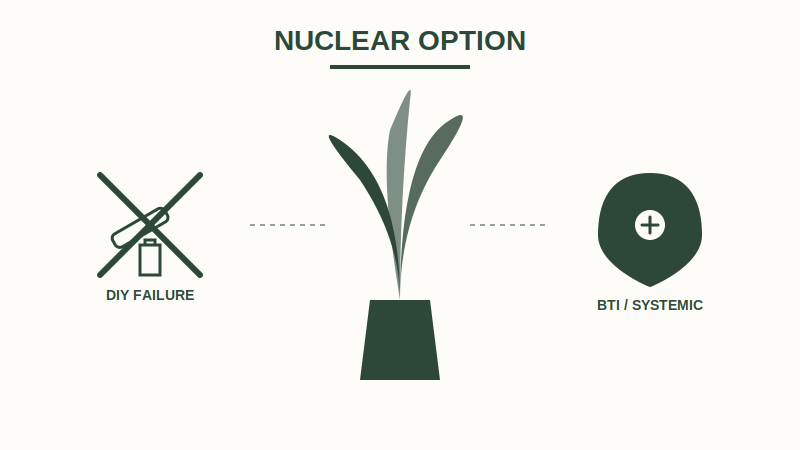
Hydrogen peroxide (H2O2) acts as an oxidizing agent that can kill larvae upon direct contact. However, H2O2 is chemically unstable and rapidly decomposes into water and oxygen upon contact with organic soil matter. Unless the entire root ball is saturated—a practice that may assist in treating root rot but is impractical for pest control—the peroxide will not reach larvae at greater depths. It typically eliminates surface larvae but leaves the majority of the population viable.
Cinnamon contains cinnamaldehyde, which has antifungal properties. The rationale is that reducing soil fungi will starve the larvae. In practice, the concentration required to eliminate fungal networks in a large volume of soil is significantly higher than a surface application. Furthermore, fungus gnat larvae are opportunistic and will consume plant root hairs if fungal sources are depleted. While cinnamon may serve as a deterrent for larger pests, such as when trying to keep cats away from indoor plants, it is insufficient for gnat colony eradication.
Application of Bacillus Thuringiensis Israelensis (BTI)
Bacillus thuringiensis israelensis (BTI) is a soil bacterium that produces delta-endotoxin protein crystals.
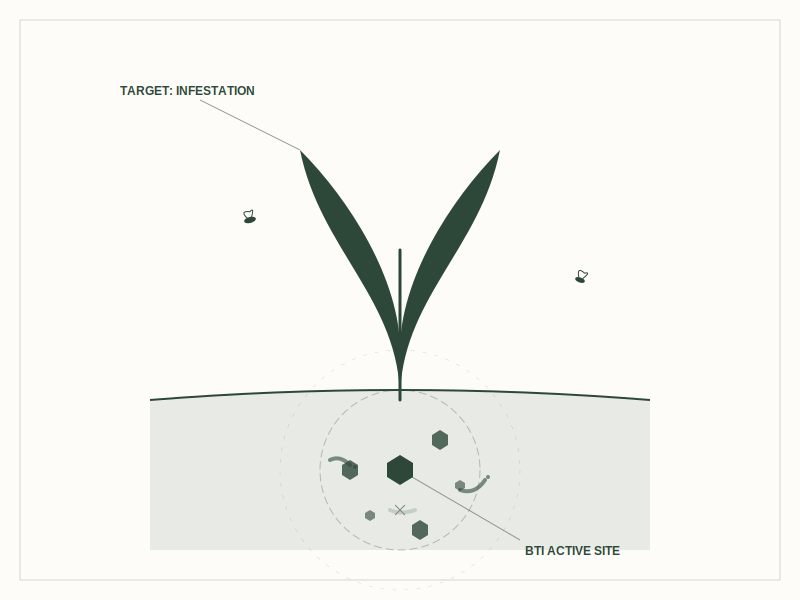
When fungus gnat larvae ingest BTI crystals, the alkaline environment of their digestive tract activates the toxin. This toxin binds to the gut lining, causing cellular disruption and cessation of feeding. Death occurs shortly thereafter. BTI is host-specific, targeting only the larvae of certain dipterans like gnats and mosquitoes, and does not affect mammals or beneficial insects.
Mosquito Bits vs. Mosquito Dunks
BTI is commercially available as ‘Mosquito Bits’ or ‘Mosquito Dunks.’ For indoor applications, ‘Bits’ are preferred for their rapid bacterial release. Surface application of the dry bits should be avoided as they are prone to molding.
The recommended application method is a ‘BTI infusion.’ Steep 4 tablespoons of Mosquito Bits in one gallon of water for 30 minutes. Strain the solids and use the liquid for the next three scheduled waterings. This ensures the toxin is distributed throughout the soil column. This method is compatible with hydroponic and semi-hydroponic systems, such as those using Leca.
Utilizing Steinernema Feltiae Nematodes
For high-density infestations, Steinernema feltiae, a species of beneficial nematode, can be employed.
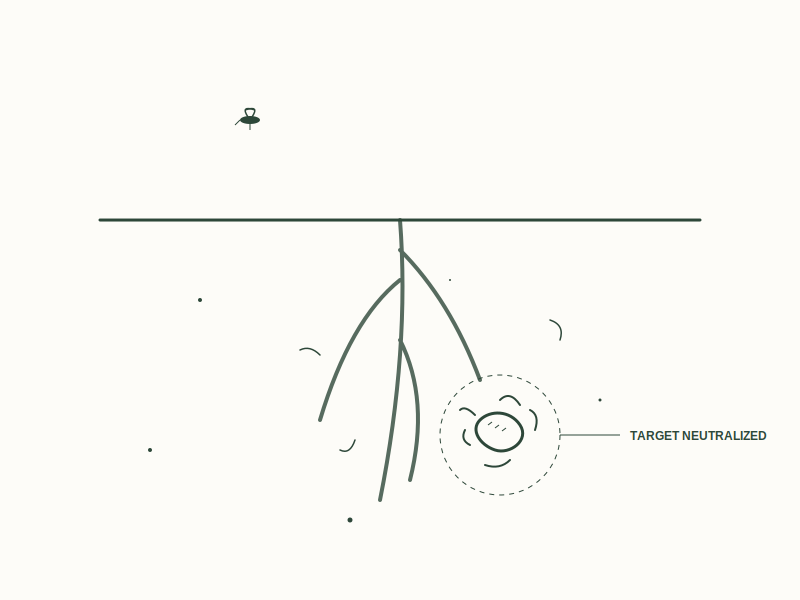
These microscopic roundworms are entomopathogenic. They actively navigate through the moisture film in the soil to locate larvae by detecting carbon dioxide and heat.
Mechanism of Action
Upon locating a host, the nematode enters through natural body openings and releases symbiotic bacteria (Xenorhabdus). These bacteria multiply, causing mortality in the host within 24 to 48 hours. The nematodes then feed on the resulting organic matter and reproduce, releasing subsequent generations into the substrate.
Successful nematode application requires consistent soil moisture. If the substrate dries completely, the nematodes will perish. In low-humidity environments, light daily misting of the soil surface is necessary to maintain the water film required for nematode mobility. This biological control provides a self-sustaining population as long as hosts and moisture are present.
Managing the 17-Day Life Cycle
The Bradysia genus has a life cycle of approximately 17 days. A single female can deposit up to 200 eggs. These progress through larval and pupal stages before emerging as winged adults.
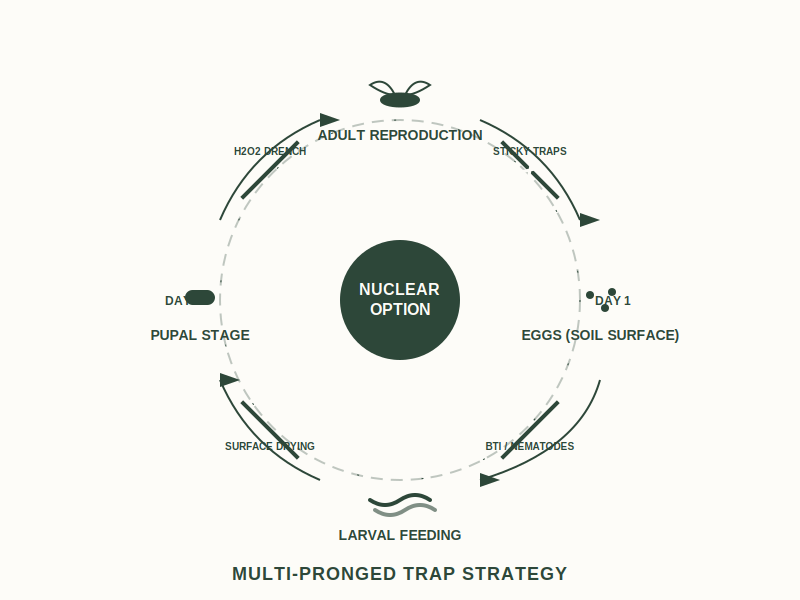
Effective control requires simultaneous targeting of all life stages. Larval treatments must be paired with adult management to prevent continuous re-infestation.
Strategic Yellow Sticky Trap Placement
Yellow sticky cards utilize phototaxis to attract adult gnats. Because fungus gnats are weak fliers and remain close to the substrate, traps should be placed directly on the soil surface or attached to the pot rim.
Traps should be monitored and replaced when 50% of the surface area is covered. This reduces the number of females available for oviposition. Note that accumulated debris on traps may include spider mites or dust, but the primary target is the adult gnat population.
Physical Barriers: Diatomaceous Earth vs. Sand Topping
Mechanical controls can prevent larvae from navigating the soil surface. Diatomaceous Earth (DE) consists of fossilized silica-based skeletons of diatoms. This powder acts as an abrasive that lacerates the exoskeleton of soft-bodied larvae, leading to desiccation.
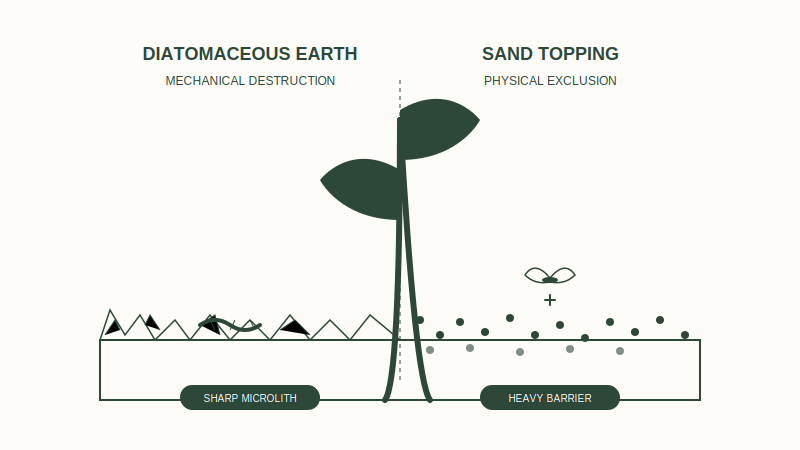
DE is only effective when dry; moisture renders it ineffective.
The Sand Barrier
A one-inch layer of coarse horticultural sand provides a more permanent mechanical barrier. Sand dries quickly, making the surface unsuitable for egg-laying. Additionally, the abrasive nature of the sand grains inhibits the movement of larvae and emerging adults. When using sand, monitor grow light distance, as light-colored sand can increase light reflection onto the abaxial side of leaves, potentially causing light stress.
Cultural Control: Adjusting Irrigation Methods
Infestations are often linked to excessive soil moisture or high organic matter content. Peat-based mixes retain significant moisture and provide a substrate for fungal growth.
Increasing the ratio of inorganic components like perlite or pumice improves drainage. ‘Bottom watering’—placing the pot in a reservoir to allow for capillary action—is an effective irrigation strategy.
This method maintains moisture in the lower root zone while keeping the top two inches of soil dry. Since larvae are concentrated in the upper layers for aeration and organic decay, this technique limits their habitat. This is a standard management practice for species like the Thai Constellation Monstera during periods of low ambient evaporation.
Systemic Pesticides for Ornamental Tropicals
If biological and cultural controls are insufficient for high-value specimens, systemic granules containing Imidacloprid may be used.
Imidacloprid is a neonicotinoid absorbed by the roots and translocated throughout the plant’s vascular system. Larvae are eliminated upon ingestion of root tissue. This provides residual control for approximately 60 days.
Systemic pesticides should not be used on plants intended for outdoor placement due to toxicity to pollinators. Caution is required in households with pets that may ingest foliage, as the compound is a neurotoxin. For indoor ornamental collections where total eradication is required, systemics offer a high degree of efficacy.