This article was researched and reviewed by Leo, an indoor plant specialist.
External temperatures in Portland are currently 34 degrees Fahrenheit. Indoor heating systems significantly reduce indoor humidity levels, creating a challenging environment for tropical plant collections. For collectors in the Pacific Northwest, winter necessitates active management of low humidity and provides an incentive to visit commercial greenhouses to observe controlled environments.
Guide Overview
- The Technical Guide to Big Box Delivery Schedules
- Mapping the Regional Distribution Center
- The Costa Farms ‘Trending Tropicals’ Distribution Model
- Identifying ‘Sport Variegation’ and Mislabeled Species
- The Science of Chimeric Mutation
- Identifying Mislabeled Philodendrons
- Negotiating Clearance and Price Matching
- The ‘Distressed Plant’ Protocol
- Inventory SKUs and Price Matching
- Bio-Security Protocol: Preventing Pest Infestation
- The 10x Jeweler’s Loupe Inspection
- Standard Home Arrival Treatment
- Acclimation Procedures: Greenhouse to Indoor Environment
- Managing Relative Humidity in Winter
- Lighting and Root Health
- The Secondary Environment Transition
Retailers like Lowe’s frequently stock the ‘Trending Tropicals’ product line. Identifying rare, high-value specimens—such as Thai Constellation or sport-variegated Philodendrons—at large retail stores is not a matter of chance. Based on experience as a botanical garden curator and observations regarding substrate quality in retail environments since 2018, acquiring these plants requires an understanding of logistics, plant biology, and store management protocols.
The Technical Guide to Big Box Delivery Schedules
Arriving at Home Depot on a Saturday morning is often ineffective for locating fresh shipments of rare Aroids. Secondary market resellers typically monitor these locations and purchase high-demand stock, such as Thai Constellations, shortly after delivery, often on weekday mornings.
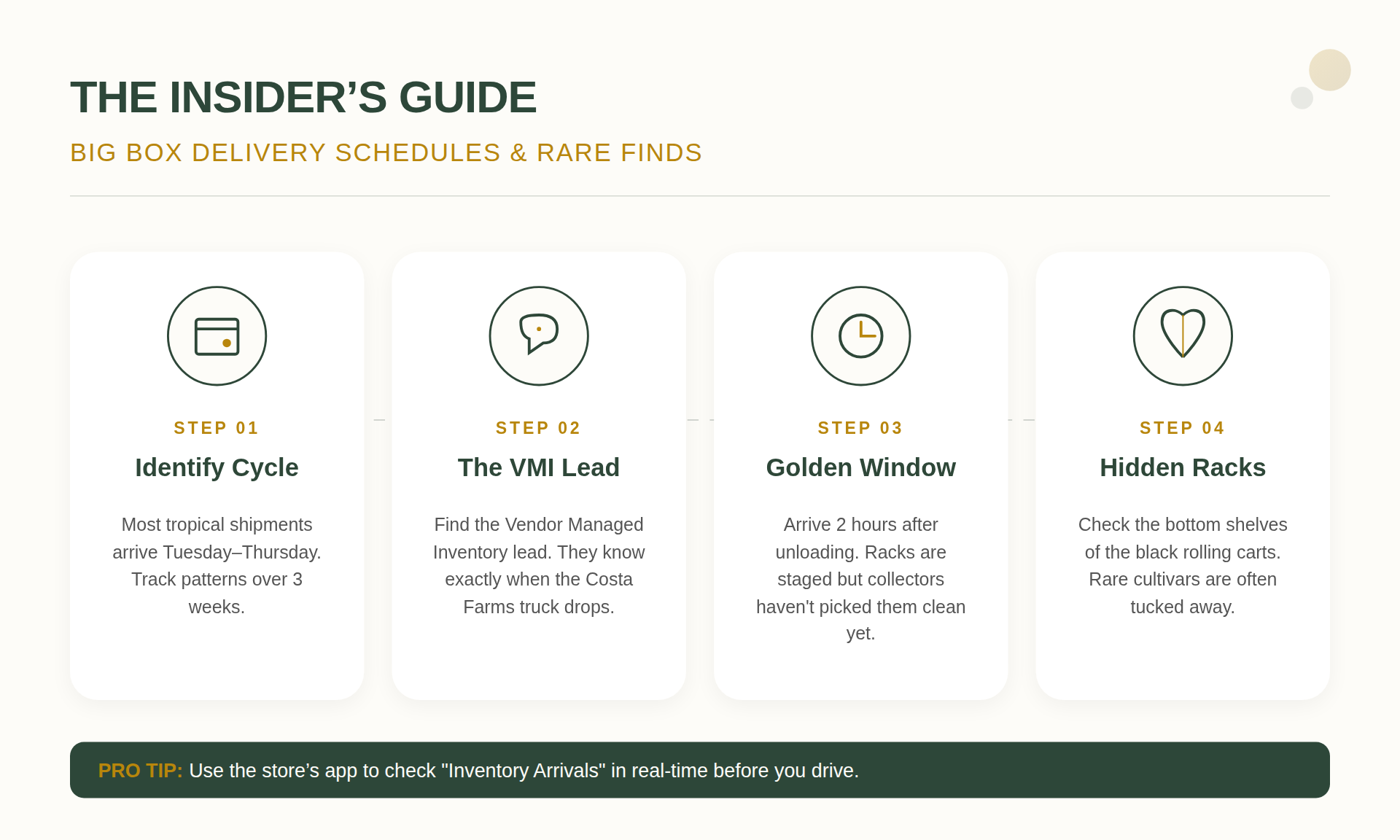
Procurement in this sector requires an understanding of Vendor Managed Inventory (VMI). Unlike standard hardware or lumber, vendors like Costa Farms retain ownership of the plants until the point of sale. Costa Farms employs a dedicated merchandising team that manages the transport, unboxing, and arrangement of the ‘Trending Tropicals’ collection. Store-level employees generally lack specific information regarding the contents of these shipments until the vendor team arrives.
Mapping the Regional Distribution Center
To optimize acquisition, identify the delivery frequency of the local store. Most large retailers receive tropical shipments from a Regional Distribution Center (RDC) twice weekly. In the Pacific Northwest, these deliveries typically occur on Tuesdays and Thursdays.
Delivery windows can be identified by observing the status of black rolling racks near the loading dock or garden center entrance. Clean, stacked racks indicate a completed shipment. Racks containing plastic wrap remnants suggest a delivery within the previous six hours. Tracking these windows in a spreadsheet provides a data-driven advantage when seeking high-value plants at retail prices.
The Costa Farms ‘Trending Tropicals’ Distribution Model
Costa Farms has altered the rare plant market by mass-producing varieties previously limited to tissue culture or specialized nurseries. These plants are shipped in cycles. Availability varies by month, ranging from Geogenanthus ciliatus to variegated Monstera ‘Thai Constellation’. Monitoring vendor social media is useful, though shipments typically reach Florida and the Southern United States first. Locations in the Pacific Northwest generally experience a 10-to-14-day delay following initial reports in Georgia or Texas.
Identifying ‘Sport Variegation’ and Mislabeled Species
High-value acquisitions often involve identifying spontaneous genetic mutations, known as “sports.” Due to high production volumes, quality control may overlook individual plants that have mutated within a tray.
Standard Monstera Deliciosa specimens may occasionally exhibit white or yellow streaks on the stem and foliage. This sport variegation is often categorized as damage or disease by retail staff, but it represents a significant genetic variation for collectors.
The Science of Chimeric Mutation
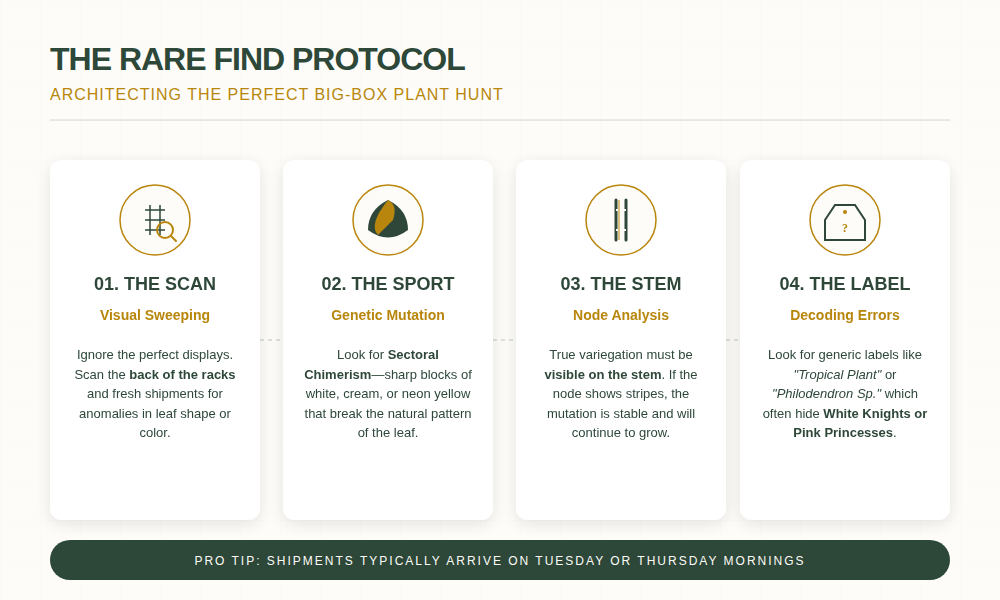
Most variegation found in these sports is chimeric, meaning the plant contains two or more distinct sets of DNA. When inspecting Philodendrons, evaluate the node and the axillary bud rather than just the foliage.
If variegation is present on a leaf, inspect the petiole and the main stem. A distinct line of variegation running through the node (meristematic tissue) indicates the mutation is likely stable and can be propagated. If the stem is solid green and variegation is limited to the leaf, the mutation is likely non-stable. Stem variegation is the primary indicator of a specimen that can produce further variegated growth.
Identifying Mislabeled Philodendrons
Mislabeling is common in large retail stores. High-value specimens, such as Philodendron ‘Pink Princess’, may be found in pots labeled as ‘Assorted Foliage’ if regional nurseries exhaust their supply of branded containers.
Identification should be based on leaf morphology. A Pink Princess is characterized by reddish-pink stems and specific cataphyll shapes. Identifying a species by its growth habit and petiole shape allows for the acquisition of high-value plants at standard prices. During winter, these plants may exhibit signs of low humidity, which can obscure them behind more resilient stock.
Negotiating Clearance and Price Matching
Retailers treat plants as perishable assets. Physical damage or dry soil conditions are viewed as liabilities, which provides an opportunity for price negotiation.
In Portland, low winter light and high indoor heat often lead to plant decline in retail garden centers. Humidity levels frequently drop to 15%, causing foliar desiccation. The clearance section often contains undervalued specimens that require rehabilitation.
The ‘Distressed Plant’ Protocol
When locating a rare plant with visible damage—such as a Thai Constellation with necrotic spots—request a consultation with a floor manager rather than a cashier.
Suggested communication: “This Monstera exhibits mechanical damage and signs of drought stress. It is likely to lose lower foliage. Given its distressed condition and the probability of further decline, would you consider a 50% discount to remove it from inventory?”
Managers operate within a shrinkage budget and may prefer a discounted sale over total inventory loss. Pointing out biological decline is a practical method for securing rare plants at a lower cost.
Inventory SKUs and Price Matching
Identical plants may be priced differently if they originate from different shipments. Verify the Inventory SKU on the tag. If a ‘Trending Tropicals’ specimen is priced at $40 while another species in the same product line and pot size is $19, you may request a price match. Managers often categorize these items by pot size and vendor rather than specific species.
Bio-Security Protocol: Preventing Pest Infestation
Retail environments are common sources for thrips and spider mites. High-density shipping racks facilitate the rapid spread of pests across an entire shipment.
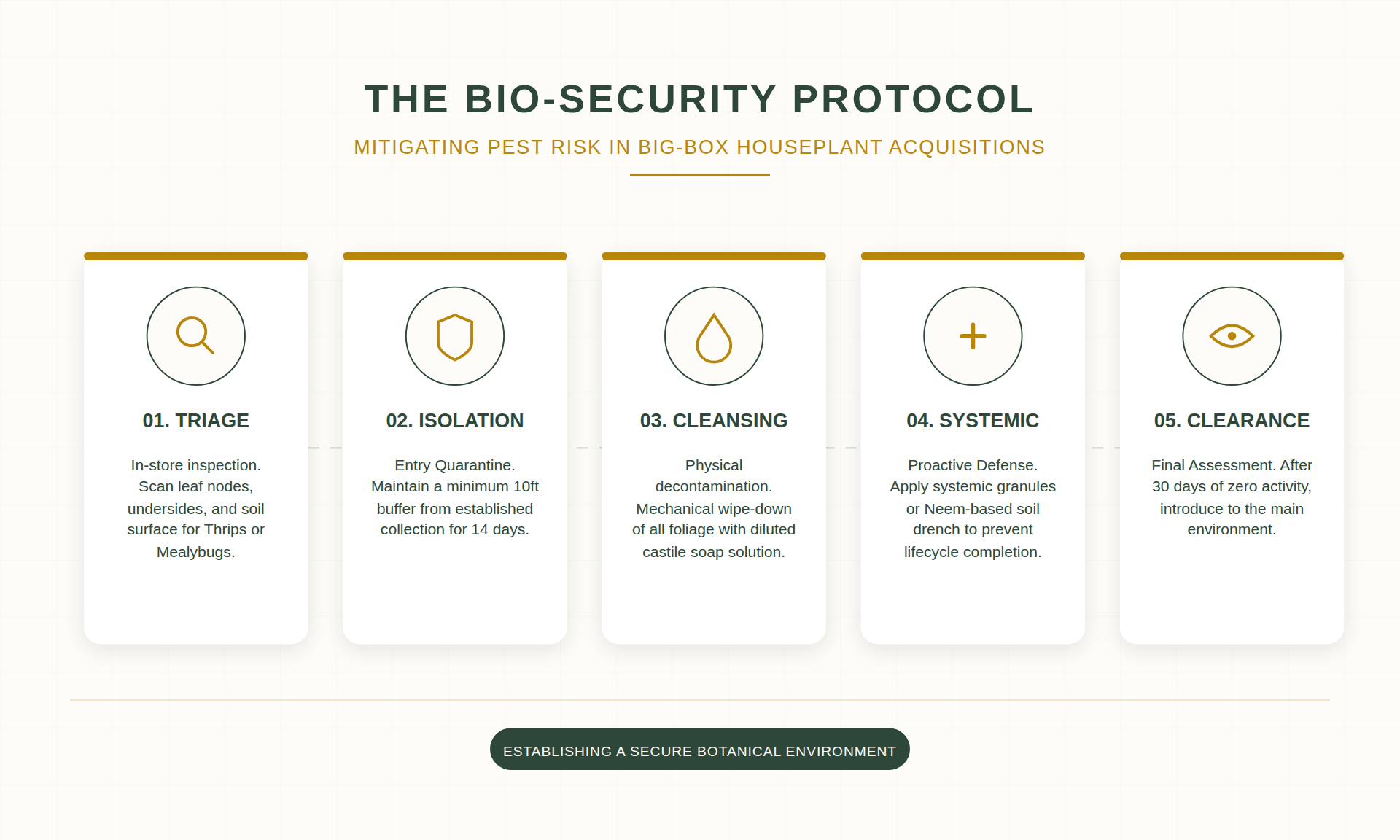
A strict quarantine protocol is necessary. New acquisitions should be isolated from existing collections for a minimum of 21 days to prevent widespread infestation.
The 10x Jeweler’s Loupe Inspection
Perform a detailed inspection prior to purchase using a 10x jeweler’s loupe. Check for: 1. Thrips: Small, elongated larvae in new growth crevices and black fecal spots (frass) on leaf undersides. 2. Spider Mites: Microscopic webbing at the junction of the leaf and stem. These pests proliferate in dry, heated indoor environments. 3. Mealybugs: White, fibrous clusters in leaf axils.
Standard Home Arrival Treatment
Upon arrival, plants should be moved to a designated area for cleaning. Wash foliage with a solution of Castile soap and water to remove pests. Apply a systemic insecticide containing Imidacloprid to the substrate.
Note: Systemic insecticides should not be used on plants intended for outdoor placement due to risks to pollinators.
Utilize blue sticky traps for monitoring. Thrips are specifically attracted to the blue spectrum. If traps remain clear for three weeks, the plant can be integrated into the main collection.
Acclimation Procedures: Greenhouse to Indoor Environment
Post-purchase mortality is typically caused by transplant shock. Plants transition from high-humidity, high-light industrial greenhouses to retail environments and then to low-humidity residential settings. This sequence creates significant physiological stress.
Managing Relative Humidity in Winter
Relative humidity (RH) in heated indoor spaces can drop to 15%. Tropical species require a minimum of 50-60% RH to maintain cellular turgor pressure. Use a cloche or a humidity tray with pebbles and water to increase local humidity.
Foliar misting is ineffective for raising humidity and may promote fungal pathogens. Grouping plants together is a more effective method, as collective transpiration creates a localized micro-climate.
Lighting and Root Health
Low natural light levels in winter require the use of full-spectrum LED grow lights. Provide 12 hours of supplemental light to support the repair of any root damage incurred during transport.
Evaluate the substrate immediately. Retail soil often consists of high percentages of peat moss to retain moisture during shipping, which can lead to root rot in home environments. A mixture of 50% orchid bark, 30% perlite, and 20% coco coir is recommended for Aroids. Delay repotting for at least 14 days to allow for environmental acclimation. Monitor moisture levels with a wooden probe; do not apply water if the probe indicates dampness in the lower substrate.
The Secondary Environment Transition
Basements often provide a more stable acclimation zone due to higher humidity and lower temperatures, which reduces the plant’s metabolic rate. Utilizing heavy-duty shelving and high-output LEDs in these areas creates an effective triage center. Rare specimens should remain in this controlled environment for the first month to ensure stability before moving to primary living areas.
Acquiring rare plants from large retailers involves identifying high-value biological specimens within a high-volume inventory system. Applying technical care and proper acclimation protocols ensures the long-term viability of these plants within a private collection.