
This article was researched and reviewed by Leo, indoor plant specialist.
Is It spider mites or Nutrient Burn? The Seedling ‘Stippling’ Test
Indoor growing environments utilizing forced-air heating create low-humidity conditions. These conditions facilitate the proliferation of *Tetranychidae* (common spider mites) and fungus gnats. When growing in a dry, heated indoor environment, the risk of infestation increases significantly.
Guide Overview
- Is It Spider Mites or Nutrient Burn? The Seedling ‘Stippling’ Test
- The Anatomy of the Stipple
- The 5-Day Life Cycle: Why Single Applications Fail
- Breaking the Reproductive Rate
- Diapause and Survival
- Eradication: Seedling-Safe Ratios to Prevent Phytotoxicity
- The ‘Soft’ Chemistry Approach
- Why Ratios Matter for Stomata
- Environmental Controls: Humidity and Airflow
- Manipulating the VPD
- The 15-Day Eradication Protocol: A Step-by-Step Schedule
- The Treatment Schedule
- Stop the ‘Ballooning’ Effect: Preventing Indoor Migration
- Sterilizing the Environment
- Ovicidal Properties and Long-Term Vigilance
Spider mite infestations on seedlings are frequently misdiagnosed as nutrient deficiency or nutrient burn. Misdiagnosis often leads to the application of additional fertilizer, which provides further resources for the pests. Seedlings have limited carbohydrate reserves compared to mature plants, meaning leaf tissue compromise leads to rapid plant failure.
The Anatomy of the Stipple
To differentiate between chemical burn and mite infestation, examine the leaf parenchyma. Spider mites possess specialized piercing-sucking mouthparts used to extract cellular contents. This process results in stippling, characterized by small, pale dots indicating chlorophyll loss.
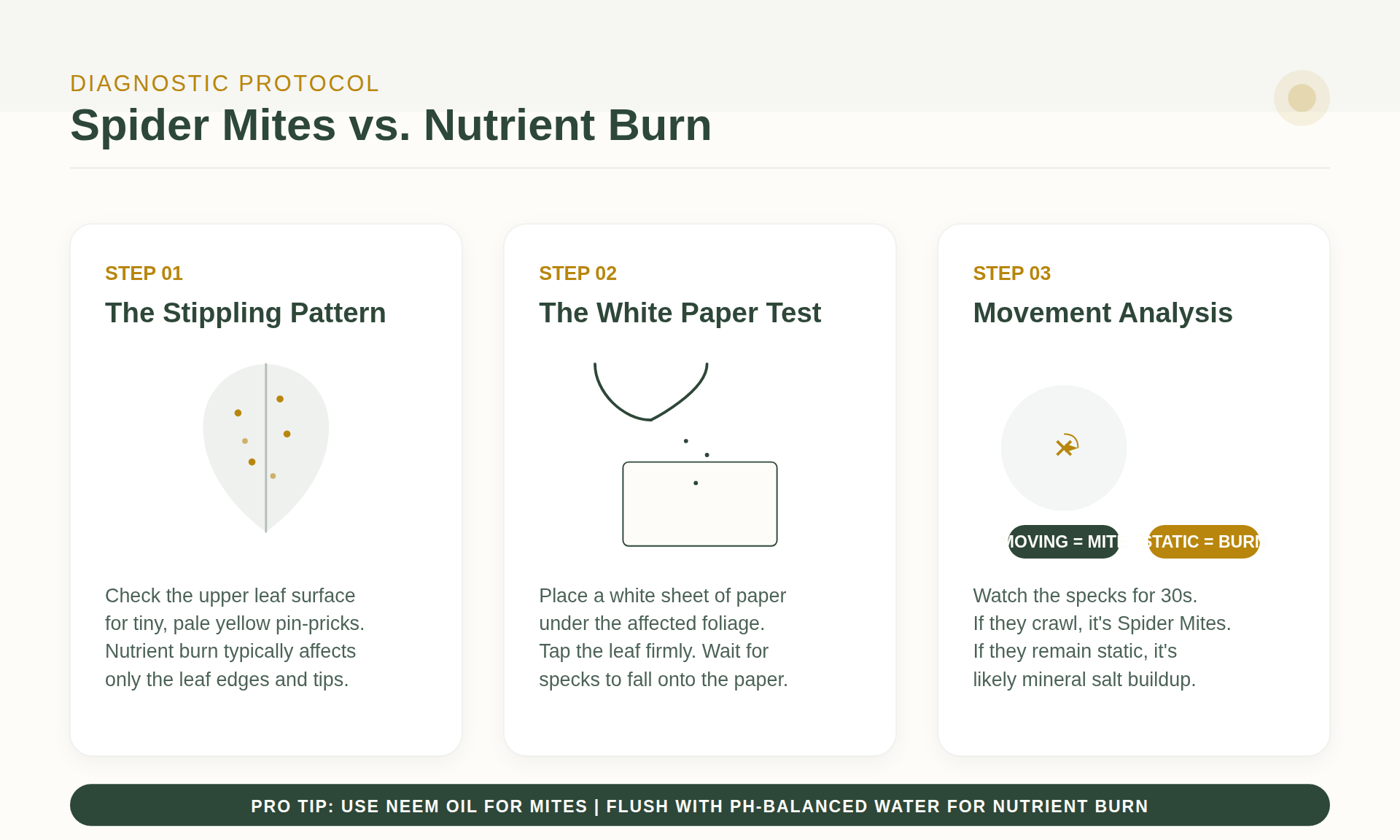
Nutrient burn typically manifests at the leaf tips or margins where salts accumulate. In contrast, stippling is distributed across the leaf surface and is often concentrated near the midrib or veins. Use a 30x jeweler’s loupe to identify mobile mites or translucent, spherical eggs in leaf crevices. Nutrient burn appears as localized, brown, necrotic tissue, whereas mite damage presents as generalized mottling and chlorosis.
The 5-Day Life Cycle: Why Single Applications Fail
Single applications of treatments like neem oil are often insufficient due to the spider mite life cycle. These pests are biological organisms optimized for rapid reproduction. In heated, dry indoor environments, the metabolic rate of these pests increases.
Breaking the Reproductive Rate
Under optimal conditions (low humidity and temperatures of 75-80°F), a spider mite can transition from egg to sexually mature adult in five to seven days. A single spray may eliminate up to 90% of mobile adults and larvae, but most organic treatments have minimal effect on eggs.
If treatment is not repeated, eggs hatch within days, and the subsequent generation reaches reproductive maturity shortly thereafter. Effective eradication requires a treatment schedule aligned with the pest’s biological cycle. Applications must occur before newly hatched larvae reach maturity to prevent the development of resistant populations.
Diapause and Survival
During winter, mites can enter diapause, a state of dormancy, allowing them to survive in nursery trays or pot rims. Seedlings are vulnerable if started in reused trays that have not been sterilized. Use a 70% isopropyl solution to clean all equipment and prevent re-infestation from dormant mites.
Eradication: Seedling-Safe Ratios to Prevent Phytotoxicity
Seedlings have thin cuticles and sensitive stomata, making them highly susceptible to phytotoxicity. Full-strength insecticidal soaps or heavy oil-based sprays can cause chemical burns on young tissue.
The ‘Soft’ Chemistry Approach
For young tissue, utilize “soft” chemistry, such as potassium salts of fatty acids (insecticidal soap) or diluted Azadirachtin (neem oil) in specific ratios.
Recommended Seedling Strength mix for a 16oz spray bottle: 1. Water: 16oz (distilled water is preferred to ensure proper emulsification). 2. Castile Soap (unscented): 1/2 teaspoon (acts as a surfactant). 3. Cold-Pressed Neem Oil: 1/4 teaspoon.
Proper emulsification is required. Agitate the solution thoroughly before each application to prevent concentrated oil from causing localized leaf burns.
Why Ratios Matter for Stomata
Seedlings require high transpiration rates to transport nutrients. Thick oil layers block stomata, inhibiting the plant’s ability to regulate internal temperature and gas exchange. To mitigate this, use a rinse protocol: apply the treatment, allow it to remain for 20-30 minutes to ensure contact kill, and then mist the seedlings with room-temperature water to remove excess oil.
Environmental Controls: Humidity and Airflow
Spider mites thrive in environments with a high Vapor Pressure Deficit (VPD). When Relative Humidity (RH) falls below 40%, reproductive rates increase. Indoor winter air often reaches levels as low as 25% RH.
Manipulating the VPD
Increasing humidity to 60-70% hinders mite physiology by interfering with their internal fluid regulation and slowing reproduction.
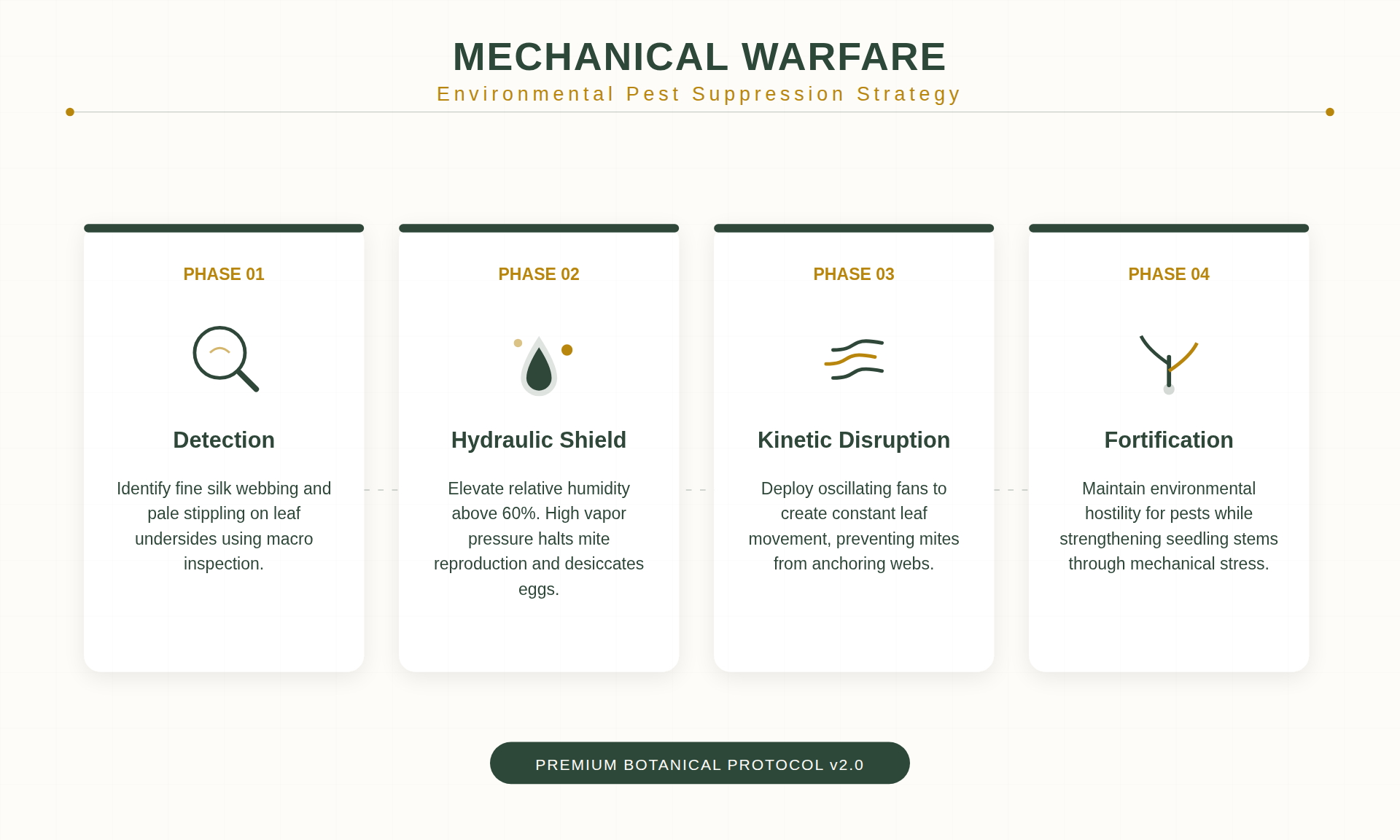
To prevent fungal pathogens such as damping off, maintain constant, gentle airflow. A small fan set to a low setting, directed near but not directly at the seedlings, provides mechanical disruption. This airflow hinders mite movement and their ability to anchor silk strands.
The 15-Day Eradication Protocol: A Step-by-Step Schedule
This protocol is designed to address every stage of the mite life cycle. Adherence to the schedule is necessary for complete eradication.
The Treatment Schedule
- Day 1: Initial Application. Apply the Seedling-Safe Neem/Soap mix to all surfaces, specifically the undersides of leaves. Use a brush for growing tips if necessary.
- Day 4: Larval Treatment. Target larvae that have hatched since the first application. Do not delay beyond Day 4 to prevent larvae from reaching maturity.
- Day 8: Residual Application. Apply treatment to break the reproductive cycle. Monitor soil moisture levels to avoid overwatering during treatment stress.
- Day 12: Final Application. Eliminate any remaining mites or individuals that have migrated from adjacent areas.
- Day 15: Evaluation. Inspect leaf parenchyma near veins with a 30x loupe. If no new stippling or movement is observed, the infestation is resolved.
Maintain strict quarantine during this process. Seedlings should be kept at least six feet away from other plants, preferably in a separate room, to prevent migration.
Stop the ‘Ballooning’ Effect: Preventing Indoor Migration
Spider mites utilize “ballooning” for dispersal. When a host plant is compromised or overpopulated, mites move to the highest point and spin silk strands to catch air currents, allowing them to migrate to new host plants.
Sterilizing the Environment
Sanitize the entire growing area. Use 70% isopropyl alcohol on shelves, light fixtures, and pot rims. Mites may remain in the texture of plastic surfaces. Misting alone does not stop ballooning; systemic prevention and environmental sanitation are required.
Ovicidal Properties and Long-Term Vigilance
The environment is often the source of infestation. While high-quality potting mixes are unlikely to contain mites, tools such as snips and watering cans can act as vectors. Sanitize all tools regularly.
Spider mites are a manageable biological variable. Eradication requires systematic monitoring, high humidity, and scheduled treatments. Ensure pets are kept away from infested plants to prevent them from acting as physical vectors for mite dispersal.